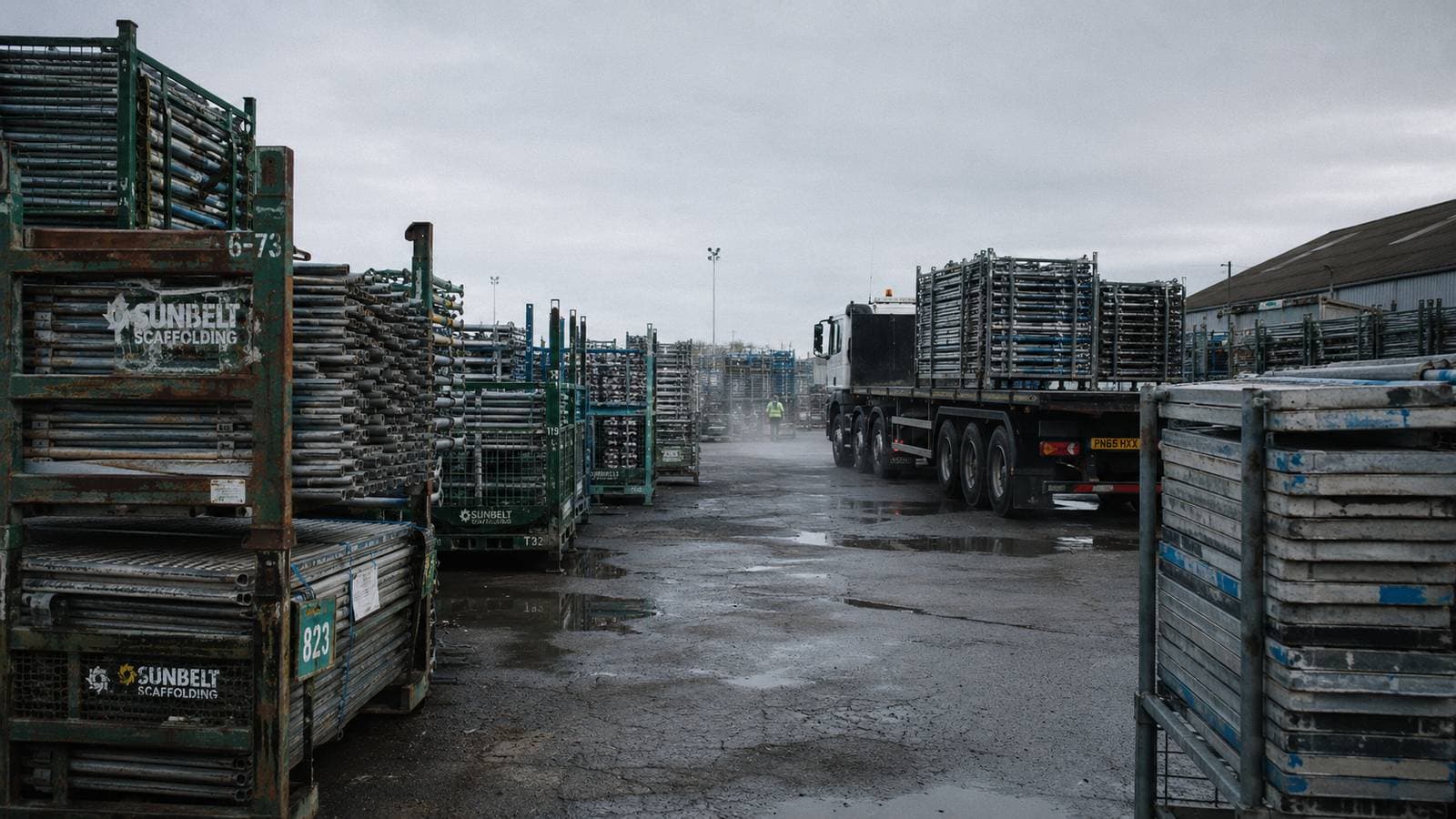
For a scaffolding rental operation, scaffolding rental tracking is a loss problem before it's a location problem. Scaffolding is the highest-shrinkage category in equipment rental — not because any single frame is valuable, but because a yard holds thousands of small, near-identical, unpowered components that are trivially easy to walk off a job site, mix into the wrong load, or lose track of between deliveries. You can't bolt a dash cam or an engine-hours sensor to a stack of frames and boards, so the telematics playbook built for excavators and lifts doesn't transfer. What scaffolding actually needs is tracking at the bundle, cage, or cart level for theft and loss recovery, accurate count reconciliation at the end of every job, and visibility into what's earning versus sitting in the yard. This guide covers what to track, how to track passive steel that has no power, and what it costs.
Key Takeaways
- Scaffolding is the highest-loss category in rental. Thousands of small, identical, unpowered components walk off sites and disappear into reconciliation gaps — the loss is volume, not unit value.
- Track at the bundle, cage, or cart level — not the individual plank. One tracker per load or storage unit catches theft and movement without the cost or impossibility of tagging every frame.
- Count reconciliation is the hidden margin killer. End-of-job disputes over how many components went out versus came back are where scaffolding revenue quietly leaks.
- GPS for the site, Hapn Sites for the yard. Scaffolding stored racked and stacked in yards or warehouses defeats GPS — BLE beacons keep visibility without WiFi.
- Hapn tracks scaffolding on its $10/mo per-asset plan — billed per tracked unit, not per yard — with all hardware free on a 3-year plan, or a 1-year plan with hardware purchased at cost.
Why scaffolding is the highest-loss category in rental
Scaffolding loses money differently than powered equipment. A boom lift or generator is a single high-value unit you can see, count, and bolt a tracker onto. A scaffolding fleet is the opposite: tens of thousands of frames, boards, couplers, jacks, and braces that are individually cheap, visually identical, and completely passive. No engine, no battery, no ignition — nothing to report hours or status. That combination is exactly what makes the category bleed.
The loss shows up in three ways. Components walk off active sites — a few boards here, a bundle of frames there — and nobody notices until the job closes out short. Loads get mixed: gear from one site goes back on the wrong truck and lands in the wrong yard or the wrong customer's pile. And counts drift: without a hard record of what physically left the yard, the end-of-job reconciliation becomes an argument instead of a number. Each leak is small. Across a season and a full inventory, they add up to the worst shrinkage profile in the rental business.
Equipment theft overall is a problem measured in the hundreds of millions to over a billion dollars a year, and scaffolding's high-volume, low-visibility profile puts it squarely in the crosshairs. The fix isn't to tag every plank — it's to track the units scaffolding actually moves in.
Bundle / cage-level tracking
Tracking scaffolding at the unit it actually moves and stores in — a banded bundle of frames, a stillage cage, a stock cart, or a transport rack — rather than the individual component. One tracker secures a whole load, which is how scaffolding leaves the yard and returns, so you get theft and movement alerts without the impossible cost of tagging every board.
What scaffolding rental tracking actually needs
Strip out the engine-data and dash-cam features that don't apply to passive steel, and three capabilities carry the entire ROI: loss and theft recovery, count reconciliation, and yard-versus-site utilization.
1. Theft and loss recovery — catch the load before it's gone
Geofencing is what turns scaffolding from invisible to accountable. Put a tracker on each bundle, cage, or cart and draw a geofence around every yard and active job site. The moment a load crosses a boundary it shouldn't — leaving a site after hours, heading to an address that isn't on the schedule — you get an alert in real time. Motion and after-hours movement alerts catch a cage being loaded onto a trailer at 2 a.m., which is when scaffolding tends to disappear. The goal isn't filing a police report after the fact; it's intercepting the load while it's still recoverable.
2. Count reconciliation — end the end-of-job argument
The most expensive scaffolding disputes aren't thefts — they're disagreements over counts. How many frames went to the site? How many came back? Who owes for the difference? Without a hard record of what physically left the yard and where it's been, that conversation is a guess, and the rental operator usually eats the gap. Tracking at the bundle and cage level gives you a defensible chain of custody: this load left this yard on this date, sat on this site, and either returned or didn't. Reconciliation becomes a report instead of a negotiation, and the shrinkage you used to write off becomes a line item you can actually bill.
3. Utilization — what's earning versus sitting in the yard
Scaffolding utilization isn't measured in engine hours — it's measured in how much of your inventory is out earning versus stacked in the yard depreciating. Tracking which bundles and cages are deployed, and for how long, tells you whether you're under-stocked and turning away jobs or over-bought and sitting on idle steel. For multi-yard operators, it also tells you where your inventory actually is, so you can rebalance between yards instead of buying more to cover a shortage that's really a distribution problem. This is the same per-asset economics that drive other rental verticals — measured in components and tonnage instead of hours.
Stop writing off scaffolding loss
Track bundles, cages, and carts on Hapn's $10/mo per-asset plan. No per-yard fees. Hardware free on a 3-year plan.
Where GPS stops and BLE starts: tracking steel in the yard
GPS handles scaffolding on the move and on open sites, but it struggles exactly where most scaffolding lives: racked, stacked, and packed tight inside yards and warehouses. Steel inventory stored under cover or in dense rows blocks satellite signal, and you don't want to run WiFi to every corner of a storage yard. This is the single biggest gap in tracking passive steel — and it's where most generic GPS solutions quietly fail.
Hapn Sites closes it. Sites uses Bluetooth Low Energy (BLE) beacons to maintain visibility on components stored where GPS can't reach, without any WiFi infrastructure. A bundle racked in the back of a covered yard still reports its presence; when it's pulled for a job, you see it leave. Pairing GPS for the road and the site with BLE for the yard is what gives a scaffolding operator unbroken coverage from storage to site and back — the full loop where reconciliation actually happens.
BLE / Hapn Sites
Bluetooth Low Energy beacons that maintain visibility on assets stored indoors, racked, or stacked where GPS signal can't reach — without requiring WiFi. Hapn Sites is built for exactly the yard-and-warehouse storage pattern scaffolding lives in, keeping passive steel inventory accounted for in places satellite tracking goes dark.
What scaffolding rental tracking costs
Because scaffolding is passive — no engine, no diagnostics, no runtime data to pull — it tracks on Hapn's asset tier, the entry tier, at $10/mo per tracked unit. You're paying for location, geofencing, motion alerts, and yard visibility on a bundle, cage, or cart — not for the engine-data telematics that powered equipment needs. That keeps the per-load cost low enough to track at the unit scaffolding actually moves in.
The pricing detail that matters most for scaffolding operators is how you're billed across locations. Hapn charges per asset, not per yard. Adding a second or fifth yard doesn't multiply your subscription — you pay for the units you track, wherever they sit. Most rental software and some telematics vendors charge per site, which quietly penalizes the multi-yard operators scaffolding businesses tend to become. The full breakdown is in per-asset vs per-site pricing. And there are two ways to buy: a 3-year plan where all hardware and install kits are free, or a 1-year plan with hardware purchased at cost. Exact pricing for your inventory is a quick quote on the Hapn pricing page.
Per-asset vs per-site pricing
Per-asset pricing charges for each tracked unit regardless of location; per-site pricing charges for each yard or facility. For a scaffolding operator running multiple yards, per-asset billing means growth doesn't inflate your subscription — you pay for the bundles and cages you track, not for the number of locations you store them in.
How Hapn fits a scaffolding rental operation
Hapn is built for equipment rental businesses — rental houses, multi-yard dealers, and equipment financing companies — and the scaffolding use case is a clean fit for how it's designed. Trackers ship pre-provisioned and activate in minutes, so you can tag a yard's worth of bundles and cages without a deployment project. Location, geofencing, and Sites visibility roll up to one map, so a single dashboard shows what's on which site, what's in which yard, and what's moving when it shouldn't. And the asset tracking platform bills per asset, so multi-yard growth scales with your inventory instead of your location count.
The scaffolding rental tracking model — bundle-level GPS plus BLE for the yard, theft and movement alerts, and a hard reconciliation record — is detailed on the scaffolding rental tracking page. If you also run aerial equipment, the same per-asset approach applied to lifts is covered in aerial lift rental tracking.
About the author
The Hapn team builds telematics for equipment rental businesses, multi-yard dealers, and equipment financing operators. We publish per-asset pricing, ship pre-provisioned hardware, and integrate with the rental management systems you already run.
Frequently asked questions
How do you track scaffolding inventory?
Track scaffolding at the bundle, cage, or cart level rather than the individual frame or board. A GPS tracker on each load handles location and geofencing on the road and on site, while Hapn Sites (BLE beacons) maintains visibility on components racked or stacked in yards and warehouses where GPS can't reach. One tracker secures a whole load, so you get theft alerts and a count record without tagging every plank.
Can you GPS track scaffolding and scaffold boards?
Yes — at the load level. Because scaffolding is passive steel with no power source, you don't tag every component; you put a tracker on the bundle, cage, or transport rack the gear moves in. GPS covers it on the move and on open sites, and BLE-based Hapn Sites covers it in covered yards where satellite signal drops. That combination keeps a load accounted for from storage to job site and back.
What's the best way to prevent scaffolding theft on a job site?
Geofence every yard and active site, then put a tracker on each bundle or cage. When a load crosses a boundary it shouldn't or moves after hours, you get a real-time alert — catching the gear while it's still recoverable instead of discovering the loss at job close-out. Motion alerts flag a cage being loaded onto a trailer overnight, which is when scaffolding most often walks.
How much does it cost to track scaffolding?
Hapn tracks scaffolding on its asset tier at $10/month per tracked unit — billed per asset, not per yard, so multi-yard operators don't pay a location premium. There are two ways to buy: a 3-year plan with all hardware and install kits free, or a 1-year plan with hardware purchased at cost. Exact pricing for your inventory is a quick quote on the Hapn pricing page.
Do you need GPS or BLE to track scaffolding stored in a yard?
Both, for full coverage. GPS tracks scaffolding on the move and on open job sites, but it struggles with steel racked and stacked inside covered yards and warehouses. Hapn Sites uses BLE beacons to keep visibility on that stored inventory without WiFi. Pairing the two gives unbroken coverage across the whole loop — yard, transport, site, and back — which is where reconciliation happens.
How do you reconcile scaffolding counts at the end of a job?
Tracking at the bundle and cage level creates a chain of custody: each load left a known yard on a known date, sat on a known site, and either returned or didn't. That record turns the end-of-job count from an argument into a report — you can show exactly what shipped and where it went, bill for what didn't come back, and stop writing off shrinkage you can't account for.
Track scaffolding from yard to site and back
Bundle-level GPS, BLE for the yard, theft alerts, and a hard count record. Per-asset pricing, no per-yard fees, live in days.
Last Updated: June 16, 2026
Explore Hapn on a live equipment fleet
Click around the real platform — a live mixed fleet with dummy data. No sales call, takes a few minutes.
Get the latest news straight to your inbox.
Share Article
