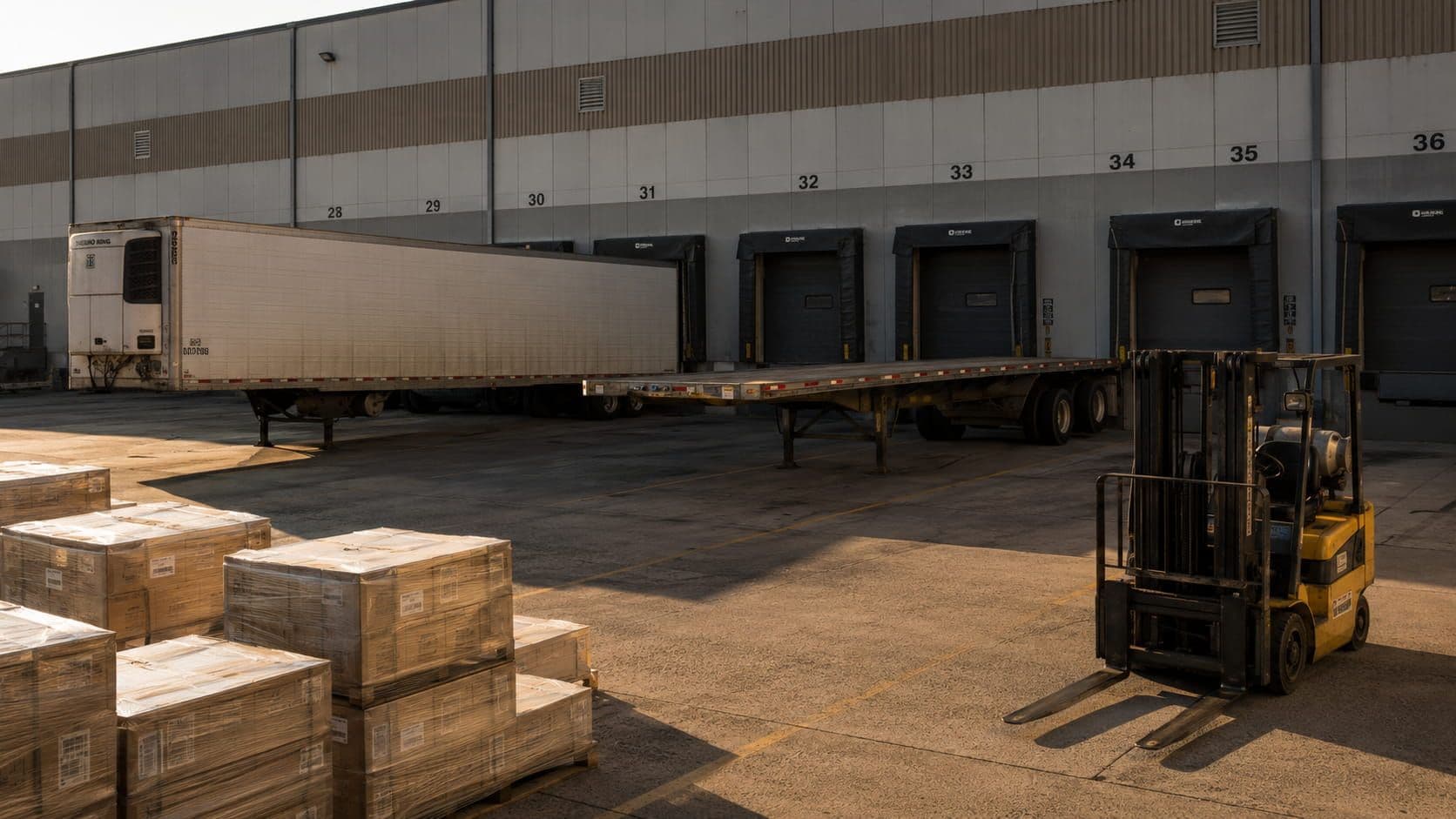
An unreliable freight ETA costs money even when the shipment isn't technically late. The moment a receiving team can't say with confidence when a truck will hit the dock, the meter starts running: a forklift and operator staged to wait, a dock door held open, a dispatcher chasing updates that keep changing. The freight might roll in exactly on schedule and the invoice will still be right — but the day around it was expensive. This is the quiet cost of shipment uncertainty, and it lands on nearly everyone in the lane. Below is a practical way to price that cost, a clear-eyed look at what "tracking" actually means, and a framework for deciding when tracking the shipment itself is worth it.
- A shipment doesn't have to be late to be costly — the expense begins the moment no one can reliably say when it will arrive.
- In a labeled illustrative example, a single 3-hour uncertain wait ran roughly $395 in idle labor and reserved equipment — before the load was ever "late."
- Four things get called "tracking" — carrier status updates, driver-phone tracking, truck/ELD tracking, and tracking the shipment itself — and only one produces an independent, shipment-level record.
- Tracking is justified when the expected cost of uncertainty, waiting, claims, or theft is greater than the cost of tracking the shipment.
- For low-value, flexible-receiving lanes, ordinary carrier updates are often enough — this is a decision, not a mandate.
The problem usually isn't lateness. It's not knowing.
Consider a common scenario. A shipper moves regular truckload freight to a customer across the country. The customer can only unload with a forklift and a certified operator, so every inbound load has to be met by scheduled labor and equipment. The carrier's updates are vague and slow, so the receiver has no dependable arrival time. To be safe, they staff the dock and stage the forklift inside a wide window — and then wait.
Notice what's actually going wrong here. The freight may not be late at all. The failure is informational: the receiver is forced to buy a large block of readiness because the ETA can't be trusted. When the arrival window is four hours wide instead of thirty minutes, someone pays for the difference in idle time. Uncertainty, not tardiness, is the line item.
That distinction matters because most "improve your on-time performance" advice aims at the wrong target. You can't make a cheap carrier faster by wishing it. But you can shrink the window of not-knowing — and the window is where the money leaks.
Who actually pays when the ETA is unreliable
The cost of a shaky ETA rarely sits with one party. It spreads across the lane, and most of it never shows up as a freight charge:
- The receiver pays employees and equipment to wait, and ties up a dock door that could be turning other freight.
- The dock becomes congested or unavailable — one uncertain load can back up the appointments behind it.
- The shipper fields complaints it can't answer, because it has no better information than the customer does.
- The carrier or broker spends time on check calls — manual phone-and-email work that scales badly across a book of loads.
- The operations team chases the same shipment across emails, phone calls, carrier portals, and driver apps, reconciling answers that don't agree.
- The customer loses confidence every time the ETA moves — repeated changes read as unreliability, even when the goods arrive fine.
- Everyone is missing the same thing: an independent, shared record of where the shipment is and when it actually arrived.
That last point is the root of the others. When each party has a different, partial view — and no neutral source of truth — the lane spends its energy debating what happened instead of acting on what's happening.
How to calculate the cost of an unreliable ETA
Before deciding whether to invest in better visibility, put a number on the problem. You don't need industry benchmarks — you need your own figures. Walk one uncertain shipment through these six buckets:
- Employee and operator waiting time — loaded hourly cost of everyone staged to receive, multiplied by the width of the uncertainty window.
- Forklift or equipment rental — half-day or full-day minimums on gear reserved for an arrival you can't pin down.
- Dock and warehouse disruption — a held door, delayed appointments, and knock-on congestion.
- Production or installation delays — downstream work (a crew, a line, an install) waiting on the material.
- Administrative follow-up — dispatcher, CSR, and manager time spent chasing and reconciling updates.
- Missed-window charges or customer penalties — redelivery, rescheduling, detention, or contractual service credits.
Imagine one inbound truckload met by scheduled labor, staged inside a wide window because the ETA can't be trusted. None of these figures are Hapn data or an industry standard — plug in your own:
- Forklift operator idle: 3 hrs × $40/hr loaded = $120
- Second dock worker idle: 3 hrs × $30/hr = $90
- Rented forklift on a reserved half-day block = $150
- Dispatcher/CSR chasing updates: ~1 hr × $35/hr = $35
That's roughly $395 for one shipment that was never late — and it excludes the held dock door and any downstream install waiting on the goods. If the window is missed entirely and delivery reschedules to the next day, much of that cost repeats, potentially alongside detention or redelivery fees. Run the same math across dozens of loads a month and the "on-time but unpredictable" lane becomes one of the more expensive things you operate.
Detention is the charge and the cost that accrue when a truck or trailer sits longer than the agreed free time at a dock, or when receiving resources are held waiting for a truck. Unpredictable arrivals drive detention in both directions — trucks waiting on docks, and docks waiting on trucks.
See how a tracker that rides with the shipment gives every party the same arrival picture.
Explore Hapn Shipment Tracking →Four things get called "tracking" — and they're not the same
When a shipper says "we have tracking," it can mean any of four very different things. Understanding the difference is the whole game, because most tracking answers a question about the vehicle or the driver rather than about your freight.
1. Carrier status updates
Milestone events — "picked up," "in transit," "out for delivery" — usually entered by hand and often lagging reality. They're useful for a rough sense of progress, but they're not continuous, and they tell you what a system was told, not where the goods physically are right now.
2. Driver-phone or app-based tracking
Location pulled from the driver's phone or a load-board app. It's better than milestones when it works, but it depends on the driver opting in and keeping the app running, and it follows the person — not the pallets. If the phone dies or the app closes, the trail goes with it.
3. Truck or ELD tracking
Location from the tractor's telematics or electronic logging device. This tells you where the truck is — but freight gets dropped at terminals, transloaded, and swapped between trailers. The tractor you were watching may no longer be anywhere near your goods.
4. Tracking the shipment itself
A tracker that physically travels with the freight and reports its own location. It follows the goods across handoffs, transloads, and trailer swaps, independent of any single carrier's system, driver, or truck. This is the only one of the four that gives every party a shared, shipment-level record.
Location and status reported by a device that moves with the freight, rather than inferred from a vehicle, driver, or carrier milestone. Because it's tied to the goods, it survives transloads and trailer changes and gives every party the same independent record of movement and arrival.
One honest caveat: a tracker riding with the freight does not make the carrier faster and does not prevent every delay. What it does is reduce uncertainty, surface exceptions sooner, and provide better evidence about how the shipment actually moved and when it arrived. It narrows the window of not-knowing — which, as the math above shows, is where the cost lives.
When shipment tracking is worth it — and when it isn't
This is a decision, not a rule. The principle is simple: track the shipment when the expected cost of uncertainty, waiting, claims, or theft is greater than the cost of tracking it. That tips toward tracking when a lane has scheduled labor or equipment waiting to receive, tight or penalty-bearing delivery windows, high-value or theft-prone goods, downstream production or installation gated on arrival, or a carrier whose updates you simply can't trust.
It tips the other way — ordinary carrier updates are often enough — when the freight is low-value, receiving is flexible with no staged labor or equipment, there's no penalty for a wide window, and the lane and carrier have a reliable track record. Not every shipment needs a tracker. The point is to spend visibility where uncertainty is expensive and skip it where it isn't.
Where Hapn Shipment Tracking fits
Once you've decided a lane is worth tracking, the practical question is how to do it without adding hardware headaches. Hapn Shipment Tracking is built around a disposable, battery-powered GPS tracker that travels with the freight. There's nothing to install, charge, pair, recover, or ship back — the device goes with the load and its job ends when the shipment does. Pricing is per shipment, with the tracker and the software included, so the cost maps to the loads you actually choose to watch.
On the software side, it's designed to answer the exact questions the uncertain lane raises. You get live ETA and late-shipment monitoring, plus route-deviation and rule-violation alerts so an exception reaches you sooner rather than after the fact. Customer-facing tracking links let a receiver or end customer see the same arrival picture without a Hapn login — which takes the pressure off the shipper fielding check calls it can't answer. When the freight lands, you get date- and time-stamped arrival confirmation as an independent record of when it actually hit the dock.
Setting up a shipment uses the information you already have — origin, destination, delivery window, reference numbers, and BOL files — and you can create shipments in bulk by CSV when you're running a book of loads. Location-update frequency is configurable, and everything active rolls up into one dashboard for shipments and exceptions. For the broader operational picture, the freight and logistics overview shows how shipment-level visibility fits alongside the rest of a lane.
Two boundaries worth stating plainly. Hapn is not a TMS or a routing engine — it doesn't procure carriers, build dynamic routes, or run freight audit, and it's meant to sit alongside the systems that do. And arrival confirmation is a time-stamped record that the shipment reached the destination; it is not the same as signed acceptance, proof of condition, or a full legal proof of delivery. It's the independent movement-and-arrival layer, not a substitute for your receiving paperwork.
Is it legal to put a tracker with your freight?
This question comes up constantly, and it deserves a careful, non-universal answer. The common-sense hinge people reach for is the difference between tracking property you own and tracking a vehicle you don't. Placing a small tracker with your own goods is a different situation from covertly tracking someone else's truck — but "different" is not the same as "automatically fine everywhere," and the specifics matter.
Before you deploy, work through the factors that actually drive the answer: who owns the tracked property and at what point title or risk transfers; what your contracts and tariffs with the carrier and customer say; whether disclosure or consent is expected or required; the jurisdictions the freight passes through; and your own and your partners' company policies. Reasonable, transparent practices — you're tracking your own shipment, and the parties in the lane know it — tend to sit on firmer ground than anything covert. None of this is legal advice. It's a checklist of what to raise with counsel, who should sign off on your specific implementation before it goes live.
The Hapn team writes about shipment visibility, freight operations, and the practical economics of knowing where goods are and when they'll arrive. Hapn builds GPS tracking that travels with the shipment, giving shippers, carriers, brokers, 3PLs, and operations teams a shared, independent record of movement and arrival.
Frequently asked questions
Does a shipment have to be late to cost money?
No. The cost of an unreliable ETA accrues from uncertainty, not lateness. When a receiver can't pin down arrival, they staff labor and stage equipment across a wide window and pay for the idle time, hold a dock door, and burn administrative hours chasing updates — all of which happen even if the freight ultimately arrives on schedule.
What's the difference between ELD tracking and tracking the shipment itself?
ELD or truck tracking reports where the tractor is. Shipment-level tracking reports where your freight is, using a device that moves with the goods. Because freight gets dropped, transloaded, and swapped between trailers, the truck you were watching may no longer be with your load — which is why a tracker on the shipment gives a more reliable, independent record.
Is it legal to attach a GPS tracker to freight on another company's truck?
It depends on the specifics, and you should get legal advice for your situation. Tracking property you own is generally treated differently from covertly tracking a vehicle you don't, but the answer turns on ownership and title transfer, contract and tariff terms, disclosure and consent expectations, the jurisdictions involved, and company policies. Transparent tracking of your own shipment is a stronger footing than anything covert.
Will a tracker make my carrier deliver faster?
No — and any vendor claiming otherwise is overpromising. A tracker doesn't speed up the carrier or prevent delays. It reduces uncertainty, surfaces route deviations and exceptions sooner, and creates better evidence of how the shipment moved and when it arrived, so you can plan labor and equipment against a real ETA instead of a guess.
How is Hapn Shipment Tracking priced?
Hapn Shipment Tracking uses per-shipment pricing, with the disposable GPS tracker and the software included. Because the tracker travels with the freight and doesn't need to be installed, charged, recovered, or returned, you can apply tracking to the specific lanes and loads where uncertainty is expensive, rather than committing to fixed infrastructure.
Does arrival confirmation count as proof of delivery?
Not on its own. Hapn provides a date- and time-stamped record that the shipment reached its destination, which is strong independent evidence of arrival. It is not the same as a signed acceptance, proof of condition, or a full legal proof of delivery — treat it as the movement-and-arrival record alongside your normal receiving paperwork.
Evaluate per-shipment tracking that rides with the freight and gives every party the same arrival picture.
See how Hapn Shipment Tracking works →Last Updated: July 31, 2026
See what tracking your fleet costs
Tell us what you're tracking and how many assets. We'll build a custom quote with volume pricing — usually within 24 hours. No contracts.
Get Your Custom Quote →Volume discounts • No 3-year contracts • Quote in ~24 hours


Get the latest news straight to your inbox.
Share Article
