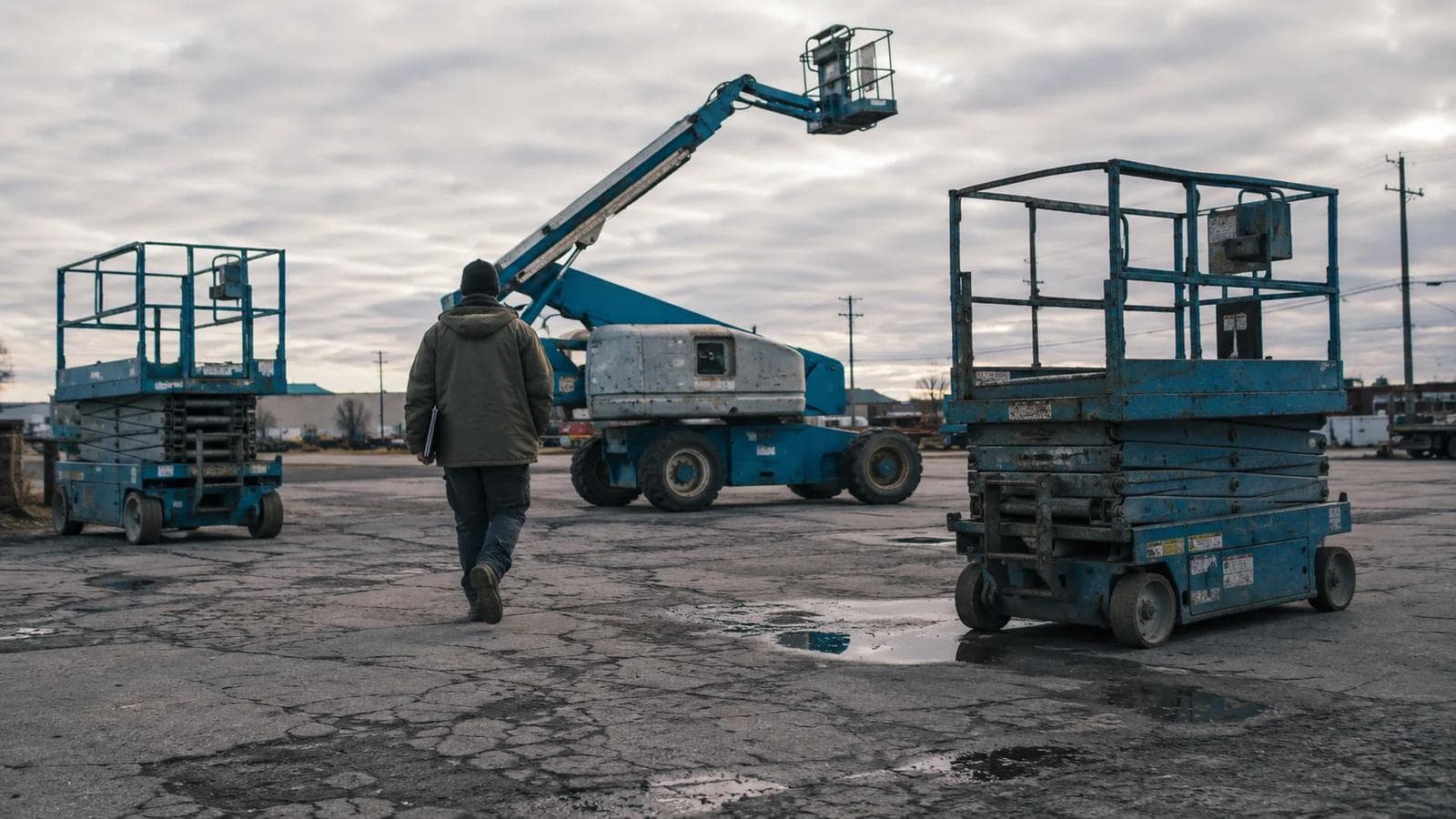
If you run an aerial lift rental fleet, aerial lift rental tracking comes down to four things: utilization, engine and battery hours, anti-theft, and OEM telematics data. Notice what's not on that list — vehicle dash cams. Here's why that's worth saying out loud: the loudest telematics marketing today is camera-first. Vendors like Samsara and Motive built their brands on AI dash cams and driver scorecards, so when a rental operator goes shopping for "telematics," the pitch that comes back is camera-led — even for an aerial fleet where a forward-facing camera does almost nothing. Boom lifts and scissor lifts don't drive on public roads, so the road-safety hardware that justifies a camera on a service truck is wasted spend on a MEWP. This guide breaks down what aerial lift rental managers should actually demand from telematics — and which line items in a typical vendor pitch you can skip.
Key Takeaways
- Dash cams are a road-vehicle tool. Aerial lifts are mobile elevating work platforms, not on-road vehicles — utilization, hours, anti-theft, and OEM data drive far more rental ROI than a forward-facing camera.
- Utilization is the #1 metric. A boom lift sitting idle on rent is invisible revenue leakage; rental operators target 50–70% time utilization, and you can't manage what you don't measure.
- Hours-based maintenance beats calendar-based. Servicing on the calendar instead of actual engine or battery hours wastes an estimated 20–30% of maintenance spend.
- Aerial lifts are theft magnets. Compact, towable, and high-resale, they're among the most-targeted rental assets — geofencing and motion alerts recover units before they disappear.
- Hapn pricing is per asset, from $13/mo for equipment, with a 3-year plan where all hardware is free, or a 1-year agreement with hardware purchased at cost. No per-yard fees.
Why the camera-first telematics pitch doesn't fit aerial lifts
To be clear, no rental manager actually believes a scissor lift needs a dash cam. The confusion isn't about the lift — it's about how telematics gets sold. The category is dominated by vehicle-first vendors whose hero product is the AI camera, so the default pitch, the default demo, and the default quote all lead with hardware built for the road. Take that framing at face value for an aerial fleet and you'll buy and budget for the wrong things.
Dash cams earn their keep on vehicles that move people down a highway at 65 mph — service trucks, delivery vans, the tractors pulling your equipment trailers. There, a forward-facing camera reduces accident liability, settles "who's at fault" disputes, and coaches risky driving. That's a real ROI story for the vehicle side of a mixed fleet.
An aerial lift is a different animal. It travels at walking pace, operates on a job site rather than a road, and spends most of its life either parked or elevated over a work area. A dash cam bolted to a scissor lift doesn't reduce road risk because there is no road. What it does do is add $35/month per unit to your telematics bill for footage almost nobody will ever pull. For a 200-unit aerial fleet, that's $84,000 a year spent watching a parked machine.
The mistake is treating every asset like a truck. Vehicle-first telematics vendors lead with cameras and driver scorecards because that's where their product started. Aerial lift rental managers need equipment-first telematics built around the questions a rental yard actually asks: is this unit earning, is it healthy, where is it, and is it safe?
MEWP (Mobile Elevating Work Platform)
The ANSI A92 / ISO 16368 term covering boom lifts, scissor lifts, and other powered platforms that lift workers to height. MEWPs are work equipment, not road vehicles — which is exactly why their telematics priorities differ from a truck's. Runtime hours, location, and platform status matter more than road-driving behavior.
The four things aerial lift rental tracking actually needs
Strip away the camera marketing and a clear short list remains. These four capabilities are where a boom lift telematics budget pays for itself.
1. Utilization — the metric that prices your fleet
Utilization is the single most important number in aerial rental. A boom lift on rent but sitting idle still costs the customer nothing extra and earns you nothing more — but a unit returned to the yard while demand is high is pure lost revenue. Telematics gives you both physical utilization (is the engine or platform actually being used?) and time utilization (what share of the fleet is out earning?).
Most rental operators target 50–70% time utilization across an aerial fleet. The gap between a yard running at 55% and one running at 68% is the difference between buying more units and sweating the ones you own. Hapn surfaces utilization per unit and per category so you can see which scissor lifts never leave the back row and which booms are booked solid — and price, position, and purchase accordingly. For the full benchmark picture, see fleet utilization benchmarks for 2026.
2. Engine and battery hours — service on usage, not the calendar
An engine-powered rough-terrain boom and an electric scissor lift wear on usage, not on dates. Calendar-based maintenance — "every 90 days, no matter what" — either services a barely-used unit too early or runs a hard-worked one past its interval. Industry estimates put the waste from calendar-based servicing at 20–30% of maintenance spend.
Hours-based maintenance fixes that. Hapn pulls runtime hours straight from the machine, so PM intervals trigger on actual use. It also gives you defensible billing: when a customer disputes hours or you need to prove a unit was run beyond the agreed envelope, the data is there. More on the mechanics in engine-hour-based maintenance.
Engine hours / runtime hours
A meter of how long a machine has actually operated — the equipment equivalent of a vehicle odometer. For engine-powered lifts it's combustion runtime; for electric scissor lifts it's powered-on or drive hours. Tracking hours instead of calendar days aligns maintenance, depreciation, and billing with real use.
3. Anti-theft — aerial lifts are among the most-stolen rentals
Compact booms and scissor lifts are theft magnets: they're towable or driveable, easy to load, and hold strong resale value. Equipment theft is a problem measured in the hundreds of millions to over a billion dollars a year, and recovery rates without tracking are dismal.
GPS tracking changes the math. Geofence each yard and active rental site; the moment a unit crosses a boundary it shouldn't, you get an alert. Motion and after-hours movement alerts catch a lift being loaded onto a trailer at 2 a.m. For units stored inside warehouses or covered yards where GPS struggles, Hapn Sites uses BLE beacons to keep eyes on the asset without WiFi infrastructure. The point isn't just recovery after the fact — it's catching the unit before it's gone.
4. OEM telematics data — JLG, Genie, and Skyjack on one map
The major aerial OEMs all ship telematics: JLG ClearSky, Genie Lift Connect, Skyjack ELEVATE. The problem is portal sprawl — a mixed aerial fleet means logging into three or four manufacturer portals to answer one question. None of them talk to each other, and none of them know your rental status.
Hapn ingests OEM data via the AEMP / ISO 15143-3 standard, so hours, location, and fault codes from supported manufacturers land on the same map as your aftermarket-tracked units. One pane of glass for the whole aerial fleet, regardless of brand — and it connects to the rental management software you already run.
AEMP / ISO 15143-3
The industry-standard data format for equipment telematics, originally developed by the Association of Equipment Management Professionals. Compliant OEM platforms expose hours, location, and fault codes in a normalized structure. Hapn ingests AEMP feeds from supported OEMs, so JLG, Genie, and Skyjack data can sit alongside aftermarket-tracked units instead of in separate portals.
Price your aerial fleet the right way
Per-asset pricing from $13/mo for equipment. No per-yard fees, no camera markup you don't need.
What this means for what you pay
Once you accept that an aerial lift doesn't need a dash cam, the budget question gets simpler. You're paying for an equipment tracker that reports location, hours, and movement — not a camera package built for trucks. Hapn's equipment tracking tier starts at $13/mo per asset, or $18/mo for full telematics; AI dash cams are a separate $35/mo line item you'd add only to the actual road vehicles in your fleet, never to the lifts.
The other half of the pricing story is how you're charged across yards. Hapn bills per asset, not per site — adding a second or fifth yard doesn't multiply your subscription. Most rental software and some telematics vendors charge per location, which quietly punishes you for growing. The full breakdown is in per-asset vs per-site pricing. And there are two ways to buy: a 3-year plan where all hardware and install kits are free, or a 1-year agreement with hardware purchased at cost.
How Hapn fits an aerial lift rental fleet
Hapn is built for equipment rental businesses — rental houses, multi-yard dealers, and equipment financing companies — not for owned-fleet construction contractors who manage by job site. For an aerial operator, that shows up in practical ways: devices ship pre-provisioned and activate in minutes, so you can fit 50 units during a seasonal ramp without a deployment project; utilization and hours roll up by category so you can make buy-and-sell decisions on the fleet; and the open API connects telematics to the rental system your team already opens every morning.
For a deeper technical look at tracking these machines specifically, see our guide to aerial lift GPS tracking for boom lifts, scissor lifts, and MEWPs, and if you're still deciding which class of lift to stock, scissor lifts vs boom lifts covers the rental economics.
About the author
The Hapn team builds telematics for equipment rental businesses, multi-yard dealers, and equipment financing operators. We publish per-asset pricing, ship pre-provisioned hardware, and integrate with the rental management systems you already run.
Frequently asked questions
Do aerial lifts need dash cams?
In almost all cases, no. Dash cams reduce road-driving risk and liability, which is why they belong on the service trucks and trailers in your fleet — not on boom lifts and scissor lifts that operate on job sites at walking pace. For aerial lifts, telematics budget is better spent on utilization, engine and battery hours, geofencing, and OEM data integration. Hapn keeps AI dash cams as a separate per-asset option you can add to road vehicles only.
What's the most important metric for aerial lift rental tracking?
Utilization. A boom lift returned to the yard during high demand, or one that sits on rent without being used, both represent revenue you can't see without tracking. Most rental operators target 50–70% time utilization. Hapn reports utilization per unit and per category so you can price, reposition, and make fleet purchase decisions on real data.
Can Hapn pull engine hours from boom and scissor lifts?
Yes. Hapn captures runtime hours from the machine — combustion runtime on engine-powered lifts and powered-on or drive hours on electric scissor lifts — so maintenance triggers on actual usage instead of the calendar. It also gives you defensible hours data for billing and customer disputes.
Does Hapn work with JLG, Genie, and Skyjack OEM telematics?
Hapn ingests OEM telematics via the AEMP / ISO 15143-3 standard from supported manufacturers, so data from platforms like JLG ClearSky, Genie Lift Connect, and Skyjack ELEVATE can appear on the same map as your aftermarket-tracked units — instead of forcing your team to hop between manufacturer portals.
How does Hapn help prevent aerial lift theft?
Aerial lifts are among the most-stolen rental assets because they're compact, easy to load, and hold resale value. Hapn lets you geofence yards and job sites, with motion and after-hours alerts that flag a unit being moved when it shouldn't be. For equipment stored indoors or in covered yards, Hapn Sites uses BLE beacons to maintain visibility without WiFi.
How much does it cost to track an aerial lift with Hapn?
Hapn's equipment tracking pricing starts at $13/mo per asset, or $18/mo for full telematics. Billing is per asset, not per yard, so adding locations doesn't multiply your subscription. You can choose a 3-year plan where all hardware is free, or a 1-year agreement with hardware purchased at cost. Get a quote for your fleet at the pricing page.
Track your aerial fleet on what actually matters
Utilization, hours, anti-theft, and OEM data — on one map. Per-asset pricing, no per-yard fees, live in days.
Last Updated: June 2, 2026
Explore Hapn on a live equipment fleet
Click around the real platform — a live mixed fleet with dummy data. No sales call, takes a few minutes.

Get the latest news straight to your inbox.
Share Article
