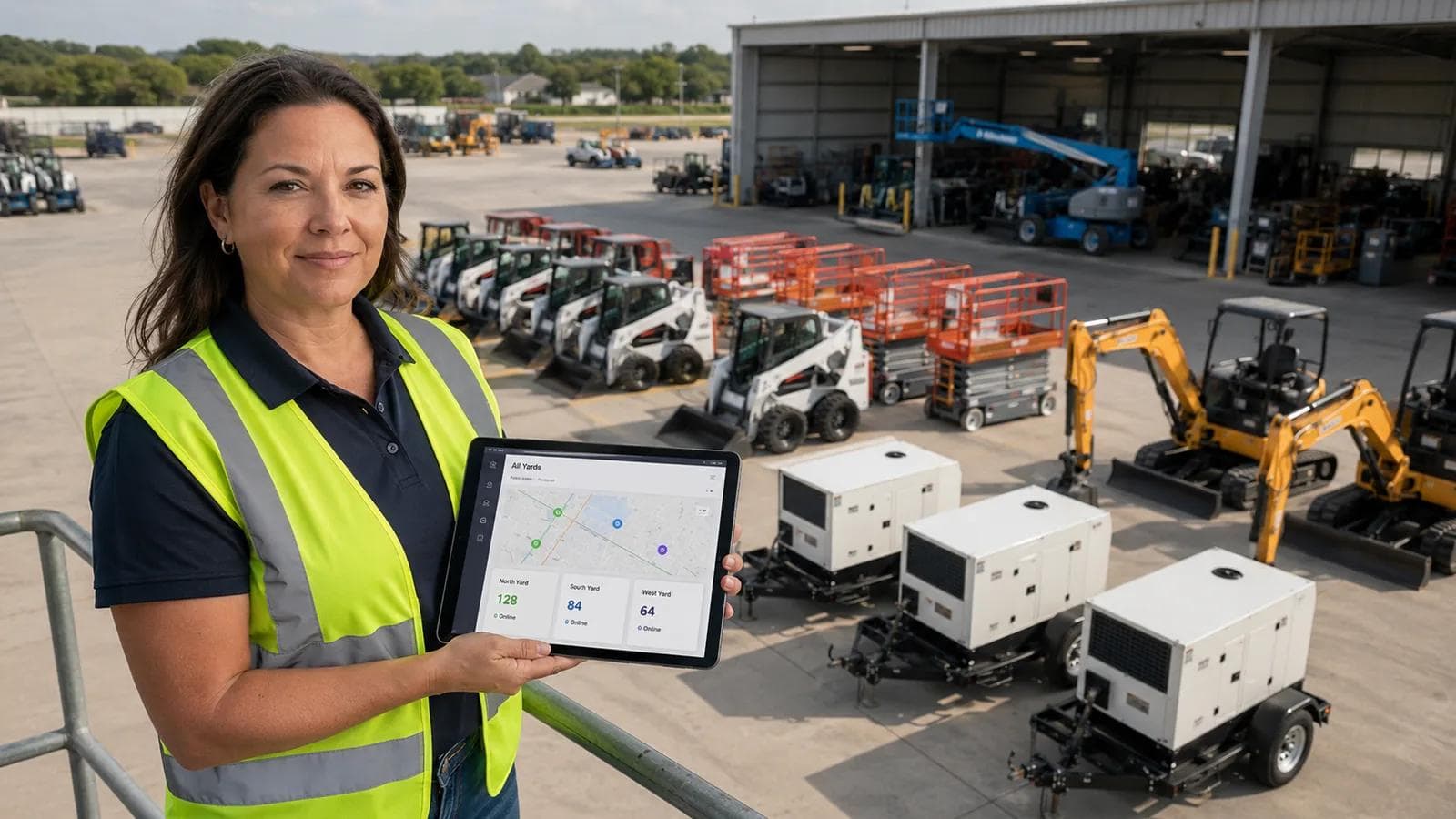
Per-site pricing punishes growth. Per-asset pricing doesn't. That's the entire thesis of this post, and for any equipment rental operator running two or more yards, the gap between the two models is worth $20,000 to $50,000+ a year. Most rental management software — and a lot of legacy telematics — prices by location, so every new yard adds a fixed monthly fee whether you put 10 assets there or 200. Hapn prices per active tracker. We'll show the math, then explain why Hapn Sites is the missing piece that makes per-asset pricing actually credible when your fleet moves between yards, service bays, and customer job sites.
Key Takeaways
- Per-site pricing scales with yards, not assets: add a yard, add a fixed fee, even before you deploy a single tracker there.
- Per-asset pricing scales with the fleet you own, not the real-estate footprint you operate it from.
- A 5-yard, 300-asset rental operator can pay $25,000+/yr more on a per-site model than a per-asset model, telematics layer only.
- Operators on Quipli, Point of Rental, or Renterra typically run those for booking and billing, then layer telematics on top — the telematics pricing model is what compounds.
- Per-asset only works in multi-yard ops if you know which yard an asset is in. That's what Hapn Sites solves, including inside service bays and warehouses where GPS goes dark.
The two pricing models, defined
Per-site pricing
A model that charges a recurring fee per location, depot, branch, or yard. Common in rental management software (Quipli, Point of Rental, Renterra, Texada, Alert Rental) and in legacy telematics that originated as single-site dispatch tools.
Per-asset pricing
A model that charges per active tracker or per asset under management. Costs scale with the fleet you actually own — not with yard count, user seats, or fleet tier. This is how Hapn prices.
Why the model matters more than the rate
Two vendors can quote you the same blended monthly cost on a one-yard, 60-asset spreadsheet. The day you open your second yard, the quotes diverge — fast. Per-site vendors add a fixed line item. Per-asset vendors don't. If your three-year plan involves opening yards, picking the wrong pricing model is a forecasting error that compounds.
For multi-yard rental operators, the question isn't "what's the rate." It's "what's the slope." That's what the table below shows.
Show the math: 1 yard to 10 yards
Illustrative monthly cost, telematics layer only. The per-site model assumes a representative $750 per yard per month base plus $5 per asset per month. The per-asset model assumes a blended ~$10 per asset per month with no location fees. Actual published pricing varies by vendor and fleet size — these numbers are for shape, not signature.
| Operator profile | Per-site model | Per-asset model (Hapn-style) | Annual delta |
|---|---|---|---|
| 1 yard, 60 assets | $1,050/mo | $600/mo | +$5,400 |
| 3 yards, 180 assets | $3,150/mo | $1,800/mo | +$16,200 |
| 5 yards, 300 assets | $5,250/mo | $3,000/mo | +$27,000 |
| 10 yards, 600 assets | $10,500/mo | $6,000/mo | +$54,000 |
At 10 yards, the per-site model costs roughly 1.75× the per-asset model — for the same trackers, watching the same equipment. None of that extra spend buys you a new feature or a better-tracked asset. It buys yards on a bill.
The "pay twice" trap
Most multi-yard rental operators end up paying for the per-site model twice over:
- Rental management software (Quipli, Point of Rental, Renterra, Texada, Alert Rental) — priced per yard. Defensible, because that's where booking, contracts, and customer pickup happen.
- Telematics or asset tracking — also priced per yard or per fleet tier. Much less defensible, because the assets being tracked move between yards. You're not buying yard-level workflow value from the telematics layer. You're buying asset visibility, and you should pay for assets.
The cleaner stack:
- Rental software priced per yard — you're getting yard-level workflow value (contracts, inventory, customer-facing).
- Telematics priced per asset — you're getting asset-level visibility (where it is, what it's doing, who has it).
Hapn integrates with Quipli, Point of Rental, Renterra, Texada, and Alert Rental so the per-yard layer and the per-asset layer stay structurally separate. You stop paying twice for the same line item. (For the same logic applied to multi-year contracts, see The Hidden Cost of a 3-Year Fleet Tracking Contract.)
Why Sites makes per-asset pricing credible
Per-asset pricing has one practical failure mode: if you can't reliably tell which yard an asset is in, you can't run multi-yard rental ops off it. You end up rebuilding yard-level visibility through manual processes — which is exactly what per-site pricing was selling you in the first place.
A GPS ping in an open lot is easy. A GPS ping inside a metal-framed service bay, a covered loading area, or a prep warehouse — that's where most telematics platforms lose the asset for hours at a time. Without a fix, the platform shows "last seen at Yard 2," and your dispatcher at Yard 3 starts texting the foreman to confirm what's actually on the ground. That's the moment you start eyeing per-site software again.
Hapn Sites solves this layer. Sites let you define yards, service bays, indoor staging areas, and customer job sites as named, geofenced spaces. Hapn keeps the asset attached to the right Zone using a combination of GPS, cellular, WiFi, and Bluetooth signals — including inside buildings where satellite GPS goes dark. Roll a generator into a covered service bay at Yard 3, and the platform still reads "Yard 3 — Service Bay," not "offline." (Deeper context here: How to track equipment inside buildings without WiFi.)
For multi-yard operators, that's what makes per-asset pricing operationally honest. You're not paying for yards on the bill — but you're getting yard-level visibility anyway. For more on managing across locations, see our branch-level fleet visibility guide.
Multi-yard? Get a per-asset quote that doesn't grow with your footprint.
See Hapn Pricing →When per-site still makes sense
Fair treatment: per-site pricing isn't always wrong. For a single-yard operator with fewer than ~40 trackers, the per-yard fixed fee is small, the per-asset rate adds up, and the math can flip. If you're never going to open a second location and your fleet stays modest, a bundled per-site product can be the simpler buy. Most multi-yard operators reading this aren't in that bucket — but it's worth saying.
What we'd push back on: per-site pricing as the default model for a telematics platform that's supposed to track moving assets. The yard is where assets sleep. It's not where they earn revenue.
How Hapn structures pricing
The same per-asset model powers our fleet pages — for example, aerial lift tracking & telematics for boom and scissor lift fleets, where high-value units make per-yard pricing especially punishing — or golf cart fleet tracking, where a rental house pays per cart no matter how many beach-town depots or resorts it supplies.
- One line item on the telematics bill: per active tracker per month.
- No yard fees. No "site" surcharges. No per-user license stacks.
- Tracker types — battery-powered, OBD-II, and wired — are priced individually based on hardware lifetime, not bundled into pricing tiers that punish multi-asset fleets.
- Published per-tracker pricing on /pricing/ — you can build a quote in under 60 seconds without a sales call. Scale pricing exists for fleets over a few hundred assets; the structure stays per-asset.
- Built on the same Hapn platform regardless of fleet size — multi-yard rental ops get the same Sites, alerts, and integrations as a 25-asset fleet, no enterprise tier required.
This is the per-asset pricing wedge for equipment rental operators. The bigger your footprint, the more it matters. And for dealers that sell, rent, and service the same machines across multiple yards, this is also the backbone of dealer-network asset visibility — one source of truth without a per-yard penalty.
Hapn Team — written for equipment rental operators running two or more yards. We work with rental businesses on Quipli, Point of Rental, Renterra, Texada, and Alert Rental, and we publish per-tracker pricing so operators can model the cost curve before a sales call.
Frequently Asked Questions
What is per-asset pricing in equipment telematics?
Per-asset pricing charges a recurring fee per active tracker (or per asset under management) instead of charging by location, user seat, or fleet tier. Costs scale with the size of the fleet you actually own — not with yard count, branches, or the org chart.
Why do multi-yard rental operators pay more with per-site pricing?
Per-site pricing adds a fixed monthly fee for every yard you operate. A 5-yard operator pays 5× that fee, even if assets are unevenly distributed or one yard is mostly cold storage. Per-asset pricing only charges for trackers that are actually deployed, so cost stays tied to active fleet, not real estate.
Doesn't rental software already track assets? Why pay for a separate telematics platform?
Rental software tracks contracts, inventory status, and customer-facing booking — what's on rent vs available, what's overdue, what's invoiced. It doesn't tell you where an asset physically is, whether it's running, or whether it has left a geofenced yard or job site. Telematics gives you ground truth. Best-in-class multi-yard operators run both layers and integrate them.
How does Hapn integrate with Quipli, Point of Rental, and Renterra?
Hapn pushes asset location, engine hours, utilization, and zone-based status into the rental software so the inventory record matches physical reality. The rental software stays the system of record for contracts and billing. Hapn stays the system of record for asset location and status. See the Quipli, Point of Rental, and Renterra integration pages for the technical details.
What is a Zone in Hapn?
A Zone is a defined, geofenced space — a yard, service bay, indoor staging area, or customer site — that Hapn tracks assets against using a mix of GPS, cell, WiFi, and Bluetooth signals. Zones work indoors and in cellular-weak environments where GPS alone fails. That's what makes per-asset pricing reliable across multi-yard rental operations: you can tell which yard an asset is sitting in without paying a per-yard fee for the privilege.
What's the typical break-even point between per-site and per-asset pricing?
It depends on the per-yard fee structure and your average asset count per yard. A useful rule of thumb: if you have more than ~40 assets per yard and more than one yard, per-asset pricing typically wins. The wider the gap between yard count and asset count, the larger the annual savings.
See per-asset pricing for your fleet
Build a quote in under 60 seconds. No yard fees.
Get Hapn Pricing →Last updated: May 19, 2026.
Related: Per-asset pricing matters most for high-volume inventory like scaffolding — hundreds of bundles moving between yards with no location surcharge. See scaffolding tracking for rental fleets at $10/asset/month.
Explore Hapn on a live equipment fleet
Click around the real platform — a live mixed fleet with dummy data. No sales call, takes a few minutes.
Get the latest news straight to your inbox.
Share Article
