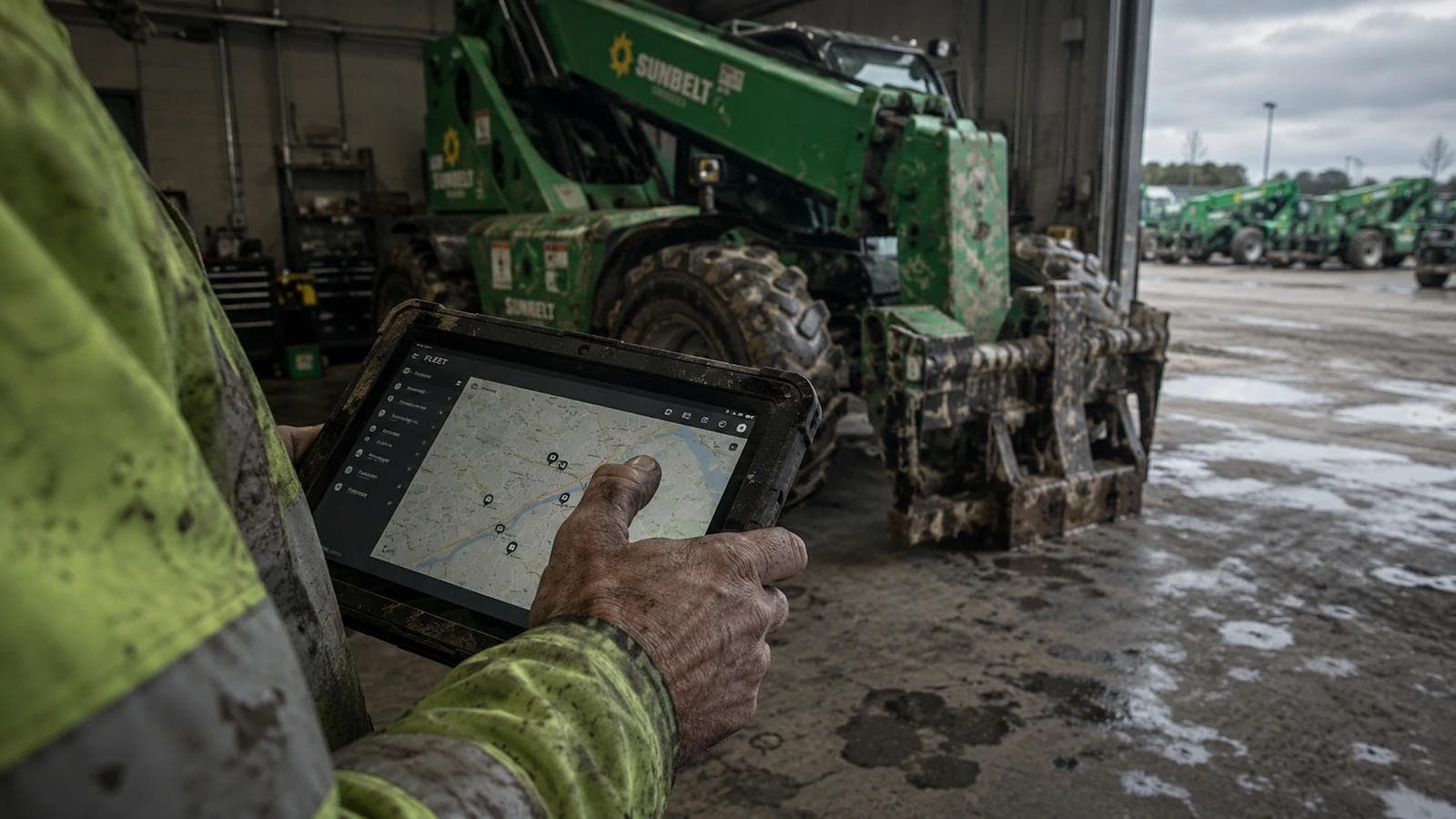
For a dealer that sells, rents, and services equipment, dealer-network asset visibility is the ability to answer one question — where is this unit and what state is it in right now — for every machine in your network, from a single record, across every yard. For a dealer running five or more locations, that answer is almost never in one place. It's split across a sales DMS, a rental system, a service module, transfer paperwork, and a few spreadsheets, and none of them fully agree. The result is a network that can't reconcile its own inventory: units logged as available that are actually on rent, machines marked "in service" that left the shop weeks ago, and ghost assets still on the books that nobody can physically locate. This guide is about closing that gap — building one source of truth for sold, rented, and serviced equipment so the map matches reality across every yard.
Key Takeaways
- The visibility gap isn't location — it's status. Most dealer networks can eventually find a unit; what they can't do is trust whether it's for sale, on rent, in service, or in transit at any given moment, because that status lives in separate systems.
- Sold, rented, and serviced equipment lives in three different silos. A DMS, a rental platform, and a service system each hold a partial record, and the handoffs between them are where assets go dark.
- One source of truth means the record lives on the asset, not the system. When location and status are properties of the physical unit, every system reads from the same truth instead of fighting over it.
- Ghost assets carry a real cost. Equipment you can't locate still sits on the books, gets insured, and gets counted as available — distorting utilization, audits, and asset-based financing.
- Hapn tracks dealer inventory per asset, not per yard — from $10/mo for non-powered assets and $13/mo for powered equipment — so adding a sixth location doesn't multiply your subscription.
Why dealer networks lose their single source of truth
A single-yard dealer doesn't really have a visibility problem. The lot is small enough to walk, and one person usually knows where everything is. The problem starts when you become a network — five, ten, fifteen yards that each sell, rent, and service equipment — and the systems you bought to run each function start pulling the same asset in different directions.
Here's the mechanism. A machine comes in as sales inventory and lives in your DMS. It doesn't move, so a yard manager flips it to the rental fleet, where it now lives in your rental software. It comes back damaged and goes to the service bay, where the work order lives in a third system. Then it gets transferred to a sister yard to cover a shortage, and that movement lives in an email or a transfer sheet. At every one of those handoffs, the asset's true state changes — but the systems don't talk, so each one keeps showing the last status it knew. The DMS still thinks it's for sale. The rental system still shows it available. Nobody is wrong inside their own tool; they're all reading a stale partial truth.
That's the real definition of a visibility problem at network scale. It's not that a unit is lost — it's that four systems give four different answers about the same machine, and no one of them is authoritative. The map you'd draw from your software doesn't match the equipment actually sitting in your yards.
Single source of truth
A single, authoritative record for each asset that every system and yard reads from, rather than each platform maintaining its own partial version. For a dealer network, it means one record per machine that carries its real-time location and current commercial state — for sale, on rent, in service, or in transit — no matter which yard it sits in or which department last touched it.
The four states a dealer asset moves through — and why each one hides it
Equipment in a sales-plus-rental-plus-service dealer doesn't have one lifecycle; it cycles through commercial states, and the visibility breaks at the transition between them. Naming the states is the first step to tracking them on one record.
1. For sale — staged, but not always where the lot tag says
Sales inventory is supposed to be the easy one: it sits on a lot with a tag. But across a network, machines get moved between locations to match a buyer or stage for a show, and the DMS rarely keeps up. A unit listed at Yard A is physically at Yard C, and the salesperson promising delivery doesn't know until the customer's there.
2. On rent — out the gate and off the radar
Once a machine leaves on a rental contract, your rental software knows it's out, but not where. If it's off-rented at the customer's request, sub-rented to another site, or simply not returned on the due date, the gap between "contract says due back" and "physically still on a job" is pure exposure — lost rental revenue and a unit you can't redeploy because you don't know it's free.
3. In service — the bay where assets disappear
The service bay is the single biggest blind spot. A unit goes in for repair, the work order opens, and as far as every other system is concerned the machine is "in service" indefinitely. It may have been fixed and rolled back to the rental line two weeks ago, or shipped to another yard's shop for a specialty repair. "In service" becomes a black hole that hides idle, rentable equipment.
4. In transit — the state no system owns
Inter-yard transfers are the state that lives in nobody's software. A machine moving from one location to another is, for the duration of that move, invisible — not in the sending yard's count, not yet in the receiving yard's, tracked only by a transfer sheet or a text. For a multi-yard network that rebalances inventory constantly, the in-transit fleet is a rolling pool of unaccounted assets.
What dealer-network asset visibility actually requires
Closing the gap isn't about buying a fourth system. It's about adding one layer of ground truth — the physical asset itself — that the systems you already run can read from. Three things make that work.
Make location and status a property of the asset
The fix for four systems disagreeing is to stop asking the systems and start asking the machine. Put a tracker on the unit and its real-time location becomes a fact, not a guess pieced together from work orders and contracts. Status follows from location plus context: a machine inside a customer geofence past its return date is overdue; a unit that's been parked in the service-bay geofence for three weeks isn't really being serviced. The asset becomes the authoritative record, and every department reads the same truth instead of maintaining its own. This is the same per-asset model that drives equipment rental tracking generally — visibility lives on the unit, not the location.
Run one live map across every yard
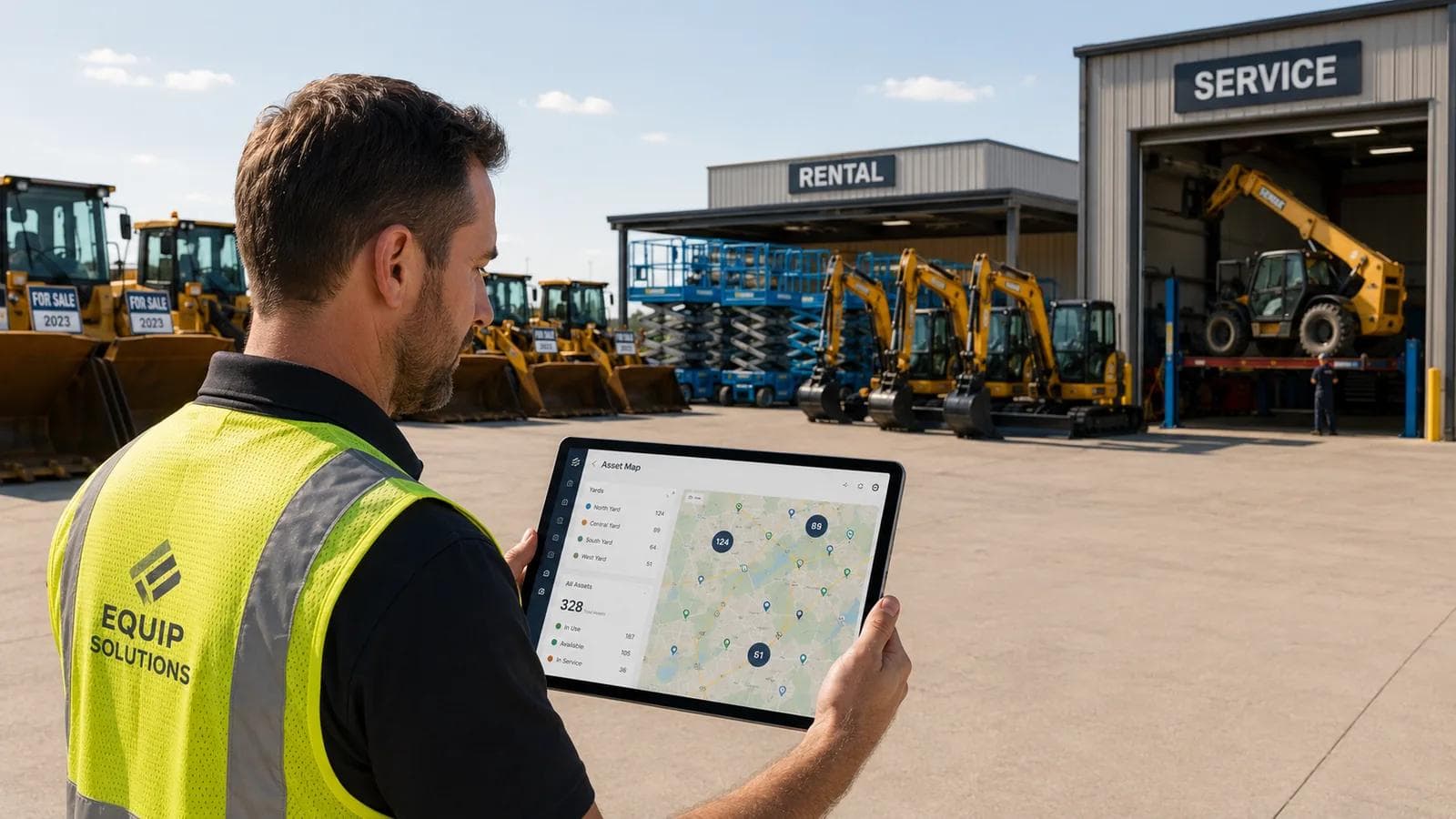
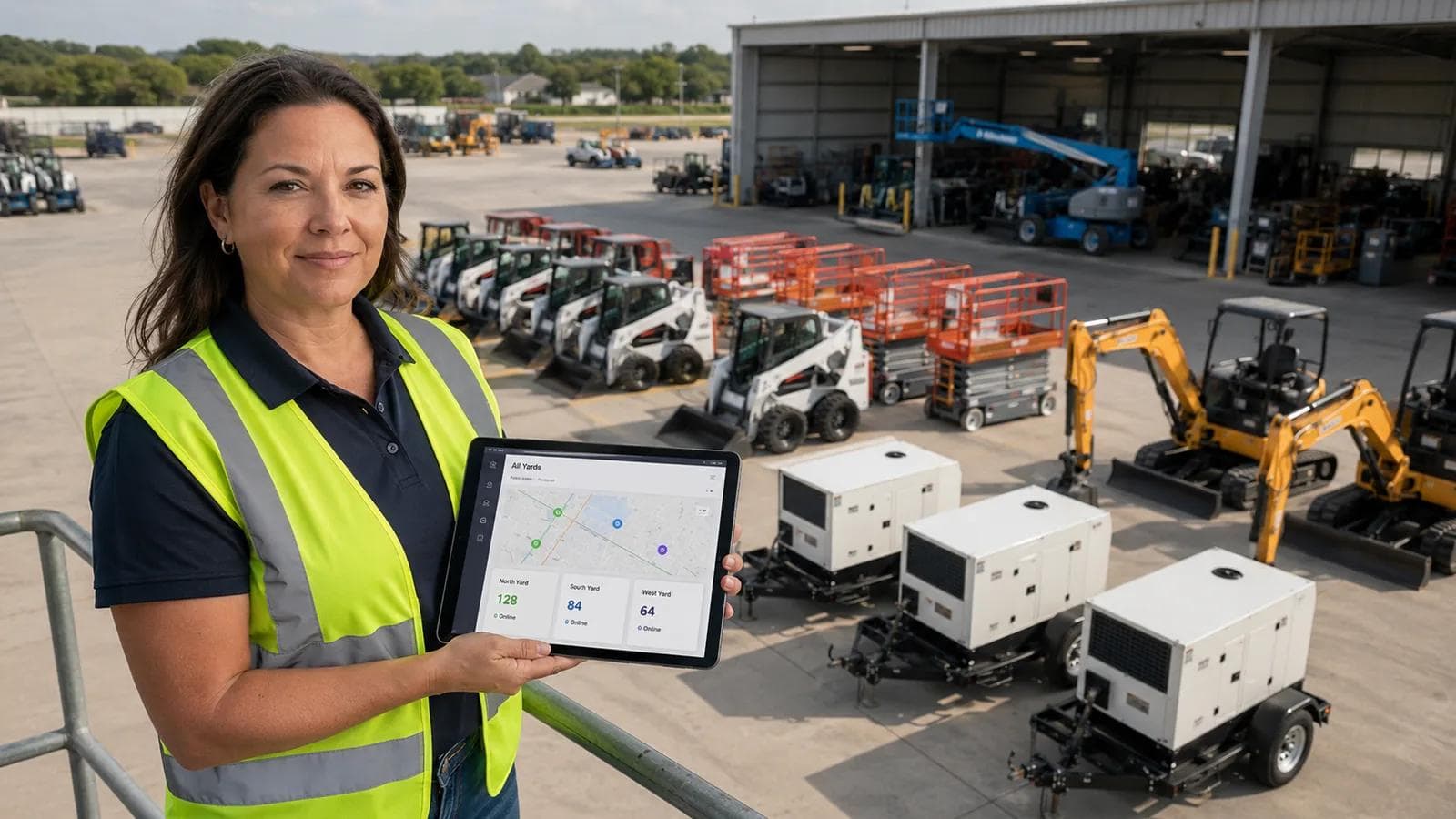
Once every asset reports itself, the network gets one map. A single dashboard shows what's on each lot, what's out on rent and where, what's actually in the bays, and what's moving between locations — across all five or fifteen yards at once. The "playbook" for operationalizing that map across departments is covered in the multi-yard dealer playbook; the point here is narrower: the map is what makes the single source of truth visible to a human who needs to answer a customer in thirty seconds, not after three phone calls.
Cover the bays and back lots, not just the open yard
The states that hide assets — in service, staged in a covered building — are exactly where GPS struggles. Equipment parked in a service bay or stored indoors blocks satellite signal, which is why the service black hole persists even with GPS trackers. Hapn Sites closes that with Bluetooth Low Energy (BLE) beacons that keep visibility on machines inside shops and covered storage, no WiFi required. Pairing GPS for the open yard and the road with BLE for the bay is what makes the map complete instead of accurate-except-where-it-matters-most.
One record per asset, every yard, every state
See sold, rented, and serviced equipment on one live map. Per-asset pricing, no per-yard fees, hardware free on a 3-year plan.
Why this is an accountability problem, not just a convenience one
It's tempting to file asset visibility under "nice to have" — a faster way to find a machine. For a dealer network, it's an accountability and balance-sheet issue.
Start with ghost assets: equipment the network owns but can't physically locate. They don't disappear from your accounting — they keep getting insured, depreciated, and counted as available inventory. That last part quietly poisons every utilization number you report, because your denominator includes machines that aren't really in play. You think a yard is running lean when it's actually sitting on idle units lost in the service-and-transfer shuffle.
It compounds when equipment is financed or distributed across the network. Asset-based lenders, floor-plan financing, and audits all assume your records match your physical fleet. When they don't, you're exposed at exactly the moment scrutiny is highest — a lender audit or an insurance claim. A defensible, asset-level record of where every machine is and what state it's in turns those events from a scramble into a report. Hapn's role in keeping financed and distributed equipment accountable across owners is the same pattern behind the C3 Rentals story — visibility that holds up when someone outside the company is checking.
What dealer-network asset tracking costs
The pricing structure matters as much as the price for a multi-location dealer, because the wrong structure punishes you for growing. Hapn bills per asset, not per yard. Non-powered assets — trailers, attachments, towables — track on the asset tier at $10/mo per unit; powered equipment that you want utilization and engine data on tracks at $13/mo per unit. Adding a sixth or tenth location adds zero to your subscription; you pay for the machines you track, wherever they sit.
That's the wedge against most dealer and rental software, which charges per site or per seat and makes every new yard a new line item. The full breakdown is in per-asset vs per-site pricing. There are two ways to buy: a 3-year agreement where all hardware and install kits are included at no upfront cost, or a 1-year agreement with hardware purchased at cost. Exact pricing for your fleet is a quick quote on the Hapn pricing page.
Per-asset vs per-site pricing
Per-asset pricing charges for each tracked unit regardless of location; per-site pricing charges for each yard or facility. For a dealer network running 5+ yards, per-asset billing means a single source of truth that scales with your inventory, not your location count — the more yards you add, the bigger the gap between the two models.
How Hapn fits a multi-yard dealer
Hapn is built for equipment rental businesses, multi-yard dealers, and equipment financing operators, and the single-source-of-truth use case is exactly what the platform is designed around. Trackers ship pre-provisioned and activate in minutes, so you can tag a network's worth of inventory without a deployment project. GPS, geofencing, and asset tracking roll up to one live map across every yard, and Sites fills in the bays and covered storage where GPS goes dark. Because Hapn exposes an open API, the location-and-status layer can feed the DMS, rental, and service systems you already run — so the asset record becomes the source of truth those systems read from instead of a fourth system to reconcile.
If you're weighing this against a traditional asset-tag platform, the trade-offs are laid out in Hapn vs Tenna.
About the author
The Hapn team builds telematics for equipment rental businesses, multi-yard dealers, and equipment financing operators. We publish per-asset pricing, ship pre-provisioned hardware, and integrate with the DMS, rental, and service systems you already run.
Frequently asked questions
What is dealer-network asset visibility?
Dealer-network asset visibility is the ability to see the real-time location and current commercial state — for sale, on rent, in service, or in transit — of every machine across all of your yards from a single record. The hard part isn't finding any one unit; it's having one authoritative answer when your sales, rental, and service systems each hold a different partial version of the truth.
Why don't our DMS, rental, and service systems give us one view of inventory?
Because each system only knows about its own function and the handoffs between them aren't tracked. When a unit moves from sales inventory to the rental fleet to the service bay to another yard, each system keeps showing the last status it recorded. None of them is wrong inside its own scope — but together they give conflicting answers, and no single system is authoritative. The fix is a location-and-status layer on the asset itself that all of them can read from.
How do you keep equipment status accurate across multiple locations?
Make status a property of the physical asset, not the software. A GPS or BLE tracker reports where a machine actually is, and geofences around your yards, service bays, and customer sites infer its state — a unit past its return date inside a customer geofence is overdue; one parked in the service geofence for weeks isn't really being worked on. That real-time ground truth keeps the record accurate no matter which department last touched the machine.
What are ghost assets and why do they matter to a dealer network?
Ghost assets are machines the network owns but can't physically locate. They keep getting insured, depreciated, and counted as available inventory, which distorts utilization numbers and creates exposure during lender audits, floor-plan financing reviews, and insurance claims. An asset-level record of every unit's location and state eliminates ghosts and makes those audits a report instead of a scramble.
Does Hapn charge per yard or per asset?
Per asset. Non-powered assets track at $10/month per unit and powered equipment at $13/month per unit, billed for the machines you track regardless of how many locations you run. Adding yards doesn't increase your subscription — which is the opposite of per-site dealer and rental software that charges for each new location. You can buy on a 3-year plan with hardware included or a 1-year agreement with hardware purchased at cost.
Does Hapn replace our dealer management or rental software?
No — it sits underneath them as the source of truth for location and status. Through Hapn's open API, the asset-level record feeds your DMS, rental platform, and service system so they're all reading the same physical reality instead of maintaining conflicting versions. You keep the systems your business runs on; Hapn makes them agree.
One source of truth across every yard
Sold, rented, and serviced equipment on one live map — location and status that match reality. Per-asset pricing, no per-yard fees, live in days.
Last Updated: June 25, 2026
Explore Hapn on a live equipment fleet
Click around the real platform — a live mixed fleet with dummy data. No sales call, takes a few minutes.
Get the latest news straight to your inbox.
Share Article
