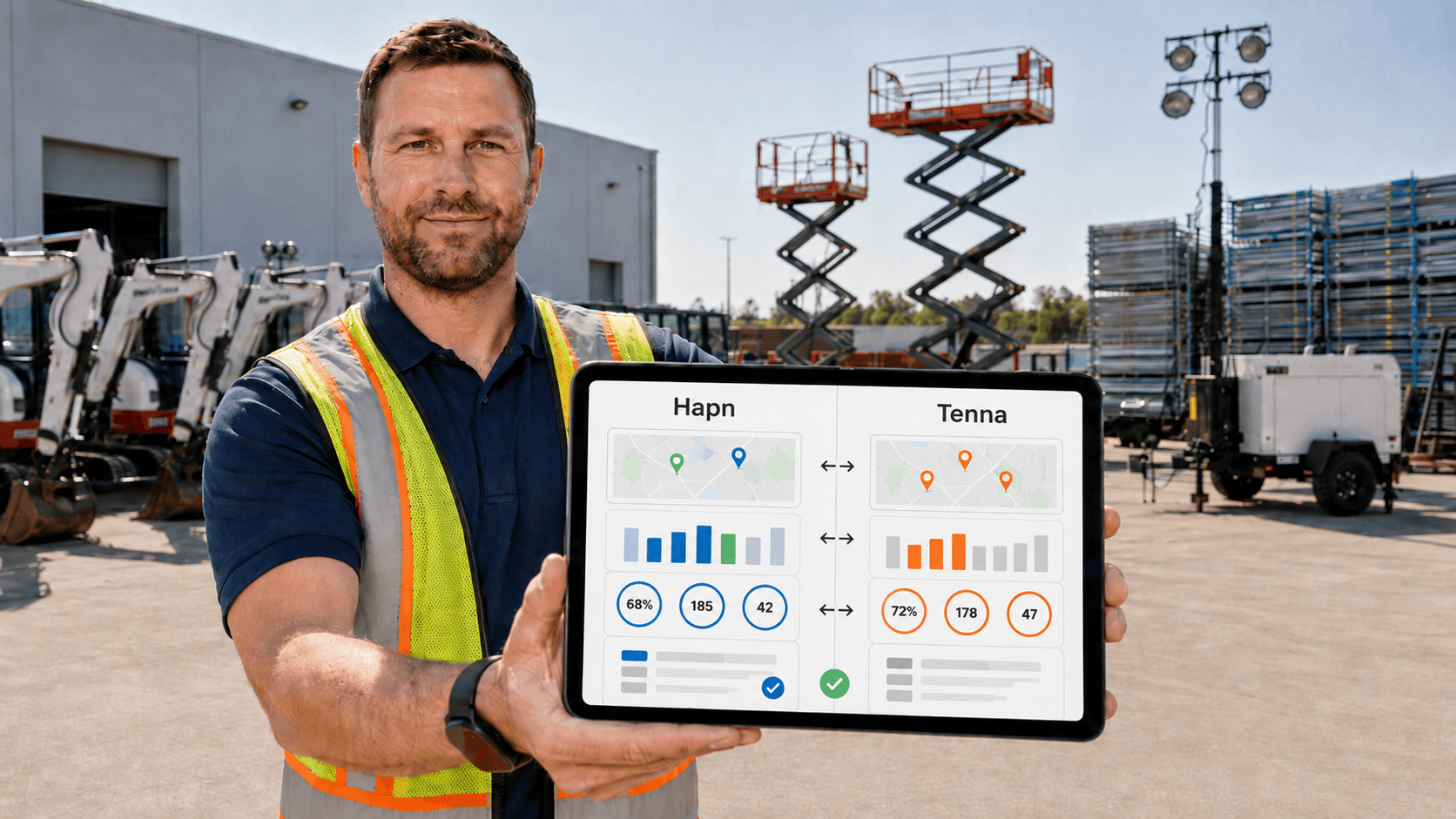
If you run an equipment rental fleet and you're evaluating Hapn vs Tenna, the short answer is this: Tenna is a comprehensive construction asset management platform built for general contractors who own and operate their own fleets. Hapn is the rental-fleet-friendly alternative: transparent per-asset pricing, a 3-year agreement with all hardware included at no upfront cost (or a 1-year agreement with hardware at cost), additions prorated onto one end date, no per-yard licensing fees, and a quick quote process that fits how independent rental houses, multi-yard dealers, and equipment financing companies actually buy software. Both platforms track equipment. They're optimized for very different buyers.
Key Takeaways
- Pricing model: Hapn publishes per-asset pricing (from $10/mo) with two ways to buy: a 3-year agreement where all hardware, AI dash cams, and install kits are included at no upfront cost, or a 1-year agreement with hardware purchased at cost. Tenna uses an enterprise quote-based model that typically includes deployment and setup fees.
- Buyer profile: Tenna is built for construction contractors managing 500+ owned assets across active job sites. Hapn fits rental houses, multi-yard dealers, and equipment financing companies with 50–5,000 assets.
- Multi-yard economics: Hapn charges per asset, not per yard. Adding a fifth or tenth yard doesn't change your subscription math.
- Indoor visibility: Hapn Sites uses BLE for indoor/outdoor coverage of high-density yards without WiFi infrastructure or per-site licensing.
- Onboarding: Hapn customers typically go live in days. Tenna deployments are project-managed and typically take 4–12 weeks.
Hapn vs Tenna at a glance
Hapn is built for equipment rental fleets that mix vehicles, heavy equipment, and battery-powered assets. Here is how the two platforms line up on the dimensions rental operators ask about most.
| Capability | Hapn | Tenna |
|---|---|---|
| Pricing model | Per-asset from $10/mo; 3-yr agreement = all hardware included, or 1-yr (hardware at cost) | Enterprise quote; deployment & setup fees common |
| Mixed-fleet support | Vehicles, heavy equipment, and battery-powered assets on one platform | Construction asset focus |
| Engine hours / AEMP-ISO 15143-3 | CAN bus + aftermarket; OEM engine data via AEMP / ISO 15143-3 | CAN bus + OEM integrations |
| Indoor tracking (Hapn Sites) | Hapn Sites — BLE indoor/outdoor, no WiFi required | Available; varies by implementation |
| Contract flexibility | 3-year (hardware included) or 1-year; additions prorated to one end date | Multi-year contracts typical |
| Onboarding | Pre-provisioned devices; live in days | Project-managed deployment; weeks to months |
How Hapn pricing works
There are two ways to buy — pick the one that fits your capital plan:
- 3-year agreement — zero upfront capex. All hardware, AI dash cams, and install kits are free. The strongest reason rental fleets leave a quote-and-deploy vendor like Tenna.
- 1-year agreement. Buy your hardware at cost and commit to a shorter term. On either term, assets you add later are prorated onto your existing agreement, so you keep one end date.
Per-asset starting prices: asset & vehicle $10/mo, equipment $13/mo, equipment telematics with engine data $18/mo, AI dash cams $35/mo, OEM integrations contact us.
Pricing is quote-based with ~24-hour turnaround, and volume discounts are available. Get pricing for your fleet →
When Tenna is the right answer
If you're a large general contractor with a heavy equipment fleet you own, a dedicated asset manager on staff, and the budget for a project-managed rollout, Tenna is a credible enterprise choice. Their construction roots show up in the workflow — daily job-site asset checks, tool crib management, and integration with construction-specific ERPs. The deployment model assumes you have an internal champion willing to drive a multi-quarter implementation.
For rental businesses, the same strengths become friction. Rental operators don't manage equipment by job site — they manage by rental status, yard location, and customer. The construction-contractor workflow doesn't map cleanly to a rental house's day-to-day, and the enterprise procurement cycle is a poor fit for an operator who needs visibility on a unit that left the yard yesterday.
Where Hapn fits — and why rental houses pick it
Hapn is the equipment rental tracking platform built around how rental operators actually buy and run software. The core differences from Tenna come down to four areas that matter on a rental yard.
1. Transparent per-asset pricing — no per-site or per-yard fees
Hapn's pricing is published on the website and scales with the number of assets you track — not the number of yards you operate. A rental house with one location and 800 units pays the same per-asset rate as a multi-yard dealer with eight locations and the same unit count. There are no per-site fees and no deployment fees, and assets you add later are prorated onto your existing agreement instead of starting a new term.
Tenna's pricing is quote-based, contract-required, and typically includes deployment, setup, and ongoing professional services components. For rental operators evaluating multi-year TCO, this is often the largest single difference in total cost of ownership for equipment rental tracking.
Per-asset vs per-site pricing
A pricing model that charges per asset tracked, regardless of physical location. Multi-yard operators pay the same subscription whether their fleet sits in one yard or ten. Per-site (or per-yard) pricing, by contrast, multiplies subscription cost as a rental business expands geographically — a structure that punishes growth.
2. Built for multi-yard visibility from day one
Rental operators rarely run a single yard for long. Dealers like Hugg & Hall operate across dozens of locations; growing rental houses add yards every 12–18 months. Hapn's data model treats yard location as a property of the asset — every unit reports its current yard, its rental status, and its movement history without any per-site configuration overhead.
Hapn Sites extends this across indoor environments — equipment stored inside warehouses, container yards, or covered storage. Sites uses BLE beacons to provide indoor/outdoor visibility without requiring WiFi infrastructure at every yard. Adding a yard means installing a few beacons, not negotiating a per-site license.
3. Open API and rental management software integration
Most equipment rental operations already run a rental management system — Quipli, Point of Rental, Renterra, or a long-standing in-house system. Hapn's open API is built to connect with the rental management software you already use, so telematics data — engine hours, geofencing alerts, utilization, last-known location — flows into the system your team already opens every morning.
Hapn complements your rental management software; it doesn't replace it. That distinction matters: rental operators who've tried to fold telematics into a single all-in-one platform often end up with worse rental workflow and worse asset data than they started with. Keeping the systems separate, with a clean API connection, preserves what each is good at.
4. Fast activation, days not quarters
Hapn devices ship pre-provisioned. A rental operator can take delivery, activate units in the app, mount them on equipment, and have live tracking inside a day. There's no implementation project plan, no kickoff meeting, no professional services engagement. For rental businesses adding 50–200 units over a few weeks of seasonal ramp-up, this matters more than feature lists.
See what Hapn costs for your rental fleet
Published per-asset pricing. No per-yard fees.
Feature-by-feature: Hapn vs Tenna for rental fleets
The feature comparison below focuses on the capabilities that actually move the buying decision for an equipment rental operator. We've left out generic GPS table-stakes — both platforms do them.
| Capability | Hapn | Tenna |
|---|---|---|
| Pricing model | Published per-asset, no per-yard fees | Quote-based, contract-required, deployment fees common |
| Contract terms | 3-year (hardware included) or 1-year; additions prorated to one end date | Multi-year contracts typical |
| Onboarding | Pre-provisioned devices; live in days | Project-managed deployment; weeks to months |
| Indoor tracking | Hapn Sites (BLE), no WiFi required | Available; varies by implementation |
| Engine hours / fault codes | CAN bus + aftermarket; OEM via AEMP | CAN bus + OEM integrations |
| Rental software integration | Open API — Quipli, Point of Rental, Renterra, and similar | Construction-ERP-oriented; rental integrations vary |
| Primary buyer fit | Rental houses, multi-yard dealers, equipment financing | General contractors, large owned-fleet construction |
When equipment financing companies pick Hapn
Equipment financing companies place financed or leased units with end customers and need ongoing visibility on the collateral. This is a different operating model than either a rental house or a construction contractor — the unit lives at a customer's site, not in your yard, and the financing company's primary question is "is the asset still where the customer said it would be, and is it being used as expected?"
Hapn fits this pattern because the per-asset pricing model decouples cost from physical location. You're not paying for a yard you don't operate. C3 Rentals' story is an example of how a financing-adjacent operator uses Hapn for distributed visibility across an installed base of equipment.
AEMP / ISO 15143-3
The industry-standard data format for equipment telematics, originally developed by the Association of Equipment Management Professionals. Compliant OEM platforms expose hours, location, fuel, and fault codes in a normalized structure. Hapn ingests AEMP feeds from supported OEMs, which means engine hours and utilization come direct from the manufacturer telematics — not from a redundant aftermarket sensor.
When Tenna still wins
If your business is owned-fleet construction, you have an internal asset manager on staff, you're integrating with a construction ERP like Vista or Procore at depth, and you have the budget and timeline for a project-managed enterprise rollout, Tenna's construction-anchored workflow is a credible fit. The deployment model matches how large GCs already buy software. Most rental businesses don't share those characteristics — but if yours does, Tenna's strengths are real.
For everyone else — rental houses, multi-yard dealers, equipment financing companies, party rental operators, scaffolding companies — Hapn is the lower-friction, more transparent, more rental-aligned choice. The decision usually comes down to whether the buyer wants to spend a quarter standing up an enterprise asset platform, or wants live tracking on next week's deliveries.
About the author
The Hapn team builds telematics for equipment rental businesses, multi-yard dealers, and equipment financing operators. We publish per-asset pricing, ship pre-provisioned hardware, and integrate with the rental management systems you already run.
Frequently asked questions
Is Hapn cheaper than Tenna?
For most rental fleets, yes — but the more important difference is predictability. Hapn publishes per-asset pricing on the website. Tenna's pricing is quote-based and typically includes deployment and setup fees that vary by implementation. Two operators with similar fleet sizes can see very different Tenna quotes; Hapn pricing is the same number for both. For a multi-yard rental operator forecasting three-year TCO, the per-asset, no-per-site structure with hardware included usually wins on total cost even before service-fee comparisons.
Can Hapn handle a fleet with both vehicles and powered equipment?
Yes. Hapn tracks vehicles, powered equipment, attachments, and battery-powered assets on one platform. The product was built around equipment-first telematics (engine hours, fault codes, CAN bus, OEM integration via AEMP/ISO 15143-3) and supports vehicles as a subset of that capability — not the other way around.
Does Hapn integrate with Quipli, Point of Rental, or Renterra?
Hapn's open API is built to connect with the rental management systems most rental operators already run — Quipli, Point of Rental, Renterra, and similar. The integration approach treats the rental management system as the source of truth for rental status and customer data, with Hapn providing the telematics layer (location, hours, utilization, geofence events) that the rental management system doesn't.
How long does Hapn take to deploy compared to Tenna?
Hapn customers typically go live in days. Devices ship pre-provisioned, and installation on most equipment takes minutes per unit. Tenna deployments are project-managed and typically take 4–12 weeks depending on fleet size and integration scope.
What about indoor tracking — does Hapn cover warehouse or covered-storage equipment?
Yes. Hapn Sites uses BLE beacons for indoor and covered-yard visibility without requiring WiFi infrastructure. Each beacon defines a zone, and equipment fitted with Hapn devices reports zone-level presence as it moves through your facility. For multi-yard rental operators, Sites means indoor coverage scales without a per-site license cost.
What contract terms does Hapn offer?
Hapn's standard agreement is 3 years with all hardware included at no upfront cost. A 1-year agreement is also available with hardware purchased at cost. Assets you add later are prorated onto your existing agreement, so you keep one start and end date.
Ready to see Hapn on your fleet?
Published per-asset pricing. Live in days, not quarters.
Last Updated: May 15, 2026
Explore Hapn on a live equipment fleet
Click around the real platform — a live mixed fleet with dummy data. No sales call, takes a few minutes.

Get the latest news straight to your inbox.
Share Article
