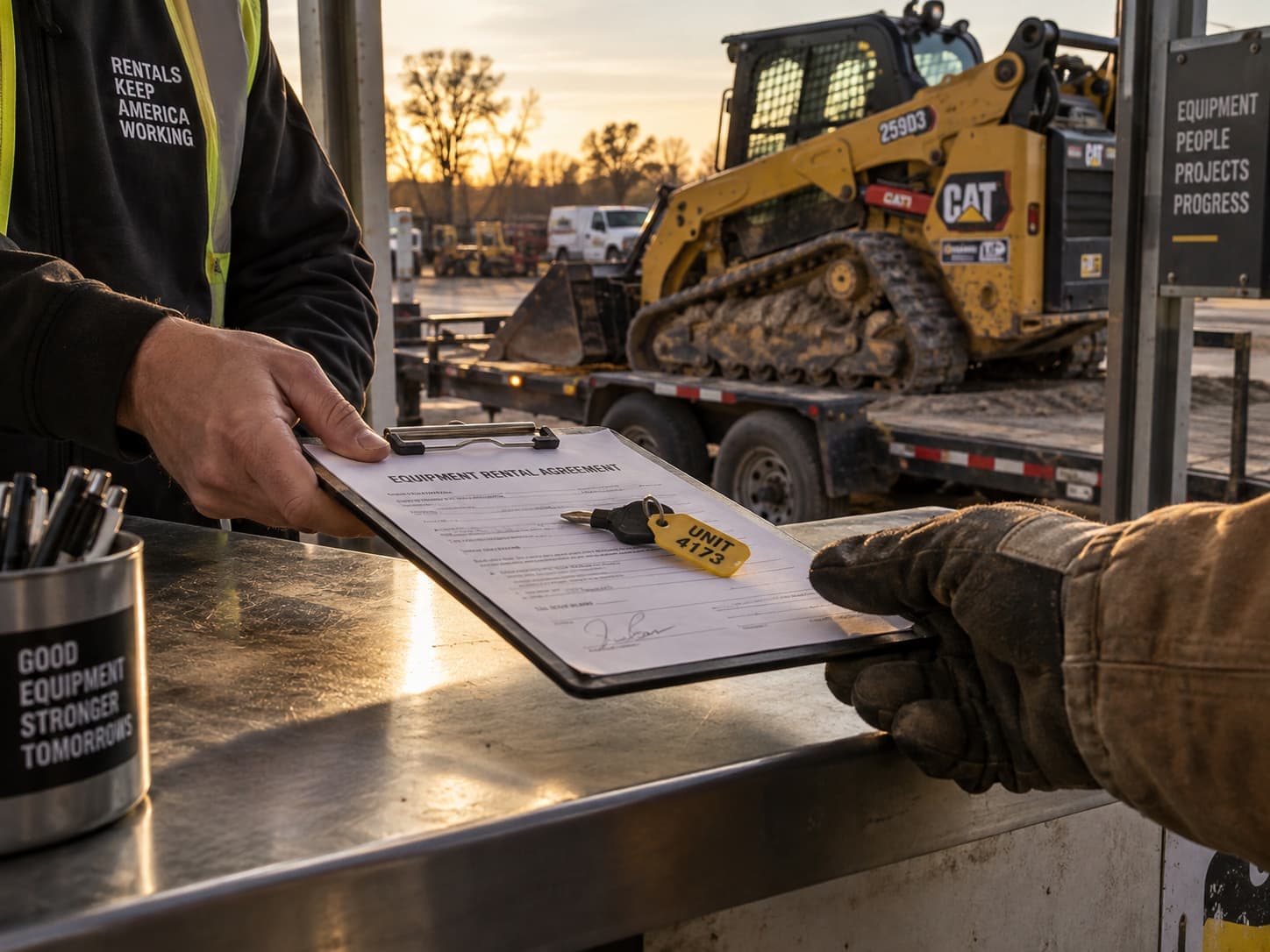
An equipment rental agreement is the contract between a rental company and its customer that sets the rental period, the rate and how it is calculated, where the equipment may be used, who pays for damage and loss, and what happens if the unit comes back late or not at all. The clauses that protect a rental fleet are the ones that turn each of those into something you can measure: hours on the meter, the time the unit left the job site, the address it is supposed to be at. This guide walks through nine clauses every equipment rental contract should carry, what each one should say, and how tracking data makes them enforceable. It is not legal advice; have your attorney review your agreement before you change it.
Key Takeaways
- Industry practice bases rental rates on one 8-hour shift per day, 40 hours per week or 176 hours per 30-day month, and bills each extra hour at 1/8, 1/40 or 1/176 of the rate, according to EquipmentWatch. Your agreement should say which basis applies.
- On a $6,000-a-month skid steer, every unbilled hour over 176 is about $34. Thirty unrecorded hours is roughly $1,000 per unit per month (illustrative).
- 9 clauses do most of the protective work: equipment ID, rental period and off-rent, usage hours, authorized location, GPS and telematics disclosure, remote disable, condition and damage, late return and non-return, and maintenance.
- The National Insurance Crime Bureau puts US construction equipment theft at over $1 billion a year, with under 25% of stolen units recovered. A location clause plus a tracker is the difference between a late return and a write-off.
- A clause is only as strong as the evidence behind it. Engine hours, movement and arrival times read from the machine, and matched to the contract in your rental system, settle disputes that a customer's memory never will.
What an equipment rental agreement has to do
Most rental agreements cover the same ground: parties, equipment, dates, rates, payment, insurance, indemnity. Where they differ is whether the terms hold up on the day a customer disputes an invoice. "Equipment shall be used for one shift per day" is a sentence. "Usage is measured by the engine hour meter, and hours above 176 in any 30-day period are billed at 1/176 of the monthly rate" is a billable term. The difference is a defined unit of measure and a record of it that you, not the customer, hold.
Off-rent (call-off)
The point at which a rental stops accruing charges, usually when the customer notifies the rental company that the equipment is ready for pickup and receives an off-rent number. Disputes over when a unit went off rent are a routine source of billing adjustments.
Time basis (overtime)
The number of operating hours included in a daily, weekly or monthly rate. Hours beyond the time basis are billed as overtime. The common basis is 8 hours a day, 40 a week and 176 a month, with some rental companies using 160 hours over a 28-day period.
The 9 clauses that protect your fleet
1. Equipment identification
List each unit by make, model, serial number and your unit number, plus attachments and accessories by count. Record the hour meter reading and fuel level at check-out. Overtime, damage and non-return all depend on proving which unit left and in what state, and when the unit number on the contract matches the one on the tracker, the rest of the record attaches itself.
2. Rental period and off-rent procedure
State when charges start (delivery, or pickup at the counter), the minimum rental period, and exactly how the customer calls a unit off rent: by phone or email, to whom, and what confirmation they receive. Say that charges continue until the unit is off rent and available for pickup at the stated address. Movement data matters here in both directions. A unit that left the job site on Tuesday supports a fair adjustment; a unit "ready for pickup" since Friday that kept running through the weekend supports the charge.
3. Usage hours and overtime
The agreement should name the time basis (8 / 40 / 176, or 160 over 28 days), the overtime rate for each hour above it, and the unit of measure: the engine hour meter, not the customer's timesheet. EquipmentWatch describes the standard practice: one-eighth of the daily rate per extra hour on a daily rental, 1/40 of the weekly rate on a weekly rental, and 1/176 of the monthly rate on a monthly rental.
The math is worth seeing once (illustrative). A skid steer at $6,000 a month runs 206 hours in a 30-day period. That is 30 hours over the 176-hour basis, at $6,000 ÷ 176 = about $34 an hour, or roughly $1,020 that should be on the invoice. Hours read from the machine make the overage a fact; see telematics-based overage billing.
4. Authorized location and job site
Name the job site address and require written approval before the equipment moves to another site, leaves the state or crosses a border. Prohibit subletting and use by anyone the customer has not authorized. This turns a geofence alert into a contract matter: if a generator rented to one county shows up 90 miles away at 2 a.m., the agreement already says that is a breach.
5. GPS and telematics disclosure
If your equipment carries a tracker, say so in the agreement and have the customer acknowledge it. State what is collected (location, engine hours, ignition events, and diagnostics where available), what you use it for (billing, maintenance, security, recovery and contract compliance) and that the equipment remains your property. Rules on tracking and data use vary by state, so this is the clause to have your attorney write.
6. Remote disable
If any units carry a starter interrupt, the agreement needs to say when you may use it: non-payment past a stated number of days, use beyond the rental period without an extension, movement outside the authorized area, or suspected theft. It should also say you will not disable a machine while it is in operation where that creates a safety risk. Our guide to starter interrupt for equipment rental includes sample contract language and the five-step remote-disable workflow.
Back every clause with data from the machine
Engine hours, location and movement on every unit, per-asset pricing, hardware included on 3-year terms.
7. Condition, damage and abuse
Require a documented inspection at check-out and return, with photos, and state that the customer pays for damage beyond normal wear, for missing attachments and for cleaning. Define abuse plainly: operating past warning lights, overloading, use outside the manufacturer's limits, operation by untrained personnel. Rental equipment damage tracking covers how to prove abuse and bill for it. Pair this clause with your damage waiver and insurance requirements; our equipment rental insurance guide covers what to require from every renter.
8. Late return and non-return
Set the charge for late return (usually the applicable rate continues, plus any additional fee you choose to state), and the point at which a unit not returned is treated as converted or stolen and reported. Spell out that the customer authorizes recovery from the stated location and pays recovery costs. Under 25% of stolen construction equipment is ever recovered, per the National Insurance Crime Bureau figures cited in our construction equipment theft post. Lenders face the same problem with financed units: C3 Rentals, which finances rent-to-own trailers through dealers nationwide, raised its trailer recovery rate after putting trackers on its installed base.
9. Maintenance and service intervals
Say who does what. The customer handles daily checks (fluids, grease, tire pressure) and reports faults immediately; you handle scheduled service. On long rentals, state that you may access the unit for service at set hour intervals and that the customer must make it available. A unit on a 90-day rental can pass a 250-hour interval without anyone at the yard seeing it.
Where the agreement meets the tracker
Each clause depends on two records lining up: what the contract says should happen, which lives in your rental management system, and what the machine says did happen, which lives in your tracking platform. In separate screens, someone has to compare them by hand, and mostly nobody does.
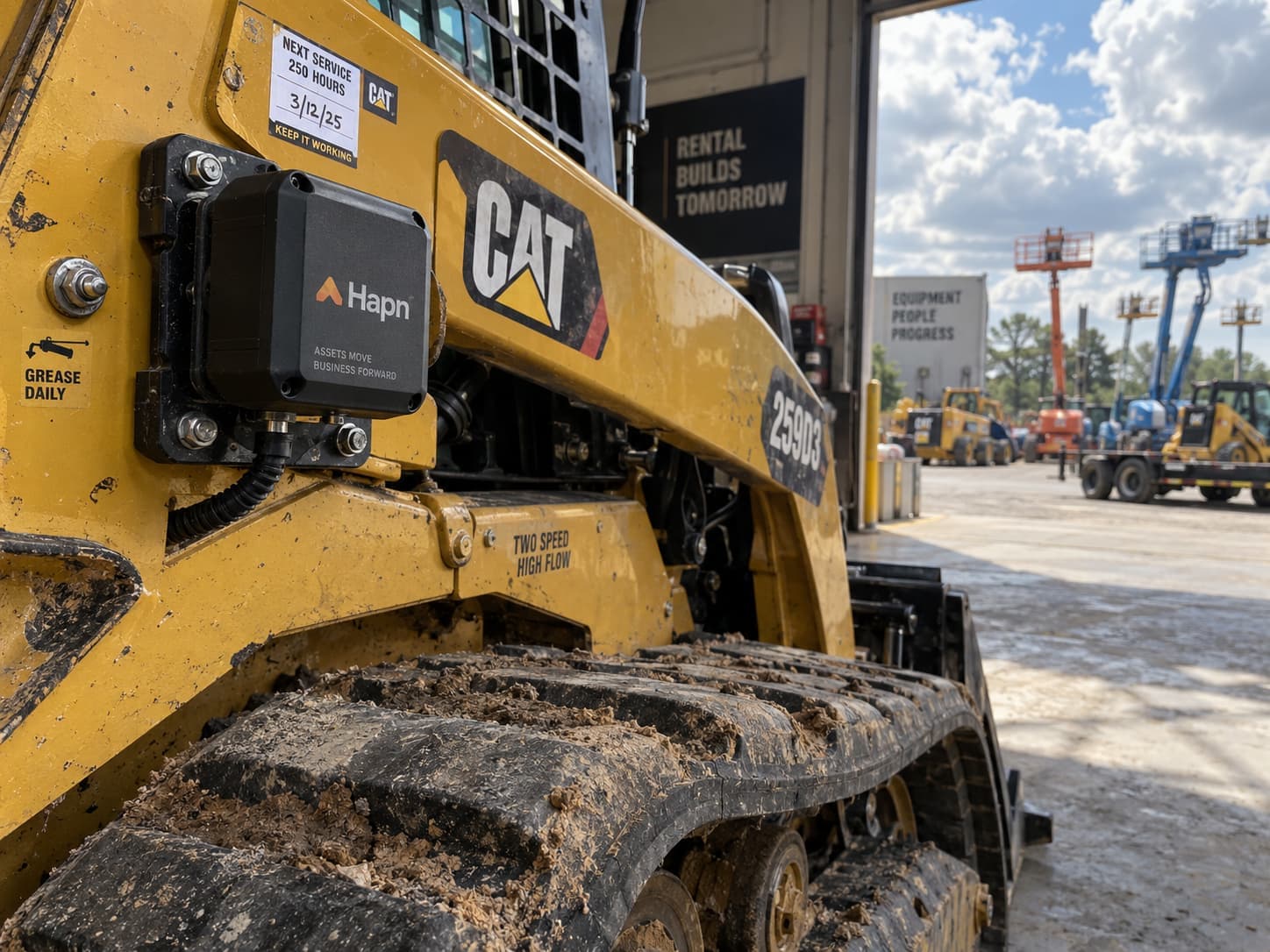
Hapn closes that gap by bringing the rental agreement data in from your RMS: the customer, the unit on the contract, the job site, the on-rent and due-back dates. Matched against live telematics, that is what makes the clauses run on their own:
- Hours against the contract (clause 3): engine hours accumulated on rent flow into billing and maintenance, so overtime is calculated from the meter rather than from a return-day estimate.
- Overdue rentals that are still moving (clauses 2 and 8): a unit past its due-back date that is still running gets flagged, which is either an extension to bill or a recovery to start.
- Status from movement (clause 2): status updates when equipment leaves the yard, and a tracking link can go out when the contract starts, so delivery and off-rent times stop being a matter of opinion.
- Service by hours (clause 9): a maintenance task opens when a unit on rent crosses its service threshold.
Hapn connects with Point of Rental, Quipli and Renterra, among others, and the open API covers systems that are not on the list yet. For the operating routine around check-out, on-rent exceptions and returns, see how to keep track of rental equipment.
What it costs to back the agreement with data
Hapn bills per asset, per month: $10 for asset and vehicle tracking (trailers, attachments, unpowered units), $13 for equipment tracking with engine hours, and $18 for full equipment telematics with CAN bus data. All hardware is included at no upfront cost on a 3-year agreement; a 1-year agreement is also available with hardware purchased at cost, and units added mid-term are prorated onto the same end date. Because billing is per asset rather than per site, adding a yard does not add a fee. Current rates are on the pricing page, and the equipment rental page covers the full platform for rental operators.
About the author
TJ Chasteen is the product manager for Hapn's enterprise platform, including its rental management software integrations with Point of Rental, Quipli and others. He works directly with rental operators and dealers on how tracking data should flow into contracts, service and billing. Hapn builds GPS tracking and telematics for equipment rental businesses, multi-yard dealers and equipment financing companies, and publishes per-asset pricing.
Frequently asked questions
What should an equipment rental agreement include?
At minimum: the parties; each unit by make, model, serial and unit number with its hour meter reading at check-out; the rental period and how the customer calls equipment off rent; the rate and its time basis with the overtime rate; the authorized job site; GPS and telematics disclosure; remote-disable terms if you use them; condition, damage and insurance requirements; late-return and non-return terms; and maintenance responsibilities. Have an attorney review the final language for your state.
How many hours are included in a monthly equipment rental?
The common industry basis is 176 operating hours in a 30-day period, matching one 8-hour shift per day, with some rental companies using 160 hours over 28 days. Hours above the basis are typically billed at 1/176 of the monthly rate each. The agreement should state which basis applies and that the engine hour meter is the unit of measure.
Can a rental company track equipment with GPS during a rental?
Rental companies routinely track their own equipment with GPS and telematics for billing, maintenance, security and recovery. The safe practice is to disclose the tracking in the rental agreement, describe what data is collected and how it is used, and have the customer acknowledge it. Requirements vary by state, so the disclosure clause should be written or reviewed by your attorney.
How do you prove overtime hours on rented equipment?
Record the hour meter reading at check-out and return, and state in the agreement that the engine hour meter is the measure of use. A tracker that reads engine hours from the machine gives a timestamped record of every hour run on rent, which is far harder to dispute than a meter photo or a customer's timesheet. When that record feeds the rental management system, overtime appears on the invoice without a manual reading.
What happens if a renter does not return equipment?
A well-written agreement says charges continue past the due date, defines the point at which non-returned equipment is treated as converted or stolen, authorizes recovery from the stated location and makes the customer liable for recovery costs. GPS tracking tells you where the unit is when that point arrives, and a starter interrupt, if the agreement allows it, can keep the machine from moving further while the matter is resolved.
Make your rental agreement enforceable
Hours, location and contract status on every unit, inside the rental system you already run.
Last Updated: October 2, 2026
Explore Hapn on a live equipment fleet
Click around the real platform — a live mixed fleet with dummy data. No sales call, takes a few minutes.
Get the latest news straight to your inbox.
Share Article
