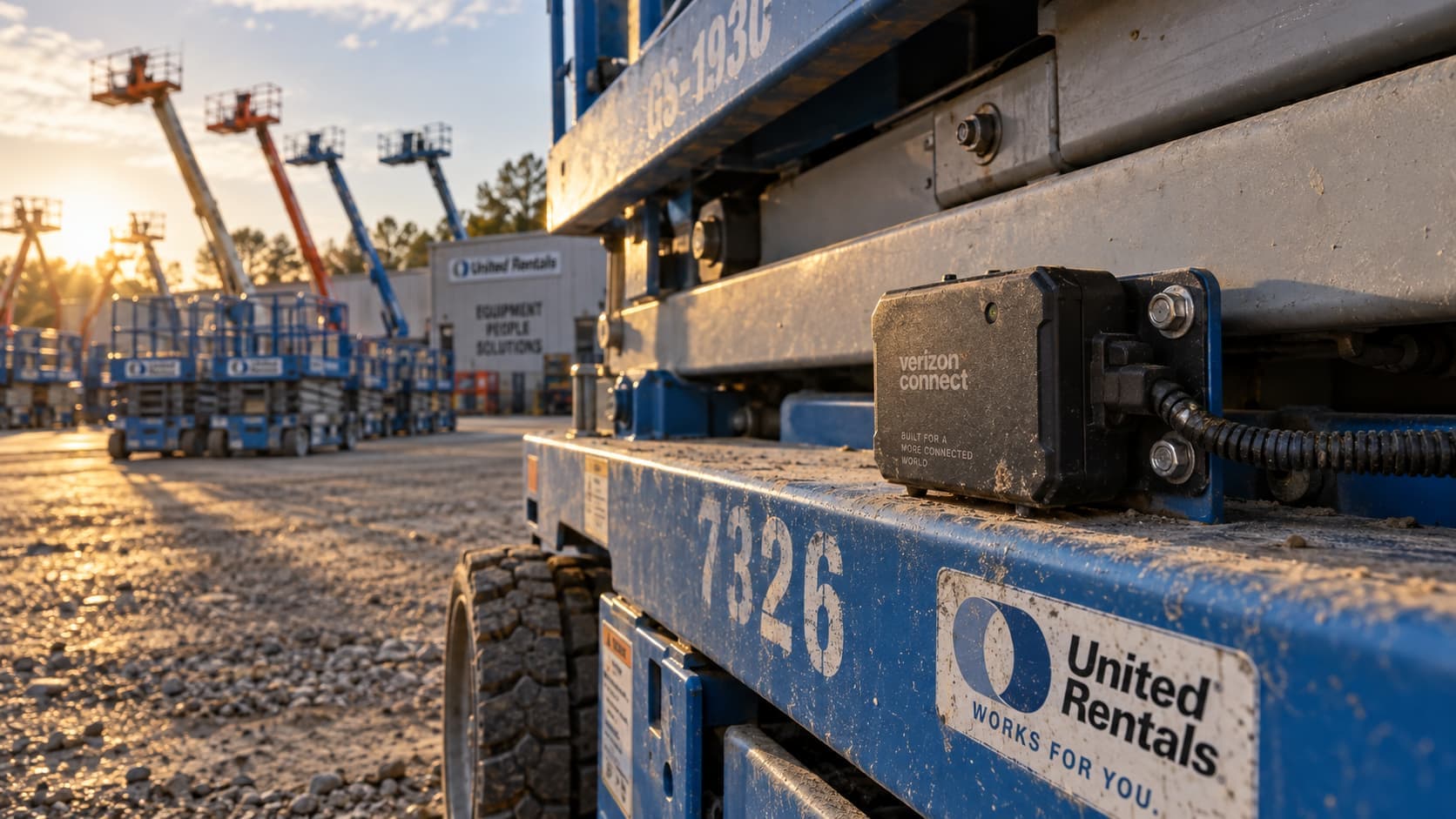
The best GPS tracking for equipment rental companies is the platform that works with the rental management system you already run. Rental shops live in Point of Rental, Quipli, Texada, Wynne or a similar system: that is where contracts are written, units are checked out and back in, meters are recorded and invoices go out. A telematics platform that cannot put its data into that workflow leaves you with two systems, and most of its other features become secondary. So this guide compares 8 equipment rental telematics platforms on rental management software integration first, and only then on hardware, equipment coverage, OEM data, satellite, vehicle features and pricing. One disclosure up front: we make Hapn. We show our work, link to each vendor's own documentation, and say where another platform is the better fit.
Key Takeaways
- Start with your RMS. Find the telematics platforms with a documented integration to the rental system you run, then compare only those on everything else.
- Documented rental-system integrations range from 0 to 7 per vendor. Hapn has the most we found (Point of Rental, Quipli, Texada, Alert Rental, DynaRent, EZRentOut, Renterra) and is the telematics partner Quipli names; Trackunit has 5 (Point of Rental, Wynne, InTempo, Texada, MCS) and is the one to check on Wynne or InTempo.
- Depth matters as much as count. The integrations with the most documented workflow detail push hour meter readings into the contract at on-rent, return, inspection and work order, and open service tasks from hours. A partner logo, or a third-party data bridge, is not the same thing.
- Samsara, Motive and Verizon Connect are vehicle telematics platforms first. Only Samsara sells an asset gateway that reads CAN bus data from off-road equipment; Motive's and Verizon Connect's equipment trackers wire to power and ignition only.
- Geoforce is the one platform here with satellite devices for equipment. Of the 8, only Hapn publishes per-asset prices ($10 to $35 per asset per month; OEM data from $4).
How we evaluated these platforms
This is a comparison, not a scored ranking. We read each vendor's product pages, data sheets, help centers and integration marketplaces, plus the partner pages published by the rental software companies themselves (Point of Rental, Quipli, Texada, Wynne, InTempo, MCS), on September 18, 2026. Where a claim comes from vendor documentation, we link to it. Where we could not find something, we say "not found" rather than "no". We compared each platform on:
- Rental management system integrations: which RMS platforms the vendor or the RMS documents.
- Depth of those integrations: what data moves, in which direction, and at which step of the rental cycle.
- Powered equipment support: engine hours, and whether the device reads the machine's CAN bus or only power and ignition.
- Unpowered asset tracking: battery devices for trailers, attachments, light towers and containers.
- OEM and CAN data: factory telematics feeds (AEMP / ISO 15143-3) and machine-side CAN bus reads.
- Vehicle capabilities where relevant: delivery trucks, dash cams, driver safety.
- Satellite availability: for units that work beyond cellular coverage.
- Pricing transparency: whether prices are published.
RMS compatibility carries the most weight, and the order of the list is deliberate. A rental company's counter, dispatch, service and billing already run through its rental software, so tracking data has to participate in that workflow to be used every day. Hardware coverage, OEM feeds and price decide between the platforms that clear that bar; they rarely rescue one that does not.
Why rental software integration matters most
A contractor opens a telematics dashboard to see where its own machines are. A rental business has a different rhythm: the unit goes out on a contract, comes back, gets inspected, gets serviced and gets invoiced, and every one of those steps happens in the rental management system. If the tracker's hours and locations sit in a separate dashboard, someone opens it when a unit goes missing, not on every contract. The value of GPS tracking for equipment rental comes from closing that gap.
Rental management system
Contracts · Customers · Billing · Maintenance
Knows what should be happening with the asset
Meter readings, location and faults flow up into the contract. Rental status and service intervals flow down.
Telematics / GPS
Location · Meter readings · Usage · Faults
Knows what is actually happening with the asset
Physical equipment
Excavators · Lifts · Generators · Trailers · Attachments
The RMS knows what should be happening. Telematics knows what is actually happening. The value comes from connecting the two.
An API is not an integration
Almost every vendor in this guide has an API, and several list rental software partners. The question that matters is narrower: does the telematics data participate in the rental workflow? Concretely, the integrations with the most documented detail let a rental operator:
- Send meter readings into the RMS automatically, so overage billing uses the machine's number rather than the customer's memory (see telematics-based overage billing).
- Capture readings at on-rent and at return, the two moments that define what a customer owes.
- Update readings during inspections and work orders, so service history matches real hours.
- Open maintenance tasks from hours, so a work order starts when a machine hits its interval, not when someone remembers.
- Put location on the open contract, so dispatch and pickup crews know where a unit sits before they roll a truck.
- Cut duplicate data entry and keep counter and service staff inside the RMS instead of toggling to a telematics dashboard.
In this guide, only some vendors document that level of detail on their own pages: for example, Hapn's Quipli integration pulls hour meter readings at on-rent, return, inspections and internal work orders, and its Point of Rental integration can open a maintenance task when hours cross a service threshold. Others document a partner listing or a third-party data bridge, which may or may not carry the same fields. Whoever you talk to, ask the same three questions: which fields move, in which direction, and at which step of the rental cycle.
Rental management software (RMS)
The system of record for a rental business: inventory, reservations, contracts, check-out and return, inspections, invoicing and often service. Examples include Point of Rental, Quipli, Texada, Wynne, InTempo, Alert Rental, DynaRent, EZRentOut, Renterra and MCS.
RMS compatibility matrix: find your rental software first
Find the column for the rental management system you run. The rows with a mark are your shortlist; everything after this section is about choosing among them.
| Platform | Point of Rental | Quipli | Texada | Wynne | InTempo | Alert Rental | Renterra | MCS | Other |
|---|---|---|---|---|---|---|---|---|---|
| Hapn | ✓ Elite | ✓ | ✓ | — | — | ✓ | ✓ | — | DynaRent, EZRentOut |
| Trackunit | ✓ Expert, Elite | — | ✓ | ✓ | ✓ | — | — | ✓ | — |
| Samsara | ✓ via XDS | — | ✓ | ✓ | — | ✓ | — | — | — |
| Motive | ✓ via XDS | — | — | — | — | — | — | — | — |
| Geoforce | — | — | — | — | — | — | — | ✓ | — |
| DPL Telematics | — | — | ✓ | — | — | — | — | — | — |
| Verizon Connect | — | — | — | — | — | — | — | — | 2Quip |
| Tenna | — | — | — | — | — | — | — | — | — |
✓ (teal) documented integration on the vendor's site or the rental software company's partner page ✓ (amber) through a third-party data bridge (XDS), listed in the vendor's marketplace — no documented integration found. Hapn also lists SmartRez and Monologix (recreation rental) and MaintainX (maintenance); Tenna's listed integrations are construction software (Viewpoint Vista, Procore, B2W). Sources: Hapn integrations, trackunit.com, Point of Rental, Wynne, Texada, Samsara marketplace, Motive marketplace, Verizon Connect marketplace, geoforce.com, Texada (DPL), tenna.com; checked September 18, 2026. A mark means a documented integration exists, not that every field syncs; depth is covered in the comparison table and vendor sections below. "Not found" means we could not find one, not that it cannot be built.
Start here: a two-step decision
Step 1
What RMS do you use?
Find its column in the matrix above. The vendors with a documented integration are your shortlist. Then ask each one which fields move, in which direction, and at which step of the rental cycle. If none integrates with your system, ask about the API route before you compare anything else.
Step 2
Among those vendors, compare
- Integration depth (meter readings, service tasks, contract-level location)
- Powered and unpowered equipment support
- OEM data and CAN bus reads
- Hardware, and satellite if your units leave cell coverage
- Vehicle and dash cam needs for your delivery fleet
- Pricing, and how it scales as you add yards
- Anything specific to your operation
The order matters. Comparing dozens of GPS features before checking RMS compatibility is how rental companies end up with a capable tracker nobody at the counter looks at.
Platform comparison at a glance
One table, in the order a rental buyer needs it: rental software first, then what each platform can actually read from the equipment, then coverage and price. OEM brand names, device details and sources are in each vendor section.
| Platform | RMS | Depth (documented) | Powered | Unpowered | CAN / OEM | Satellite | Vehicles | Pricing |
|---|---|---|---|---|---|---|---|---|
| Hapn | 7 | Meter readings into contracts at on-rent, return, inspection, work order; service tasks from hours | ✓ CAN bus | ✓ 3 battery sizes | ✓ CAN ✓ OEM 53 brands | — none | ✓ AI dash cams | ✓ per asset |
| Trackunit | 5 | Partner listings; field-level detail not published | ✓ CAN bus | ✓ Kin tags | ✓ CAN ✓ OEM 100+ feeds | — not found | — not found | — quote |
| Samsara | 4 | Point of Rental via XDS bridge (AEMP data); Alert Rental routes; partner listings | ✓ CAN bus | ✓ battery gateway | ✓ CAN ✓ OEM 7 OEMs | ✓ vehicles only | ✓ AI dash cams | — quote |
| Motive | 1 | Point of Rental via XDS bridge | ✓ power and ignition only† | ✓ | — CAN ✓ OEM 4 OEMs, Enterprise plan | — not found | ✓ AI dash cams | — quote |
| Geoforce | 1 | MCS partner listing | ✓ engine hours only, no CAN found | ✓ | — CAN ✓ OEM AEMP feeds | ✓ satellite or dual | ✓ AI dash cam | — quote |
| DPL Telematics | 1 | Texada partner listing | ✓ CAN bus | ✓ AssetView | ✓ CAN — OEM not found | — not found | ✓ OBD-II, dash cam | — quote |
| Verizon Connect | 1 | 2Quip marketplace listing | ✓ power and ignition only‡ | ✓ | — CAN ✓ OEM 3 OEMs | — not found | ✓ AI dash cams | — quote |
| Tenna | 0 | None; construction ERP only | ✓ CAN bus | ✓ BLE, QR tags | ✓ CAN ✓ OEM 5 OEMs | — not found | ✓ AI dash cams | — quote |
✓ (teal) documented on the vendor's site ✓ (amber) partial, see note — not found on the vendor's site. †Motive's help center: its Asset Gateway "does not provide CAN bus error codes or vehicle diagnostics"; the 3-wire cable is power, ground and ignition. ‡Verizon Connect's Equipment Asset Tracker install guide wires power, ground and ignition; no CAN or J1939 documentation found. Samsara's AG52/AG53 gateway data sheet lists J1939 9-pin and Caterpillar 9/14-pin CAN cables for powered equipment; its satellite option is an add-on for the Vehicle Gateway. All capabilities and prices come from vendor documentation checked September 18, 2026, and change; confirm with the vendor before you buy.
Equipment telematics vs vehicle telematics
Vehicle telematics is built for trucks and vans: GPS, driver behavior, hours of service and dash cams, usually through the OBD or diagnostic port. Equipment telematics is built for off-road machines like excavators, lifts and generators: engine hours, fault codes and utilization read from the machine itself, plus battery trackers for units with no engine. Rental billing and service run on equipment data, which is why "does it read the machine" is a separate column above.
AEMP / ISO 15143-3
The industry standard format manufacturers use to share telematics data such as hours, location and fault codes. A platform that reads AEMP feeds can pull hours from machines that already have factory telematics, without installing another device.
The 8 platforms, in detail
Each platform below follows the same format so you can compare like with like. Vendors are ordered by the number of documented rental-system integrations, which is also the order a rental buyer should read them in.
1. Hapn
Best fit: Independent rental houses and multi-yard dealers on Point of Rental, Quipli, Texada, Alert Rental, DynaRent, EZRentOut or Renterra.
7 RMS integrationsMeter readings into contractsPowered + unpoweredCAN bus + 53 OEM feedsVehicles + AI dash camsPublished pricingNo satellite
- RMS integrations: Point of Rental (Elite), Quipli, Texada, Alert Rental, DynaRent, EZRentOut and Renterra, plus SmartRez and Monologix for recreation rental and MaintainX for maintenance. The full list is on the Hapn integrations page.
- What the integrations enable: The Quipli integration embeds a live map in Quipli with order-level tracking for equipment on rent, and pulls hour meter readings automatically at on-rent, return, inspections and internal work orders; trackers match to units by IMEI, with single sign-on and two-way API sync. Hapn is the telematics partner Quipli names. The Point of Rental integration is built for Point of Rental Elite and can open a maintenance task when hours hit a service threshold, using data from Hapn trackers, dash cams and any OEM feeds connected through Hapn. Alert Rental receives meter readings that update rental tickets automatically. Texada, DynaRent, EZRentOut and Renterra receive live location and meter data in their rental and service workflows.
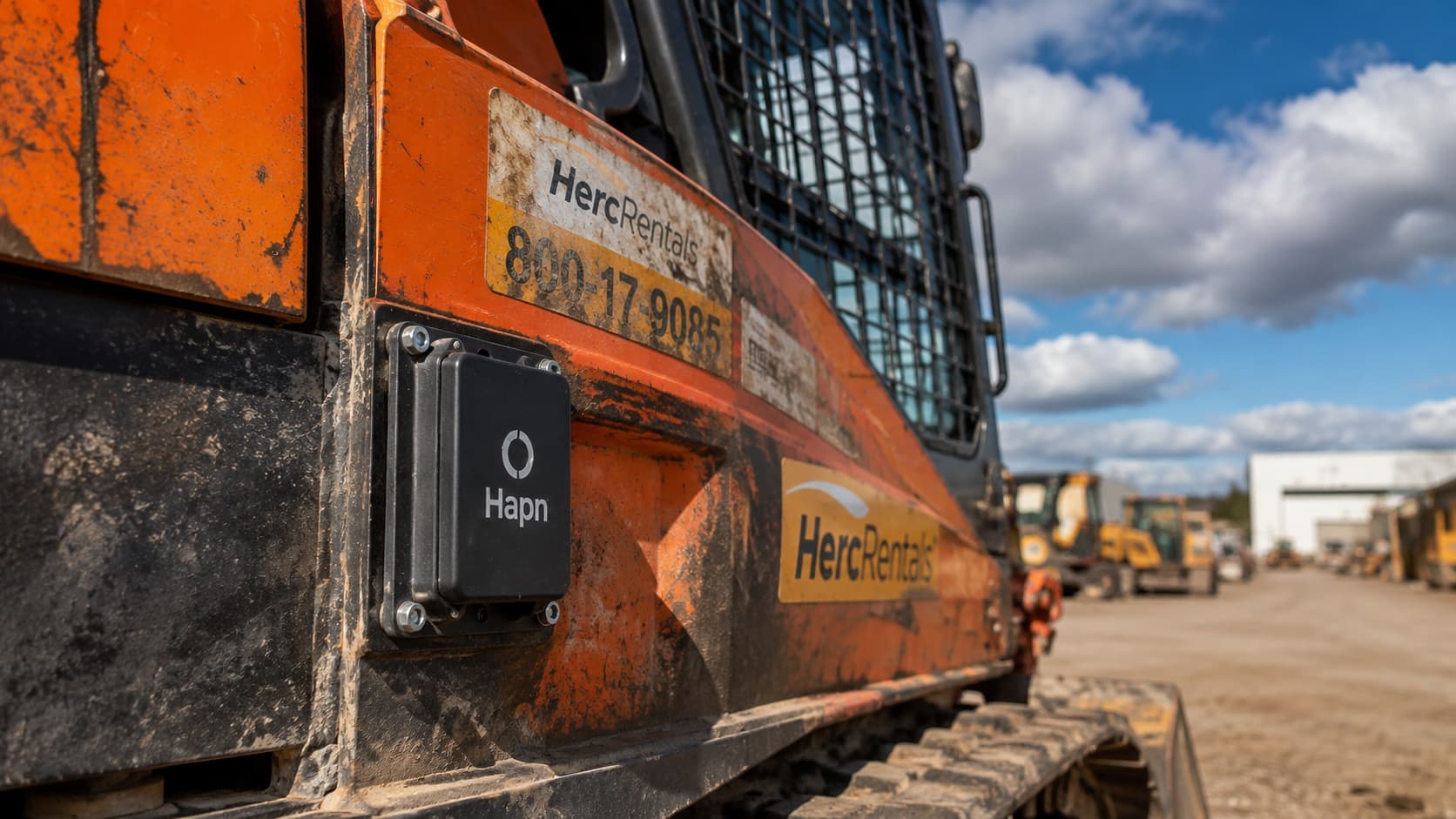
- Equipment coverage: CAN bus equipment telematics for heavy machinery, three sizes of battery tracker for trailers, attachments and light towers (the smallest is 2.5" × 1.5"), vehicle tracking and AI dash cameras. Machines with factory telematics can report through OEM feeds from 53 brands, including Cat, Deere, Komatsu, JLG and Terex. Scout, an AI assistant built into the Hapn app, answers questions about the fleet in plain language.
- Where it stands out: The most rental-system integrations we found, with the most documented workflow detail (meter readings at the four moments that matter, and service tasks triggered from hours). Per-asset billing, so opening a yard adds no fee (see per-asset vs per-site pricing). For a financed, distributed installed base, see the C3 Rentals customer story.
- Main limitation: No satellite devices, and no documented Wynne or InTempo integration. See the next section.
- Pricing: Published on the Hapn pricing page: asset and vehicle tracking from $10 per asset per month, equipment tracking with engine hours from $13, full equipment telematics from $18, AI dash cams $35, OEM data integration from $4. Hardware is included at no cost on a 3-year agreement; a 1-year agreement is available with hardware purchased at cost.
Where Hapn may not be the best fit
- Units that work beyond cellular coverage. Hapn has no satellite devices. Remote oilfield, pipeline and mining rentals should look at Geoforce.
- Rental companies on Wynne or InTempo. Hapn does not list either system. Trackunit documents both; Samsara is listed on Wynne's integration page. Hapn shops on those systems should ask about the API route before assuming a fit.
- Fleets that need 100+ OEM feeds. Hapn covers 53 brands; Trackunit's IrisX documents more than 100. If most of your fleet reports through factory telematics from less common manufacturers, check the brand list first.
- Operations where the delivery trucks are the main risk. Hapn tracks vehicles and sells AI dash cams, but Samsara and Motive are built around driver safety programs at a depth Hapn does not claim.
Get tracking data into your rental software
Tell us your unit count and which rental system you run. Per-asset pricing, no per-yard fees.
2. Trackunit
Best fit: Large rental fleets on Wynne, InTempo or MCS, and fleets that lean on factory telematics from many manufacturers.
5 RMS integrationsPowered + unpoweredCAN bus + 100+ OEM feedsNo vehicle product foundQuote pricing
- RMS integrations: Point of Rental (a 2019 partnership covering Expert and Elite), Wynne, InTempo, Texada and MCS.
- What the integrations enable: The partner pages confirm the connections but do not publish field-level detail (which readings move, at which step). Ask Trackunit for the Point of Rental and Wynne data maps before you sign.
- Equipment coverage: Powered machines, non-powered assets through the Kin tag, access control, and an IrisX platform that ingests 100+ OEM data feeds. We found no on-road vehicle product or dash camera.
- Where it stands out: Rental is one of its three core segments, alongside OEMs and contractors, and its OEM feed coverage is the broadest here. It is the obvious first call on Wynne or InTempo.
- Main limitation: No documented vehicle or dash cam product for the delivery fleet, and no published prices; its pricing page describes plan tiers and 36- or 42-month contracts but routes to a quote.
- Pricing: Not publicly listed. Source: trackunit.com
3. Samsara
Best fit: Rental companies with a large delivery truck fleet, where driver safety and equipment tracking need one vendor.
4 RMS integrations (1 via bridge)Vehicle platform firstCAN bus on equipment7 OEM integrationsSatellite for vehiclesQuote pricing
- RMS integrations: Its marketplace lists Point of Rental (syncing AEMP data, enabled through third party XDS) and Alert Rental (routes sent to drivers); Wynne and Texada list Samsara on their own integration pages.
- What the integrations enable: The Point of Rental connection is a data bridge built and supported by XDS rather than Samsara, syncing AEMP-format data. The Alert Rental listing is about sending routes to drivers, not meter readings into contracts. Wynne and Texada publish a partner listing without field detail.
- Equipment coverage: Of the three vehicle-first platforms here, Samsara is the only one with real equipment telematics hardware: its AG52/AG53 asset gateway data sheet lists J1939 and Caterpillar CAN cables to pull engine hours, fuel and fault codes from powered equipment, plus a battery gateway for unpowered assets. OEM integrations cover Caterpillar VisionLink, John Deere JDLink, Komatsu Komtrax, CNH SiteWatch, Volvo CE, Liebherr and Vermeer. A satellite connectivity add-on is available for its Vehicle Gateway (vehicles, not equipment).
- Where it stands out: Vehicle telematics, AI dash cams and driver safety at scale, with equipment coverage that is deeper than Motive's or Verizon Connect's.
- Main limitation: Built and priced for large fleets, and the rental-software links run through partners rather than Samsara itself.
- Pricing: Not publicly listed.
4. Motive
Best fit: Rental companies whose biggest risk is on the road and whose equipment reports through factory telematics.
1 RMS integration (via bridge)Vehicle platform firstNo CAN on equipmentAEMP 2.0 OEM feedsQuote pricing
- RMS integrations: A Point of Rental data bridge built by XDS in Motive's marketplace. We found no other rental system.
- What the integrations enable: The XDS bridge moves Motive data into Point of Rental; the listing does not document which rental-cycle steps it touches. Ask XDS, not Motive, for the field map.
- Equipment coverage: An asset gateway that wires to power and ignition; Motive's help center says it "does not provide CAN bus error codes or vehicle diagnostics." Engine data from heavy machinery comes through AEMP 2.0 / ISO 15143-3 feeds from Deere, Caterpillar, Komatsu and Volvo, on the Enterprise subscription. Battery trackers for unpowered assets, vehicle tracking and AI dash cams.
- Where it stands out: Driver safety, coaching and dash cam programs for a trucking-style fleet.
- Main limitation: No machine-side CAN data, so engine hours and fault codes on off-road equipment depend on the OEM feed, and OEM feeds require the Enterprise plan.
- Pricing: Not publicly listed.
5. Geoforce
Best fit: Rental fleets whose units work beyond cellular coverage: oilfield, pipeline, mining, remote infrastructure.
1 RMS integrationSatellite + cellular devicesEngine hours, no CAN foundAEMP feedsVehicles + AI dash camQuote pricing
- RMS integrations: MCS names Geoforce as a telematics partner. Geoforce's rental manager says it supports integrations with external rental systems without naming them.
- What the integrations enable: Not documented at field level on the pages we checked.
- Equipment coverage: Satellite, cellular or combined devices for powered and unpowered assets, engine-hour reporting, AEMP ingestion, vehicle tracking and an AI dash cam (a resold Geotab camera).
- Where it stands out: The only platform in this guide with satellite devices for equipment, which is decisive if your units leave cell coverage.
- Main limitation: Thin documented rental-software integration, and no machine-side CAN bus read that we could find.
- Pricing: Not publicly listed. Source: geoforce.com
6. DPL Telematics
Best fit: Rental shops that mainly want rugged devices on off-road and unpowered assets and will work in DPL's own dashboard.
1 RMS integrationHardware-ledCAN bus unitsNo OEM feeds foundOBD-II + AI dash camQuote pricing
- RMS integrations: Texada lists DPL as a partner for rental and service management. Note that Hapn and Trackunit also integrate with Texada.
- What the integrations enable: Not documented at field level on the Texada partner page.
- Equipment coverage: AssetView battery trackers, CAN bus units that log diagnostic codes and hour meter readings, an OBD-II vehicle tracker and an AI dash cam. We did not find OEM / AEMP data ingestion.
- Where it stands out: More than 20 years in the business and a line it sells on "rugged, reliable products", with a device for most asset classes.
- Main limitation: One documented rental system and no OEM feeds, so machines with factory telematics need a second device.
- Pricing: Based on fleet size and quoted. Source: dpltelematics.com
7. Verizon Connect
Best fit: Rental companies that already run their trucks on Verizon Connect and want one vendor.
1 RMS integrationVehicle platform firstNo CAN on equipmentAEMP 2.0 OEM feedsQuote pricing
- RMS integrations: 2Quip in its marketplace. We did not find Point of Rental, Quipli, Wynne or Texada.
- What the integrations enable: Not documented at field level on the marketplace listing.
- Equipment coverage: An Equipment Asset Tracker that wires to power and ignition (no CAN or J1939 documentation found), a battery version for unpowered assets, and AEMP 2.0 feeds from John Deere, Caterpillar and Komatsu on its Fleet product. Vehicle GPS, AI dash cams and driver management.
- Where it stands out: One vendor and one contract for a fleet that is already standardized on Verizon Connect for its trucks.
- Main limitation: The weakest rental-software coverage of the vehicle platforms here, and no machine-side CAN data on equipment.
- Pricing: Not publicly listed.
8. Tenna
Best fit: Contractors that own most of their fleet and rent some of it out, and already run construction ERP software.
0 RMS integrationsConstruction ERP integrationsCAN bus + OEM feedsVehicles + AI dash camsQuote pricing
- RMS integrations: None found. Its listed integrations are construction software: Viewpoint Vista, Procore and B2W.
- What the integrations enable: Construction ERP workflows (job costing, project management), not rental contracts.
- Equipment coverage: Vehicles, AI dash cams, battery and CAN bus trackers, BLE and QR tags, and OEM data from Cat, Deere, Komatsu, Volvo and JCB. Tenna says it is trusted by 750+ construction businesses.
- Where it stands out: Broad asset coverage for a contractor, down to small tools with BLE and QR tags.
- Main limitation: No rental management system integration, so a rental business would retype hours and locations. For a closer look, see Hapn vs Tenna for rental fleets.
- Pricing: By request, based on asset count. Source: tenna.com
What it costs: an illustrative multi-yard fleet
Only Hapn publishes prices, so this example uses Hapn's list rates; the other platforms quote individually. For shape, not signature: a dealer with 4 yards tracks 150 powered machines on the $13 equipment tier and 250 trailers, light towers and attachments on the $10 asset tier. That is 150 × $13 + 250 × $10 = $4,450 per month in software, with hardware included on a 3-year agreement. Opening a fifth yard with no new units changes nothing; adding 20 machines adds $260. Volume discounts apply on top. Check your own mix on the pricing page.
Shortlist by rental system
- Point of Rental: Hapn (Elite, with service tasks from hours) and Trackunit (Expert and Elite). Samsara and Motive reach it through the XDS bridge.
- Quipli: Hapn, the telematics partner Quipli names.
- Texada: Hapn, Trackunit, Samsara and DPL Telematics.
- Wynne or InTempo: Trackunit; Samsara is listed on Wynne's page.
- Alert Rental: Hapn (meter readings update rental tickets) and Samsara (routes to drivers).
- Renterra, DynaRent or EZRentOut: Hapn.
- MCS: Trackunit and Geoforce.
- Then the tie-breakers: satellite (Geoforce), a large delivery truck fleet (Samsara, Motive, Verizon Connect), 100+ OEM feeds (Trackunit), rugged hardware without OEM feeds (DPL), or a contractor fleet on construction ERP (Tenna).
Whichever you pick, the day-to-day process matters as much as the hardware. Our guide on how to keep track of rental equipment walks through check-out, on-rent exceptions and off-rent verification step by step.
About the author
TJ Chasteen is the product manager for Hapn's enterprise platform, including its rental management software integrations with Point of Rental, Quipli, Texada, Alert Rental and others. He works directly with rental operators and dealers on how tracking data should flow into contracts, service and billing. Hapn builds GPS tracking and telematics for equipment rental businesses, multi-yard dealers and equipment financing companies, publishes per-asset pricing, and competes with several of the platforms in this guide.
Frequently asked questions
What is the best GPS tracker for rental equipment?
The best choice is the one that integrates with your rental management system, because that is where contracts, meter readings and billing already live. Hapn integrates with 7 rental systems (Point of Rental, Quipli, Texada, Alert Rental, DynaRent, EZRentOut and Renterra), prices per asset rather than per yard, and pulls hour meter readings into the rental workflow. Large fleets on Wynne or InTempo should shortlist Trackunit, and fleets that work beyond cellular coverage should consider Geoforce.
Which GPS trackers integrate with Point of Rental?
We confirmed Point of Rental integrations for Hapn (built for Point of Rental Elite, with maintenance tasks triggered from hours), Trackunit (Expert and Elite), and Samsara and Motive through a third-party bridge from XDS. Ask each vendor which data syncs, such as hour meter readings, location and service triggers, before you sign.
Which GPS trackers integrate with Quipli?
Hapn is the telematics partner Quipli names. The integration embeds a live tracking map in Quipli, adds order-level tracking for equipment on rent, and pulls hour meter readings automatically at on-rent, return, inspections and internal work orders.
Which GPS trackers integrate with Texada?
Texada lists Trackunit and DPL Telematics as partners, Hapn lists Texada on its integrations page, and Samsara appears on Texada's integration page. Ask each vendor which fields sync into Texada's rental and service workflows.
What is the difference between equipment telematics and vehicle telematics?
Vehicle telematics is built for trucks and vans: GPS, driver behavior, hours of service and dash cams, usually through the OBD port. Equipment telematics is built for off-road machines: engine hours, fault codes and utilization read from the machine's CAN bus or from the manufacturer's AEMP feed, plus battery trackers for units with no engine. Rental billing and service depend on equipment data, so a vehicle platform's equipment tracker should be checked for whether it reads the machine or only power and ignition.
How much does GPS tracking cost for a rental fleet?
Hapn publishes per-asset pricing: $10 per month for asset and vehicle tracking, $13 for equipment tracking with engine hours, $18 for full equipment telematics, $35 for AI dash cams and from $4 for OEM data integration. Hardware is included at no cost on a 3-year agreement, or you can choose a 1-year agreement and buy the hardware at cost. The other platforms in this guide quote pricing individually.
Does rental tracking pricing go up when I add a yard?
With per-asset pricing, no. Hapn bills for each tracked unit, so opening another yard only changes the bill if you add units. Systems licensed per site or per location add a fee for every new yard, which gets expensive for dealers growing by branches.
See Hapn inside your rental software
Per-asset pricing, hardware included on 3-year terms, and hours and location on every contract.
Last Updated: September 18, 2026
Explore Hapn on a live equipment fleet
Click around the real platform — a live mixed fleet with dummy data. No sales call, takes a few minutes.
Get the latest news straight to your inbox.
Share Article
