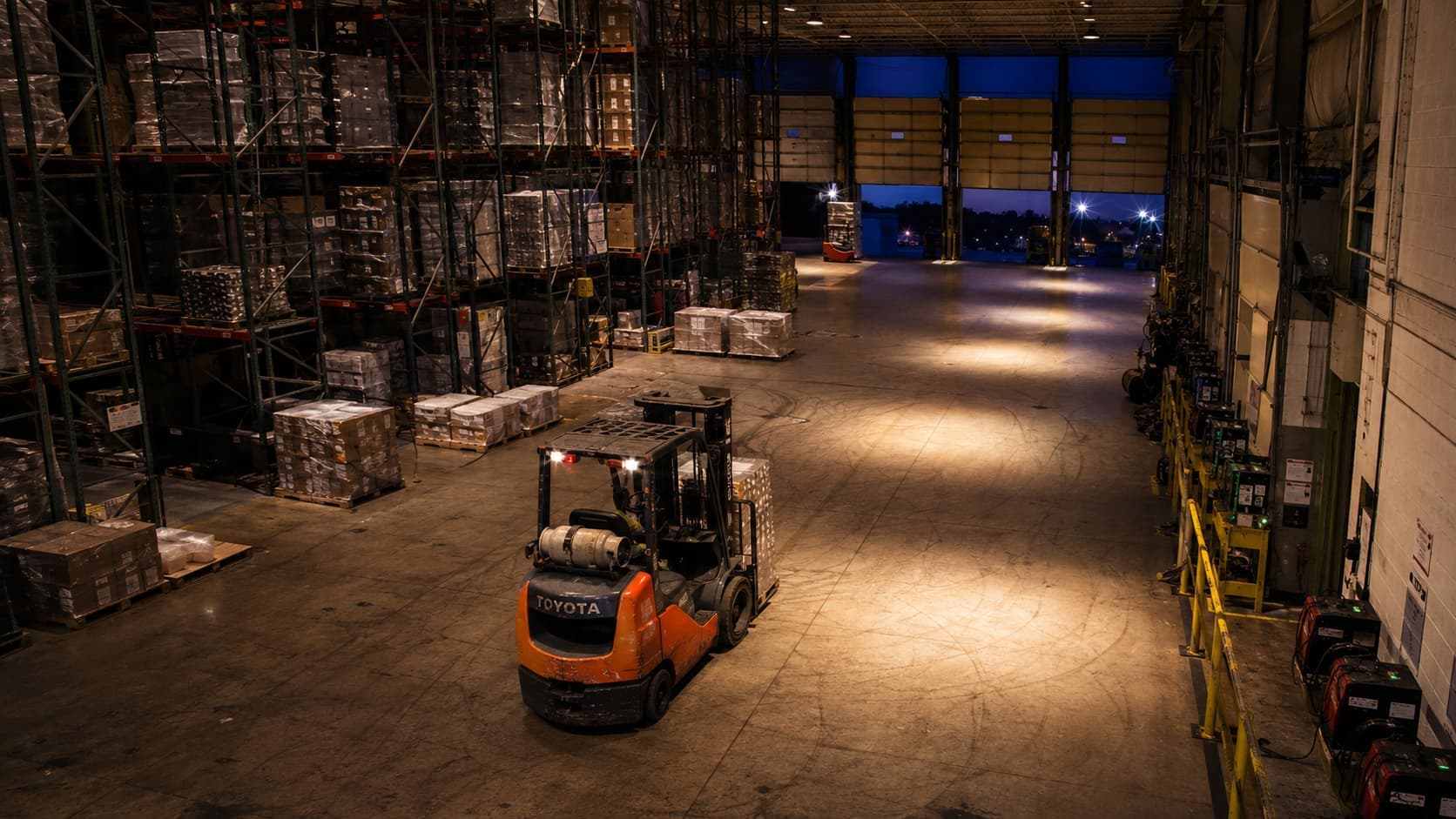
Indoor forklift tracking is the blind spot in most tracking programs: GPS works beautifully right up to the dock door, then goes dark exactly where your forklifts spend their lives. The fix isn't a six-figure RTLS build-out — it's BLE zone tracking. Hapn Sites uses low-cost tags and connected gateways to keep every truck visible aisle by aisle, bay by bay, across facilities of 500,000 square feet or more, with no WiFi infrastructure required. Here's how it works, what it solves, and what it costs.
Key Takeaways
- GPS goes dark indoors — for a facility running 20–30 forklifts across 500,000+ sq ft, that means your most-used equipment is your least visible.
- BLE zone tracking restores visibility with battery-powered beacons — no WiFi build-out, no fixed reader infrastructure across every aisle.
- Forklift tracking starts at $13/month per asset (GPS + utilization) or $18/month with engine-hour telematics — hardware included at no upfront cost on a 3-year agreement.
- Utilization data typically reveals which trucks actually work: a 25-forklift fleet running at 70% utilization is carrying roughly 5 trucks of excess capital (illustrative — run your own hours).
- One platform covers indoors and out — the same forklift stays visible in the racking, in the covered yard, and on a flatbed headed to another site.
Why GPS alone can't see inside your facility
GPS needs line of sight to satellites. Steel roofs, high racking, and concrete kill it. That's not a defect in any particular tracker — it's physics — and it's why so many operations that already track their trucks and trailers still answer "where's the reach truck?" by sending someone walking.
At small scale that's an annoyance. At warehouse scale it's a real cost. The operators we hear from are running 20–30 forklifts across facilities in the 500,000–700,000 square foot class — multiple buildings, multiple shifts, equipment that migrates constantly between zones. Every misplaced truck is search time, and search time multiplied across shifts and months is a line item nobody sees because it never gets measured.
The traditional answer is a real-time location system. The honest problem with that answer is what it takes to install one.
Definition: RTLS (Real-Time Location System)
An indoor positioning system that reports asset coordinates in real time, typically using ultra-wideband or WiFi triangulation. RTLS delivers meter-level precision — but requires fixed reader infrastructure wired across the entire facility, which is why deployments are typically scoped in months and priced like construction projects.
Zone-level visibility: the answer that actually gets deployed
Most forklift questions don't need coordinates. "Which building is it in?" "Did it leave the cold-storage side?" "How long has it been parked at the charging bay?" Those are zone questions, and they're answerable with far less infrastructure than an RTLS install.
Definition: BLE Zone Tracking
Bluetooth Low Energy beacons placed in the areas you care about — aisles, bays, buildings, staging zones — detect tagged equipment as it moves through. Instead of coordinates, you get zone-level presence: which truck is in which zone, when it arrived, and how long it stayed. Beacons are battery-powered, so there's no wiring and no WiFi dependency.
Hapn Sites is built on exactly this model. You define the zones that matter, place beacons, tag the forklifts, and the same Hapn platform that tracks your outdoor assets starts showing indoor position — with alerts when a truck enters or exits a zone it shouldn't. If you've read our broader guide on tracking equipment inside buildings without WiFi, this is that approach applied to the hardest-working asset class in the building.
What forklift tracking actually fixes
Search time and misplacement
Zone presence means "where's unit 14?" is a lookup, not a walk. For multi-building campuses, that alone justifies the program — especially on night shifts, when the person who last parked the truck went home hours ago.
Utilization and right-sizing
Engine-hour data tells you which trucks work and which ones sit. As a worked example (for shape, not signature): a 25-forklift fleet where hour meters show 70% effective utilization is carrying about 5 trucks of excess capital — either lease returns waiting to happen or capacity you can redeploy to another building instead of buying new. Our utilization benchmarks guide covers how to read those numbers honestly.
Maintenance on real hours
Forklift PM schedules run on hours, not calendars. Automated hour capture means service happens when the truck needs it — not when the spreadsheet guesses it does — and the maintenance history follows the asset, not the building it happened to be parked in.
Accountability and safety adjacency
Powered industrial trucks remain one of the most scrutinized equipment classes in any facility — OSHA maintains an entire standard for them, and forklift incidents cause tens of thousands of serious injuries a year in US workplaces. Tracking isn't a safety system, but zone history — who had which truck, where, on which shift — makes incident review and operator accountability dramatically less ambiguous.
Running forklifts across a facility GPS can't see into?
Tell us your building count, fleet size, and zones — we'll scope indoor visibility and send a per-asset quote, usually within 24 hours.
Get Hapn pricing →One platform, indoors and out
The reason to solve this with a GPS + BLE platform rather than a standalone indoor system: forklifts don't respect the dock door. They work the yard, load trailers, move between buildings, and — for dealers and rental operations — ship to customer sites entirely. A standalone RTLS loses the asset the moment it leaves the readers. With Hapn, the same tag and the same record follow the truck from the racking to the covered yard to the flatbed, with GPS taking over where the sky is visible.
That matters double for equipment rental operations and forklift dealers running rental fleets: your trucks live at customer facilities you don't control and can't wire. Zone beacons at your own yards plus GPS everywhere else means the fleet stays visible without negotiating infrastructure into every customer's building. And because Hapn bills per asset, not per site, visibility scales with your fleet — not with how many buildings or yards it's spread across. It's the same model that lets lenders and lessors like C3 Rentals keep a distributed installed base visible without per-location fees.
What indoor forklift tracking costs
Hapn pricing is per asset, per month: forklift tracking with GPS and utilization starts at $13/month per truck, and full equipment telematics — engine hours, diagnostics — at $18/month. Non-powered assets around them (attachments, chargers, trailers) track from $10/month. Two commercial models: a 3-year agreement with all hardware and install kits included at no upfront cost, or a 1-year agreement with hardware purchased at cost. Volume discounts apply as the fleet grows; zone scoping is part of the quote conversation.
About the author: Written by the Hapn team. Hapn provides GPS and BLE asset tracking for equipment rental businesses, multi-yard dealers, and equipment financing companies — hundreds of thousands of assets tracked across North America.
Frequently Asked Questions
How do you track forklifts indoors where GPS doesn't work?
Use BLE zone tracking: battery-powered Bluetooth beacons placed in the zones you care about detect tagged forklifts as they move through the facility. You get zone-level presence — which truck is in which building, aisle, or bay — without GPS line of sight and without wiring readers across the facility. Hapn Sites pairs this with GPS on the same platform, so trucks stay visible outdoors too.
Do I need WiFi throughout the warehouse to track forklifts?
No. BLE beacons are battery-powered and don't depend on facility WiFi, so there's no network build-out, no IT project, and no dead-zone survey. That's the main practical difference from WiFi-based RTLS, which requires infrastructure coverage everywhere you want visibility.
What does forklift tracking cost per truck?
With Hapn, forklift tracking starts at $13 per truck per month for GPS plus utilization, or $18 per month with engine-hour telematics and diagnostics. On a 3-year agreement, all tracking hardware is included at no upfront cost; a 1-year agreement is also available with hardware purchased at cost. Pricing is per asset, so it doesn't multiply by building or site count.
Can I track forklift utilization and engine hours automatically?
Yes. Hour-meter and utilization data are captured automatically and reported per truck, so you can see which forklifts actually work, schedule preventive maintenance on real hours instead of calendar guesses, and right-size the fleet using measured demand rather than shift-supervisor intuition.
What's the difference between RTLS and BLE zone tracking?
RTLS gives continuous meter-level coordinates but requires fixed, wired reader infrastructure across the whole facility — a major installation project. BLE zone tracking gives zone-level presence (which area, when, how long) using battery-powered beacons you can deploy in days. For most forklift operations, zone-level answers the real questions at a fraction of the infrastructure.
Can forklift dealers or rental companies track units at customer sites?
Yes — that's where a combined GPS + BLE platform beats a facility-bound system. GPS covers trucks working outdoors or in transit, BLE zones cover your own yards and service bays, and the per-asset pricing model means adding a customer site or a new yard doesn't add a license fee. The unit's full history follows it wherever it goes.
See every forklift — racking to yard to customer site.
Per-asset pricing from $13/month, hardware included on 3-year agreements. Tell us about your fleet and get a quote in about 24 hours.
Get Hapn pricing →Last Updated: July 17, 2026
Explore Hapn on a live equipment fleet
Click around the real platform — a live mixed fleet with dummy data. No sales call, takes a few minutes.

Get the latest news straight to your inbox.
Share Article
