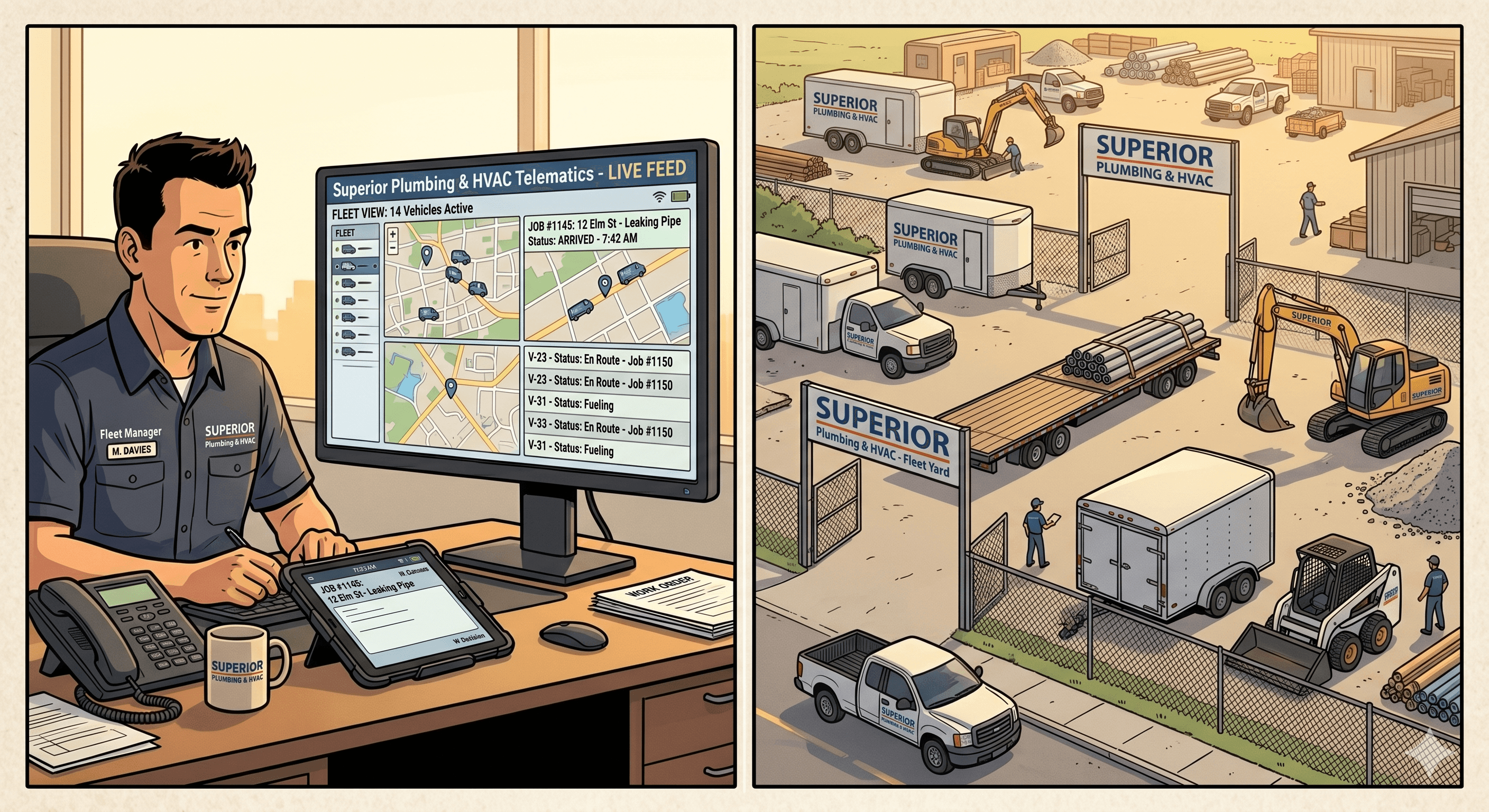
If you're comparing Hapn vs DPL Telematics, you're likely running a mixed fleet — vehicles, heavy equipment, trailers, or unpowered assets — and deciding whether a hardware-first asset tracker is enough, or whether you need a full telematics platform. Short answer: DPL Telematics is a solid choice if you only need battery-powered or hardwired GPS on stationary and off-road assets. Hapn is the better fit if you need vehicles, equipment, AI dash cameras, indoor/yard zone tracking, and OEM data on a single platform — with open API access and transparent pricing.
Key Takeaways
- DPL Telematics is hardware-first (AssetView battery trackers, AssetCommand hardwired, FleetView OBD-II). Hapn covers all 4 hardware categories plus AI dash cameras and BLE zone tracking on one platform.
- Hapn manages 463,000+ assets across 50,000+ customers and 50+ industries, with $720M+ in stolen assets recovered and 99.9% uptime.
- DPL offers pay-as-you-go subscriptions. Hapn offers a 3-year agreement with all hardware included at no upfront cost, or a 1-year agreement with hardware at cost, and publishes transparent pricing at /pricing/; DPL requires a sales call for quotes.
- Hapn Sites delivers indoor/outdoor BLE tracking with low-cost tags and connected gateways — no WiFi required. DPL does not offer zone-based indoor tracking.
- Hapn ships a production-grade open API and integrations with Point of Rental, Wynne, and Salesforce. DPL's integration story is more limited and primarily portal-based.
Who Each Platform Is Built For
DPL Telematics has 20+ years of experience in GPS asset tracking and positions itself around rugged, long-battery-life hardware for construction, agriculture, rental, mining, rail, and oilfield. Their core lineup — AssetView (battery-powered, IP68-rated, up to 3.5 years of battery life with TruTrace Adaptive Tracking), AssetCommand Base and Max (hardwired with runtime, geofences, curfews, rollover, and remote disable), and FleetView OBD-II for light vehicles — is well-regarded in those categories.
Hapn is a full-stack telematics platform for mixed fleets. We build our own hardware across four categories — hardwired equipment trackers, vehicle telematics, battery-powered asset trackers, and AI dash cameras — plus Hapn Sites for indoor/outdoor BLE tracking, and ingestion of OEM data from major manufacturers. Everything runs through one portal and one open API.
What is a mixed fleet?
A mixed fleet is any operation that runs more than one asset class — for example on-road vehicles plus heavy equipment, or powered equipment plus unpowered trailers, dumpsters, or attachments. Mixed fleets are the norm in construction, equipment rental, and field services, and they're the hardest fleets to track on a hardware-first platform.
Hapn vs DPL Telematics: Side-by-Side
| Capability | Hapn | DPL Telematics |
|---|---|---|
| Hardwired equipment telematics (engine hours, fault codes, CAN bus) | Yes — ignition wire or CAN bus, full diagnostics | Yes — AssetCommand Base/Max (runtime, rollover, remote disable) |
| Battery-powered asset tracking | Yes — IP67-rated, long life, OTA configuration | Yes — AssetView, IP68, up to 3.5 years battery |
| Vehicle telematics (speed, idle, driver behavior) | Yes — OBD and hardwired | Basic — FleetView OBD-II |
| AI dash cameras (driver- and road-facing) | Yes — native on the platform | Not offered |
| Indoor/outdoor BLE zone tracking | Yes — Hapn Sites, low-cost tags, connected gateways | Not offered |
| OEM equipment data (mixed-brand telematics) | Yes — major manufacturers ingested into one portal | Not emphasized in public materials |
| Open API | Yes — production-grade, our own products are built on it | Limited |
| Rental / ERP integrations (Point of Rental, Wynne, Salesforce) | Yes | Limited |
| Contract model | 3-year (hardware included) or 1-year; additions prorated to one end date; transparent published pricing | Pay-as-you-go, deactivate/reactivate without penalty; quoted |
| Scale | 463,000+ assets, 50,000+ customers, 99.9% uptime, $720M+ recovered | $1B+ in customer mobile assets tracked over 20+ years |
Where DPL Telematics Wins
DPL does a few things very well, and we'll say so plainly:
Rugged, long-life battery hardware
AssetView's IP68 rating and 3.5-year battery life with TruTrace Adaptive Tracking is genuinely strong for unpowered, exposed assets like trailers, generators, and oilfield equipment parked for long stretches. If your entire use case is "stick a tracker on something and walk away for three years," DPL's hardware is competitive.
Stealth/anti-tamper design for theft
DPL has leaned into anti-tamper, stealthy form factors. That matters if theft is your dominant risk and you want hardware that's hard to find and disable. Hapn solves the same problem with real-time geofencing, after-hours alerts, and platform-side theft workflows — we've helped customers recover over $720M in stolen assets — but the philosophies are different: DPL leans hardware, Hapn leans software + hardware.
No-contract commercial model
DPL's pay-as-you-go model with no deactivation penalty is operator-friendly, especially for rental yards with seasonal inventory. Hapn works differently: a 3-year agreement with all hardware included at no upfront cost, or a 1-year agreement with hardware purchased at cost, and assets you add later are prorated onto one end date. If pausing units between seasons matters most, DPL has the edge here.
Where Hapn Wins
One platform for everything, not just assets
If you run a mixed fleet — pickups, service trucks, skid steers, excavators, trailers, dumpsters, generators, tools — DPL forces you to think in product SKUs (AssetView for this, AssetCommand for that, FleetView for vehicles). Hapn gives you one platform, one portal, one API, one invoice. The advantage compounds as your fleet gets more heterogeneous. If you want a deeper breakdown of what that looks like operationally, see our heavy equipment GPS tracking guide for mixed fleets.
AI dash cameras and driver safety
DPL does not offer AI dash cameras. If you have any on-road risk — service vans, delivery trucks, construction pickups — you'll need a second vendor to cover driver-facing and road-facing video with AI event detection. Hapn ships this natively. One platform, one login, video events correlated with vehicle telematics.
Hapn Sites for yards, warehouses, and jobsites
This is the biggest capability gap. Anything that moves between a yard, a warehouse, and a jobsite — small tools, attachments, hand-held equipment, skid-mounted assets — is invisible on traditional GPS unless you pay for a tracker per item. Hapn Sites uses low-cost tags and connected gateways that don't need WiFi, with flexible capacity packages that support focused deployments and complete Site-wide coverage. Enterprise RTLS systems run $50–100+ per tag and require WiFi infrastructure. DPL doesn't offer indoor or zone-based tracking at all. See the rise of RTLS in asset management for why this matters for rental and construction ops.
Software depth: integrations, API, analytics
Hapn integrates with Point of Rental, Wynne, Salesforce, and custom ERPs via a production-grade open API. Our own products are built on it — so if you want to pipe equipment data into your rental system, dispatch tool, or BI stack, the plumbing exists. DPL's public materials emphasize hardware and a portal; deeper system integration will typically mean custom work on your side.
Transparent pricing
Hapn publishes pricing at gethapn.com/pricing/. DPL requires a sales call to quote. Hapn's 3-year agreement includes all hardware at no upfront cost, and a 1-year option is available with hardware at cost. Only one of the two lets you size your deployment without a demo.
See what mixed-fleet tracking actually costs.
No sales call required to see pricing. Transparent plans for vehicles, equipment, assets, cameras, and zones.
See Hapn Pricing →Which One Should You Choose?
What is a full-stack telematics platform?
A full-stack telematics platform covers hardware, firmware, connectivity, portal software, alerts, and API access across multiple asset classes (vehicles, equipment, trailers, cameras, indoor assets) under one vendor and one data model. The alternative is stitching together point solutions from multiple vendors.
Pick DPL Telematics if…
You're tracking a homogenous pool of unpowered or off-road assets, theft prevention is your dominant driver, you don't need dash cameras, you don't need indoor zone tracking, and you're comfortable running a vendor portal separate from your other systems.
Pick Hapn if…
You run a mixed fleet and want vehicles, equipment, trailers, dash cams, and indoor assets on one platform. You want an open API, transparent pricing, hardware included on a 3-year agreement, and rental/ERP integrations out of the box. You're in equipment rental, construction, or any business where a single data layer across asset types is worth more than best-in-niche hardware for one category.
How to Evaluate Both Vendors
If you're actively in market, run both through a structured evaluation rather than a demo-to-demo comparison. A few things to ask each vendor:
- Coverage: What percentage of my asset types can you cover natively (not through a partner)?
- Data model: Do vehicles, equipment, and assets live in the same object model, or separate silos?
- API: Is the API the same one your own product runs on, or a stripped-down read-only export?
- Theft: How do alerting, after-hours geofences, and recovery workflows work — and what's your recovery track record?
- Integrations: Do you have production integrations with my rental management system (POR, Wynne), CRM (Salesforce), or ERP?
- Total cost: Hardware + subscription + install + any integration fees over 3 years. See our fleet tracking ROI calculator for a defensible model.
If the answers to those questions don't converge on a single-platform story, you're going to end up with more vendors, more logins, and more reconciliation work than you want.
Written by the Hapn Team
Hapn provides GPS fleet and asset tracking for 50,000+ customers across construction, equipment rental, and 50+ other industries. Our platform monitors 463,000+ assets and processes over 4 billion messages annually with 99.9% uptime.
FAQ: Hapn vs DPL Telematics
Is Hapn a direct competitor to DPL Telematics?
Partially. Both companies sell GPS tracking for construction, rental, and fleet customers, and both sell tracking on a monthly subscription. The key difference is scope: DPL is hardware-first and specialized in rugged asset tracking, while Hapn is a full-stack telematics platform covering vehicles, equipment, battery-powered assets, AI dash cameras, and indoor BLE zones on one system.
What's the best DPL Telematics alternative for mixed fleets?
If you run vehicles and equipment together — which is the norm in construction, equipment rental, and field services — Hapn is the better fit because it handles both asset classes (and dash cameras, and indoor tracking) on one platform. DPL requires you to run vehicle tracking on FleetView OBD-II and asset tracking on AssetView or AssetCommand as separate products.
Does DPL Telematics offer AI dash cameras or indoor tracking?
Based on DPL's publicly available product lineup, no. DPL focuses on cellular GPS tracking hardware — AssetView (battery), AssetCommand (hardwired), and FleetView (OBD-II). AI-powered dash cameras and BLE-based indoor zone tracking are not part of the DPL product suite. Hapn offers both natively.
How does Hapn pricing compare to DPL Telematics?
DPL uses a pay-as-you-go model with no deactivation penalty but requires a quote. Hapn publishes transparent pricing publicly at /pricing/. Its standard agreement is 3 years with all hardware included at no upfront cost, and a 1-year agreement is available with hardware purchased at cost. Assets you add later are prorated onto your existing agreement. For Hapn Sites specifically, low-cost tags and flexible capacity packages come in meaningfully cheaper than enterprise RTLS systems that start at $50–100 per tag.
Can I keep DPL hardware and use Hapn software?
No — Hapn's platform runs on Hapn hardware or ingested OEM data feeds. If you're moving off DPL, the typical path is to swap hardware on the assets where you need richer telematics (vehicles, equipment with engine hours or CAN bus data, assets you want on Hapn Sites) and retire DPL units as batteries deplete or contracts lapse. Talk to us about a phased migration.
Which platform is better for equipment rental companies?
Hapn, in most cases. Equipment rental fleets are inherently mixed — delivery trucks, service vans, powered equipment, attachments, trailers, generators — and they need integration with rental management systems like Point of Rental or Wynne. Hapn covers all of that on one platform with a production-grade API. DPL is a solid option if you only need asset-level GPS for unpowered rental inventory and already have your vehicle and rental-system tooling figured out.
Stop Guessing. Start Tracking.
See how Hapn gives you complete visibility across your mixed fleet — vehicles, equipment, and assets in one platform. Transparent, per-asset pricing.
Get Pricing →Explore Hapn on a live equipment fleet
Click around the real platform — a live mixed fleet with dummy data. No sales call, takes a few minutes.
Get the latest news straight to your inbox.
Share Article
