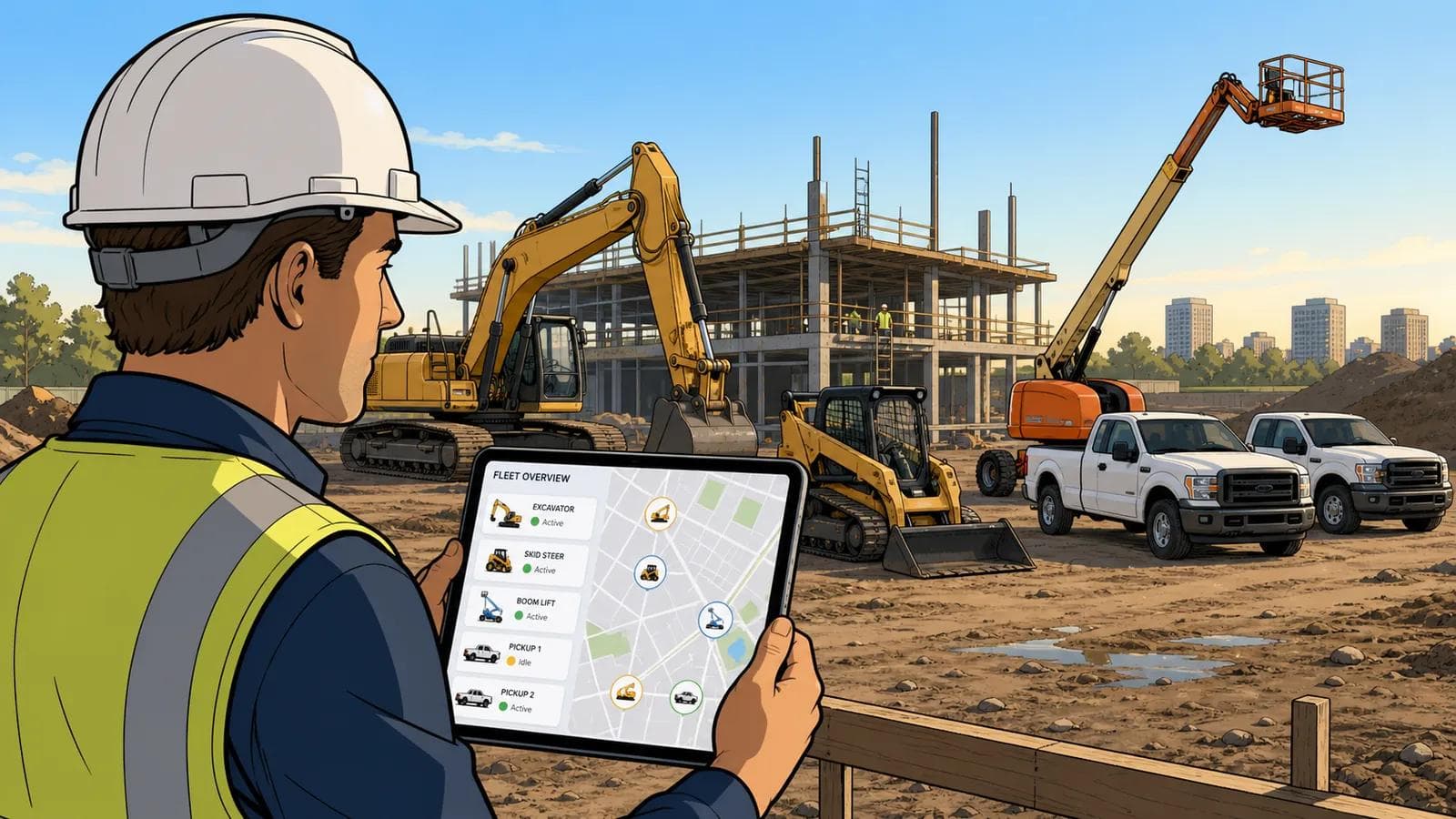
Motive (formerly KeepTruckin) built its brand on AI-powered driver safety. Hapn built its brand on getting out of the way and letting you track everything in your fleet without sales calls. If driver scorecards are your top priority, Motive is a strong choice. For most construction fleets — where equipment outnumbers drivers and rental yards, idle time, and theft drive the P&L — Hapn fits better. This Hapn vs Motive comparison is written for construction operators making that call in 2026.
Key Takeaways
- Origin matters: Motive started in trucking ELD and added asset tracking; Hapn started in asset tracking and added vehicles. That shows up in every product decision.
- Pricing transparency: Hapn publishes per-device pricing publicly; Motive remains sales-led and quote-gated for most plans.
- AI safety: Motive’s AI Omnicam plus its 400+ person safety review team is genuinely best-in-class for high-driver-count fleets.
- Asset depth: Hapn’s wired, OBD, and battery-powered asset trackers are purpose-built for mixed construction fleets where equipment is the largest line item.
- Contracts: Hapn offers month-to-month with no minimums; Motive’s standard term is multi-year.
Origin Story Matters
Every fleet platform carries its origin story in the product. You can read it in the menu structure, the support team, the sales motion, the integrations roadmap.
Motive started life as KeepTruckin in 2013 — a paper-logbook replacement for over-the-road trucking. It built its core around ELD compliance, hours-of-service, and IFTA reporting. The brand pivot to “Motive” in 2022 reflected the company’s move from a trucking-only ELD vendor into a broader fleet operations platform with AI dashcams, asset tracking via Asset Gateway, and spend management. The DNA is still trucking. The org chart still leans heavily toward DOT compliance, driver scorecards, and OTR safety. When Motive added asset trackers, it added them as an attachment to a trucking platform — not as the centerpiece.
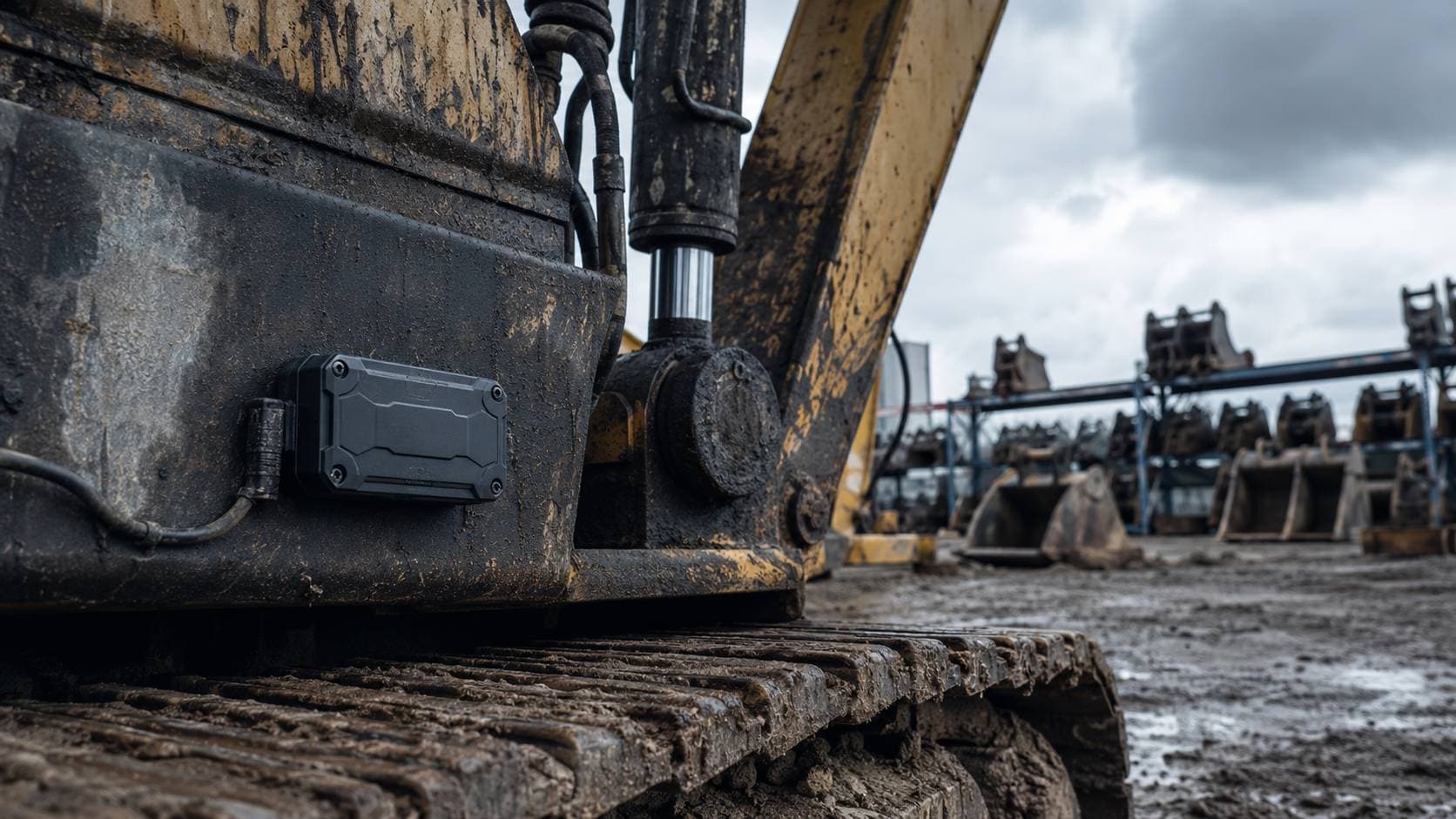
Hapn started as an asset tracking platform. The first product was a battery-powered tracker built for equipment that doesn’t have a constant power source — trailers, generators, light towers, attachments, tool bins. The second product line added wired and OBD vehicle trackers. The third added cameras. Today Hapn is a unified telematics platform, but the underlying assumption has never changed: in a real fleet, the most expensive things are usually the things that aren’t moving — a $90,000 mini excavator parked at a job site overnight, a $14,000 generator idling at a remote pour, a $40,000 boom lift sitting in a rental yard between jobs.
That difference shows up in product decisions. Motive’s UI defaults to drivers first, then vehicles, then assets. Hapn’s UI treats every tracked thing — vehicle, trailer, piece of equipment, person — as a first-class object. For a long-haul trucking operation, Motive’s hierarchy makes sense. For a construction fleet running 18 vehicles and 60 pieces of equipment, Hapn’s flat asset model maps to how you actually think about the business.
Neither approach is wrong. They’re built for different problems. The question is which problem matches yours.
Feature-by-Feature Comparison
Both platforms cover the same broad surface area: vehicle GPS, asset GPS, driver behavior, dashcams, geofences, maintenance, and reporting. The differences show up in the depth of each feature and how the platforms package and price them.
| Capability | Motive | Hapn |
| — | — | — |
| Origin focus | Trucking / ELD | Asset & equipment tracking |
| ELD & HOS compliance | Deep, FMCSA-registered, mature | Available; built for non-OTR mixed fleets |
| AI dashcam | AI Omnicam — flagship product, multi-camera, 360° visibility | Dual-facing AI dashcam — utilitarian, event-triggered |
| Asset gateway battery life | Up to 5+ years (Asset Gateway Mini, ~2 check-ins/day) | Up to ~10 years (GL502, 1 update/day); 30 days–18 months (GL501/GL521, configurable) |
| Equipment telematics depth | Engine hours, location, basic utilization | Engine hours, fuel level, DTCs, J1939/CAN, idle vs. work time |
| CAN bus / J1939 support | Yes (vehicle-focused) | Yes (vehicle and off-road equipment, including Cat, Komatsu, Volvo CE) |
| Rental billing & utilization | Not native | Native engine-hour billing exports, rental utilization reports |
| API access | Available, plan-gated | Open REST API on every plan |
| Pricing transparency | Sales-led, custom quotes | Published per-device pricing on the website |
| Contract terms | Standard 36-month; monthly options exist | Month-to-month, no contract minimums |
| Best fit | Long-haul, high-driver-count, safety-driven fleets | Construction, rental, industrial, mixed equipment fleets |
Two things to call out from the table.
First, on asset gateway battery life: this is closer than people assume. Motive’s Asset Gateway Mini is rated up to 5+ years at 2 check-ins per day. Hapn’s lineup splits the use case: the GL502 long-life tracker is rated up to ~10 years at 1 update per day for set-and-forget remote-asset deployments, while the GL501/GL521 trades raw life for flexibility (30 days to 18 months depending on reporting mode and movement). Both vendors will quote you a multi-year rated life. The real differentiator isn’t the headline number — it’s how the device handles cold-weather degradation, ping-rate flexibility for stolen-asset recovery mode, and replacement economics when batteries finally die. Ask each for their replacement program before you commit.
Second, on equipment telematics depth: this is where the origin-story difference becomes operational. Motive can pull engine hours and basic utilization off most assets. Hapn pulls those plus fuel level, DTC fault codes, idle-vs-work time, and OEM-specific data via J1939/CAN integration on yellow iron from Cat, Komatsu, Volvo CE, John Deere, and Bobcat. If you’re running a mixed fleet that’s mostly trucks and pickups, that depth doesn’t matter. If you’re running a fleet where the excavators and loaders cost more than the trucks, it matters a lot.
Definition: J1939 / CAN bus — J1939 is a heavy-duty vehicle communications standard built on the CAN bus protocol. It’s how engines, transmissions, and other electronic control units in trucks and off-road equipment exchange diagnostic and operational data. Telematics platforms that can read J1939 directly get real engine hours, fuel level, fault codes, and idle data — not just GPS pings.
Skip the sales call. See live pricing for your fleet →
Motive’s AI Omnicam vs. Hapn’s Dashcam Approach
This is the section where Motive looks best, and we’ll say so plainly.
Motive’s AI Omnicam is one of the most sophisticated commercial fleet camera systems on the market. Multi-camera setups give 360° visibility around tractor-trailers. The AI engine flags distracted driving, drowsy driving, mobile-phone use, smoking, seatbelt violations, and following-too-close events — and Motive backs the AI with a 400+ person human safety review team that audits flagged events to cut false positives and write coachable summaries for fleet managers. For a 200-driver long-haul operation that’s worried about a $5M nuclear verdict, that combination is genuinely best-in-class. The price-per-event of avoiding a single major liability claim makes the math work.
Hapn’s dashcam is more utilitarian. It’s a dual-facing AI dashcam with on-device event detection — harsh braking, harsh acceleration, harsh cornering, distraction, drowsiness, and severe collision events trigger automatic uploads. Fleet managers review events in the same dashboard they use for everything else. There is no 400-person review team. The system is designed so a fleet manager who runs both equipment and a small driver pool can handle event review themselves in 15 minutes a week.
When does that tradeoff matter? For high-driver-count fleets where the safety program is the single biggest insurance lever, Motive wins. The AI ensemble plus the human review team plus the deep coaching workflow is built for exactly that profile. Hapn’s AI dashcam is built for the much more common construction or service fleet profile — 8 to 80 drivers, dashcam coverage as one of several risk controls, and a fleet manager who’s also worried about excavators, generators, and trailers. In that environment a dashcam needs to be effective but not all-consuming.
A useful test: count your insured drivers and divide by your tracked equipment count. If drivers are at least 2x your equipment count, Motive’s safety-led platform earns its premium. If equipment is 2x or more above drivers, you’ll pay for safety capability you can’t operationalize, and a more equipment-first platform like Hapn will return more.
Explore Hapn on a live equipment fleet
Click around the real platform — a live mixed fleet with dummy data. No sales call, takes a few minutes.
Volume discounts • No 3-year contracts • Quote in ~24 hours
Get the latest news straight to your inbox.
Share Article
