Key Takeaways
- GPS asset tracking provides real-time location data and recovery capabilities for stolen equipment and inventory
- Essential features include live tracking, geofencing (smart boundaries), and historical playback (Time Machine)
- Miniaturized tracking devices can be covertly embedded in retail items, product packaging, and equipment casings
- Rapid casing redesign capabilities keep your security strategy ahead of theft adaptation patterns
- A single operator can monitor hundreds of assets simultaneously, replacing the need for dedicated staff
- Data from GPS tracking (speed, location, timing) accelerates insurance claims and legal reimbursement
Last Updated: February 2026
What is GPS Asset Tracking? Definition and Core Function
GPS asset tracking is the use of enterprise-grade software and hardware to monitor the real-time location and movement of valuable business assets. This technology combines positioning data, motion sensors, and connectivity to provide comprehensive visibility into where your assets are, how they're being used, and whether they're being moved without authorization.
If your business is like many, your operations and revenue depend on valuable items and equipment, all of which are constantly moving. If you manage a construction company, it's your heavy vehicles and high-powered equipment. If in retail, it's the thousands of products that you sell to your customers. One thing is for sure, no matter your industry, theft is a frequent and expensive risk.
Today, every third tradesperson has been subjected to asset theft in the past two years. And this risk of theft comes from both external and internal parties. Research shows that 5% of employees have stolen from their employer at least once. The consequential financial loss can be significant, with more than 30% of business bankruptcies being attributed to employee theft.
How Does GPS Tracking Prevent Theft and Enable Asset Recovery?
GPS asset tracking prevents theft through deterrence and detection, while enabling rapid recovery through precise location data. When assets are equipped with active tracking devices, thieves face two obstacles: the risk of being tracked in real-time if they steal an asset, and the certainty that stolen items can be located and recovered. This combination creates a powerful dual defense that protects your bottom line.
Businesses that lease or own equipment want to protect their assets at all costs, given the high cost of acquisition and the very real risk of theft. A business with tens or hundreds of assets would typically need to hire dedicated staff to track and recover business assets.
However, with GPS asset tracking software, a single individual can keep track of hundreds of business assets at the same time. Real-time GPS tracking specifically offers foolproof asset protection that can pinpoint the location of all your business's assets. This technology has made it easier and less expensive to find and recover assets while maintaining efficiency.
Three Essential GPS Features for Theft Prevention and Recovery
Not all GPS asset tracking systems are created equal. If you're choosing a solution provider specifically for theft prevention and recovery, look for these three targeted features:
1. Live Tracking
Live GPS tracking is the best option for businesses striving to prevent theft because it offers access to real-time data on your physical assets, giving you the ability to act immediately if something is not right. For instance, if a vehicle is stolen, a live tracker will alert you instantly and provide you with its exact location.
Live trackers continuously emit a signal that can be tracked in real-time, wherever it may be. The data collected is transmitted to your phone up to the minute with the help of cellular wireless connectivity, as opposed to needing to be stored on a device and downloaded later for viewing.
Live GPS trackers come with a range of features to help you manage your business assets and fleet more effectively:
- Live map viewing
- Trigger-based alerts
- Landmarks and geofences
- Real-time analytics
- Maintenance alerts
- Driver dispatching
- Mobile tracking on any device
2. Smart Boundaries (Geofencing)
Smart boundaries or geofencing is a critical function available in enterprise GPS tracking solutions. Geofences are zones that can be defined on a map, such as a radius around a single point, which you can leverage to enhance live GPS tracking.
You can set up geofences around:
- Locations that contain your business's physical assets
- Neighborhoods you want to avoid
- Customer locations
- Restricted zones
- Job sites
- Retail stores and warehouses
You can use geofence alerts to create a virtual boundary that triggers an immediate warning if it is broken. These triggered alerts enable you to observe GPS activities with less effort. Rather than continually monitoring live tracking, you can simply be notified when a geofence is crossed.
For instance, many construction companies install GPS trackers with smart boundaries in their vehicles and heavy equipment that trigger alerts when they are moved outside a specified area or during off-work hours. Using their asset monitoring technology, managers can get warnings if an asset is operated during an unlawful time or if an asset is moved during off-hours or without authorization.
Additionally, this asset tracking system feature allows for faster asset recovery if one is stolen. All you have to do is reference your tracking map to find the asset in question. Learn more about how geofence alerts work in detail.
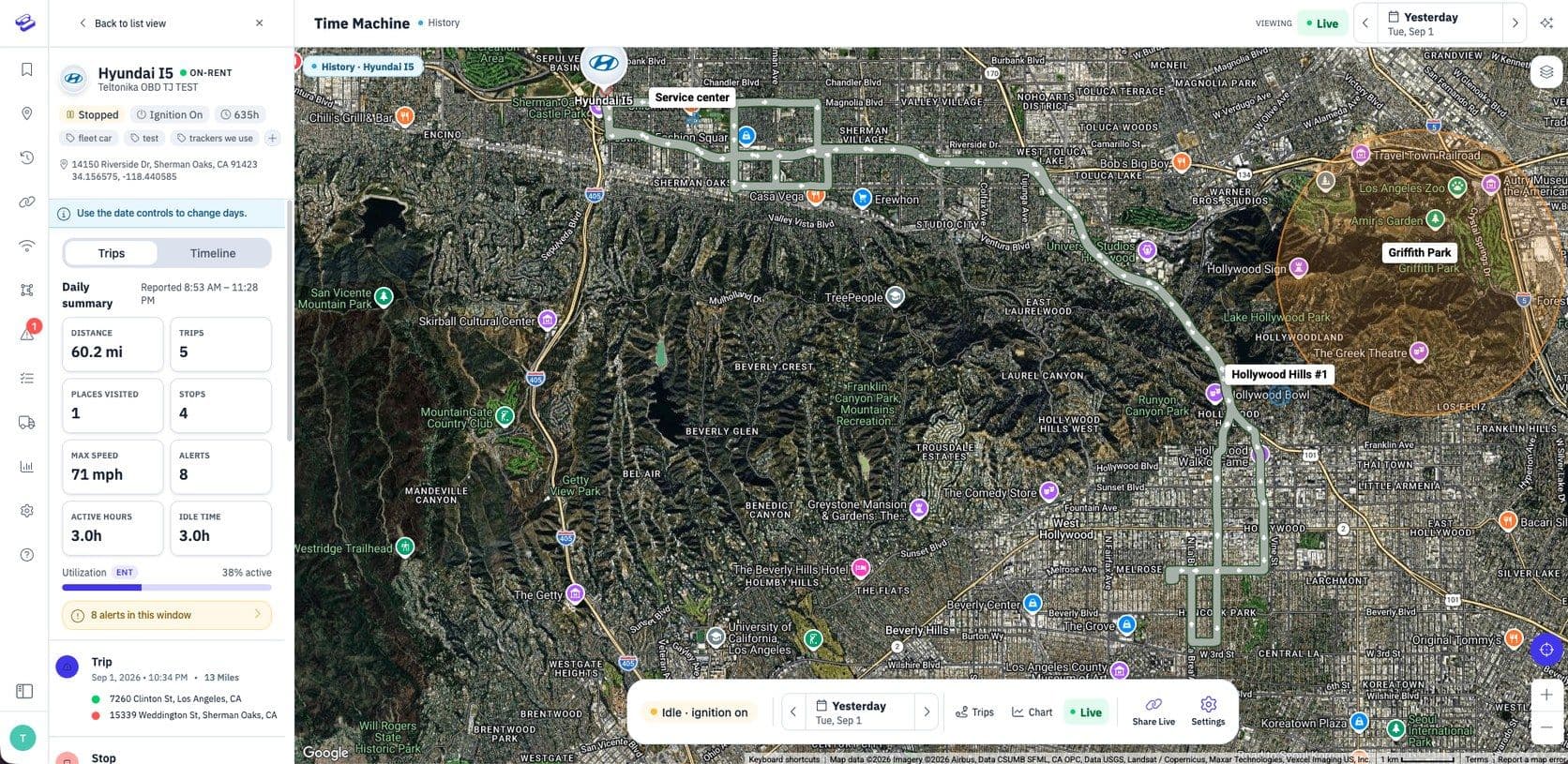
3. Time Machine (Historical Playback)
Last but not least, GPS asset trackers with a 'Time Machine' feature gives you a window into each tracker's past—so you know exactly where your business assets went and when. This information is useful in a variety of business situations, including theft prevention and recovery.
Time Machine provides:
- A complete map of each tracker's movement during a specific time period
- Speed, distance, and environmental details at various locations along the route
- Detailed incident documentation for insurance claims
- Evidence for legal proceedings
If you rent out vehicles or equipment, you know that accidents, theft, and damage are ever-present threats to your business. While you can't always avoid these misfortunes, you can expedite the legal and insurance reimbursement process by having easy access to information like driver speed and weather conditions at the time of the incident.
Miniaturized Tracking Technology: The New Frontier in Covert Asset Protection
Traditional asset trackers have an obvious problem: they look like trackers. Bulky, obvious, and easy to spot, they practically advertise their presence to anyone looking to steal inventory. But what if the most powerful anti-theft technology didn't look like security equipment at all?
Modern miniaturized tracking technology enables you to shrink tracking devices to unprecedented sizes, opening up entirely new possibilities for covert asset protection. Using advanced mesh technology, full-featured tracking capabilities can be embedded into casings that look like anything but security devices.
The Power of Miniaturization
Miniaturized trackers aren't just "small trackers." They're tracking solutions disguised as everyday retail items. A price tag. A product label. A piece of packaging. Even components that appear to be part of the merchandise itself. This approach gives retailers unprecedented flexibility in how they protect their inventory.
Instead of choosing between obvious security measures and no protection at all, you can embed enterprise-grade tracking technology into items that thieves will never suspect. The result? When inventory walks out the door, you can track it beyond your store perimeter—turning theft from a total loss into a recoverable situation.
Rapid Casing Redesign Capabilities
Here's where strategic advantage emerges: modern tracking platforms can design and manufacture new casing formats rapidly. When thieves start recognizing one type of tracker, you simply deploy a different design. This agility keeps your security strategy constantly ahead of theft patterns and criminal adaptation.
The underlying mesh network technology creates an invisible security perimeter that works seamlessly regardless of which casing format you're using. Your organization gets the same powerful tracking capabilities whether the device looks like a standard retail tag or something completely unexpected.
Retail-Specific Deployment Examples
Miniaturized tracking devices are transforming retail security across multiple product categories:
- Electronics and High-Value Items: Embed trackers in product packaging or device casings to track theft beyond store perimeters
- Apparel: Integrate tracking into price tags and security labels that appear indistinguishable from normal retail fixtures
- Pharmaceuticals and Beauty Products: Use covert casings that blend into standard retail packaging
- Liquor and Premium Goods: Deploy disguised trackers that maintain the unboxing experience while providing full tracking capability
- Seasonal Inventory: Track high-theft seasonal items with rapidly redesigned casings that evolve with each season
For organizations managing retail operations at scale, understanding how retail shrink occurs and why old-school security falls short helps prioritize GPS-enabled protection over conventional methods. Additionally, retailers exploring comprehensive security strategies should review our guide on retail theft prevention in 2026 with GPS and BLE mesh technology. For a dedicated retail-inventory intelligence product built on this same architecture, see StockOS.
Traditional Security vs. GPS-Enabled Protection: A Comparison
| Security Approach | Coverage | Recovery Capability | Operational Overhead |
|---|---|---|---|
| Traditional CCTV | Store perimeter only | Video evidence only; no item recovery | High (constant monitoring required) |
| Security Tags/EAS | At checkout points | Prevents exit; no recovery if bypassed | Low |
| Basic Asset Tracking | Known storage locations | Limited to last-known location | Medium (staff needed to check) |
| GPS-Enabled Protection (with miniaturization) | Complete coverage (store + beyond) | Real-time tracking + historical data + legal evidence | Low (one operator monitors hundreds of assets) |
Getting Started with GPS Asset Tracking Today
No matter what industry or business you're in, GPS asset tracking can play a crucial role in protecting your business against theft and offering faster asset recovery. Modern tracking systems combine:
- Real-time location visibility across all your assets
- Intelligent geofencing with automated alerts
- Historical data for insurance claims and legal proceedings
- Covert miniaturized devices that stay ahead of theft tactics
- Centralized dashboards that reduce operational overhead
Ready to Protect Your Assets?
See how enterprise GPS tracking can reduce theft and accelerate recovery in your organization.
Get Pricing & DemoFrequently Asked Questions
How much does GPS asset tracking cost?
Cost varies based on the number of assets, tracking frequency, and features required. Most enterprise solutions offer flexible pricing models ranging from per-device subscriptions to unlimited asset plans. Request a customized quote to understand pricing for your specific use case.
Can GPS trackers work indoors?
Traditional GPS requires line-of-sight to satellites, making it unreliable indoors. Advanced systems use mesh networks, WiFi triangulation, and Bluetooth connectivity to provide indoor tracking capabilities. Discuss your specific environment with your provider to ensure coverage.
What's the difference between passive and active tracking?
Passive trackers store location data locally and require manual download for review. Active trackers transmit real-time data to the cloud, enabling instant alerts and live monitoring. For theft prevention, active tracking is essential.
How quickly can miniaturized trackers be redeployed?
Modern manufacturing capabilities enable new casing designs to be produced and deployed within days to weeks. This allows security teams to stay ahead of thief adaptation patterns by continuously evolving device appearances.
Can historical tracking data be used in legal proceedings?
Yes. Time Machine data (location, speed, timing, environmental conditions) creates a detailed forensic record that insurance companies and law enforcement can use. This documentation significantly speeds up claims processing and investigations.
Related Articles
- GPS Tracking for Construction Equipment: Reducing Theft and Downtime
- Retail Inventory Security: Modern Solutions Beyond CCTV
- Fleet Tracking Best Practices for 2026
- Step-by-Step Asset Recovery Procedures with GPS Data
Transform Your Asset Protection Strategy
Explore pricing, request a demo, or speak with an asset security specialist.
View PricingAuthor Byline
This article was written by the Hapn team, specialists in enterprise asset tracking, GPS fleet management, and theft prevention technology. We help organizations of all sizes protect their valuable assets and recover losses through real-time tracking and intelligent security solutions. For more information, visit gethapn.com.