Last updated: March 2026
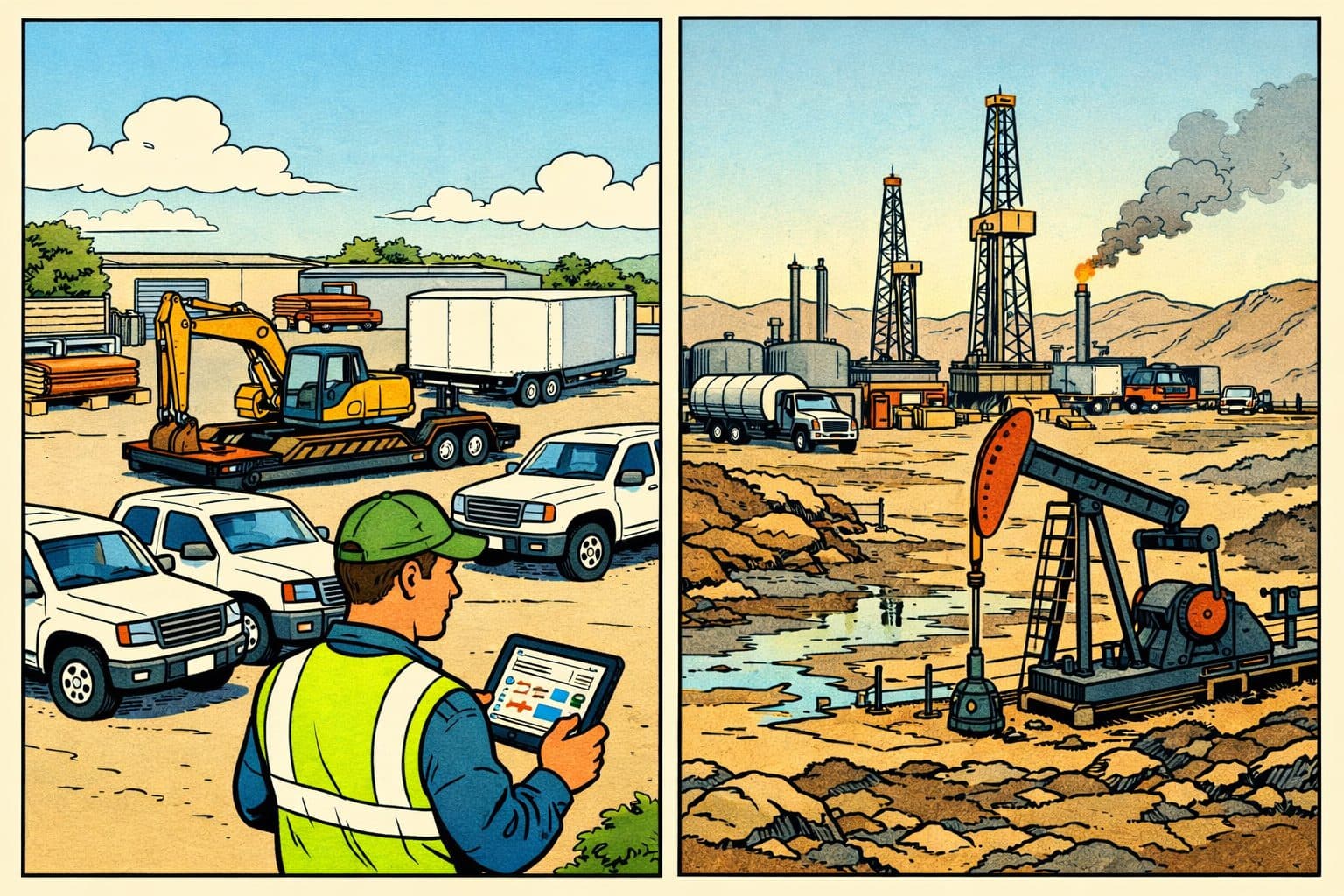
If you're comparing Hapn vs Geoforce for fleet and asset tracking, the short answer is: Hapn covers more ground for less money — unless your operation requires ATEX or IECEx-certified hardware for explosive atmospheres. Geoforce carved out a niche in oil and gas with satellite-connected, hazardous-location-rated trackers. But for construction companies, equipment rental businesses, and mixed fleets that need vehicles, heavy equipment, battery-powered assets, and AI dash cameras on a single platform, Hapn is the stronger choice by a wide margin.
Key Takeaways
- Hapn tracks 463,000+ assets across 50+ industries on a single platform — vehicles, equipment, and battery-powered assets — while Geoforce focuses primarily on non-powered industrial equipment.
- Geoforce's GT1 tracker holds IECEx/ATEX Zone 0 certification for explosive atmospheres — a genuine advantage for upstream oil and gas operations in classified hazardous locations.
- Hapn offers transparent, no-contract pricing with plans starting at competitive rates; Geoforce requires custom quotes with no published pricing.
- Hapn provides hardwired equipment telematics (engine hours, fault codes, CAN bus diagnostics), AI dash cameras, and indoor/outdoor zone tracking — none of which Geoforce offers.
- For the 95%+ of fleet operations that don't require hazardous-location hardware certifications, Hapn delivers more capability at a lower total cost of ownership.
What Geoforce Does Well
Credit where it's due. Geoforce was founded in 2007 by oil and gas industry veterans, and their hardware reflects that heritage. Their GT-series trackers are built for extreme conditions — hermetically sealed, HALT-tested (Highly Accelerated Life Testing), and designed for mud, chemicals, deep cold, and sustained vibration.
Their standout product is the GT1, which carries IECEx and ATEX Zone 0 certification. That's the most restrictive hazardous-location rating available — it means the device is approved for continuous use in environments where explosive gas or dust atmospheres are present. Think wellheads, refineries, underground mining operations, and offshore platforms where a single spark from uncertified electronics could be catastrophic.
What is ATEX/IECEx Zone 0 Certification?
ATEX (EU Directive 2014/34/EU) and IECEx (international) are safety certification frameworks for electrical equipment used in explosive atmospheres. Zone 0 is the highest classification — it covers areas where an explosive gas-air mixture is present continuously or for long periods. Equipment must be designed as "intrinsically safe," meaning it cannot release enough electrical or thermal energy to ignite the surrounding atmosphere under any fault condition.
Geoforce also offers satellite connectivity, which matters if you're tracking assets on remote wellpads or offshore rigs with zero cellular coverage. Their hybrid satellite-cellular devices can switch between modes automatically.
If your operation is primarily upstream oil and gas, you're tracking frac equipment and pressure vessels on Class I Division 1 or ATEX Zone 0 sites, and you need satellite reporting from locations with no cell signal — Geoforce is purpose-built for that scenario.
For everyone else, Hapn is the better platform. Here's why.
Where Hapn Pulls Ahead: Full Platform vs. Hardware Niche
The core difference between Hapn and Geoforce is platform breadth. Geoforce is a rugged tracking hardware company with a software layer on top. Hapn is a full-stack telematics platform that manages your entire fleet — vehicles, heavy equipment, unpowered assets, and indoor zones — from a single login.
That distinction matters enormously for mixed fleets. If you run a construction company or equipment rental business, you don't just need to know where your generators are. You need engine hours from your excavators, driver behavior from your service trucks, dash cam footage from your delivery vehicles, and zone-level visibility across your yard. Geoforce can't do most of that. Hapn does all of it.
Head-to-Head Comparison: Hapn vs Geoforce
| Capability | Hapn | Geoforce |
|---|---|---|
| Vehicle telematics (OBD/hardwired) | ✅ Full — speed, idle, trips, diagnostics | ⚠️ Basic vehicle tracking only |
| Heavy equipment telematics | ✅ Engine hours, fault codes, CAN bus, OEM data | ⚠️ Runtime and utilization only |
| Battery-powered asset tracking | ✅ IP67, long-life, OTA config | ✅ Solar-powered, satellite option |
| AI dash cameras | ✅ Road + driver-facing, AI event detection | ❌ Not offered |
| Indoor/outdoor zone tracking | ✅ Hapn Zones — BLE tags, $5–8/tag | ❌ Not offered |
| ATEX/IECEx hazardous location hardware | ❌ Not offered | ✅ Zone 0 certified (GT1) |
| Satellite connectivity | ❌ Cellular only | ✅ Satellite, cellular, and hybrid |
| OEM equipment data integration | ✅ Multi-manufacturer, AEMP/ISO compliant | ⚠️ Limited |
| Third-party integrations (ERP, rental software) | ✅ Point of Rental, Wynne, Salesforce, custom | ⚠️ API available, limited pre-built |
| Open API | ✅ Production-grade, Hapn's own products built on it | ✅ Developer APIs available |
| Pricing transparency | ✅ Published pricing, no contracts | ❌ Quote-based only |
| Theft recovery | ✅ $720M+ recovered, geofencing, after-hours alerts | ✅ Asset recovery features |
Mixed Fleet Management: One Platform vs. Portal Hopping
This is the biggest practical gap. Most construction and equipment rental operations run a mix of trucks, excavators, generators, trailers, attachments, and small tools. With Geoforce, you get GPS dots on a map for your non-powered assets. For everything else — vehicle telematics, driver behavior, dash cameras, equipment diagnostics — you're buying additional platforms from other vendors and toggling between portals.
Hapn eliminates that. Total fleet visibility means your pickup trucks, excavators, trailers, and yard inventory all live in the same platform. Your dispatcher sees everything on one screen. Your fleet manager pulls one report. Your billing team reconciles against one data source.
For equipment rental companies specifically, that integration goes deeper. Hapn connects directly with rental management systems like Point of Rental and Wynne, so utilization data flows into your billing without manual entry. Geoforce offers a "Rental Manager" module, but without the depth of hardwired equipment telematics — engine hours, fault codes, diagnostic data — the utilization picture is incomplete.
Equipment Telematics: Data Depth Matters
Geoforce's trackers tell you where an asset is and whether it's running. Hapn's hardwired equipment trackers connect via ignition wire or CAN bus to pull engine hours, runtime, fault codes, and full diagnostics. That's the difference between knowing a generator is on a job site and knowing it's logged 847 hours and is 53 hours from its next service interval.
What is CAN Bus Telematics?
CAN bus (Controller Area Network) is the internal communication protocol in modern heavy equipment and vehicles. A telematics device connected to the CAN bus can read engine hours, fuel consumption, fault codes, temperature, RPM, and other diagnostic data directly from the machine's onboard computer — far richer than GPS location and motion sensing alone.
Hapn also ingests OEM telematics data from major equipment manufacturers, so even mixed-OEM fleets consolidate into one view. If you're running Caterpillar excavators alongside JCB loaders and Kubota minis, Hapn normalizes that data into a single dashboard instead of forcing you to check each manufacturer's portal separately.
Yard and Indoor Tracking: A Capability Geoforce Doesn't Have
If you manage a rental yard, laydown area, or warehouse, Hapn Zones solves a problem that GPS alone can't — knowing exactly which bay, row, or staging area an asset is in. Zones uses BLE tags ($5–8 each) and dedicated cellular gateways (no WiFi infrastructure required) to deliver indoor and outdoor zone-level tracking at $3–5/month per tag.
Geoforce has no equivalent product. Their GPS-only approach works fine for tracking a frac tank across West Texas, but it can't tell you which row of your 10-acre equipment yard holds the 60-inch trencher a customer just reserved.
AI Dash Cameras: Safety and Liability Protection
Hapn offers AI-powered dash cameras with both road-facing and driver-facing lenses. The AI detects events like hard braking, distracted driving, tailgating, and near-collisions — then automatically flags and uploads footage for review. This is a must-have for fleets that put vehicles on public roads and want to reduce accidents, manage liability, and lower insurance costs.
Geoforce doesn't offer dash cameras at all. If your fleet includes service vehicles, delivery trucks, or any CDL drivers, you'd need to buy a separate camera system and manage it outside Geoforce's platform.
Ready to See the Full Platform?
Compare plans and get transparent pricing for your entire fleet — vehicles, equipment, and assets. No contracts required.
Get Pricing →Pricing and Contracts: Transparency vs. Black Box
Hapn publishes its pricing and doesn't require contracts. You can see what you'll pay before talking to sales, and you're not locked into multi-year commitments. That's by design — Hapn earns retention through product quality, not contract penalties.
Geoforce has no public pricing. Everything is quote-based through an enterprise sales process. That typically means longer sales cycles, custom contracts, and less visibility into what you're actually paying per device. For midmarket companies that want to evaluate options quickly and pilot a solution without a six-week procurement process, that's a real friction point.
When Geoforce Is the Right Choice
There is one scenario where Geoforce is genuinely the better pick: if you operate in ATEX/IECEx-classified hazardous environments and need certified intrinsically safe hardware.
In upstream oil and gas, mining, and certain chemical processing operations, equipment deployed in Zone 0 or Class I Division 1 areas must meet strict certification standards. These standards ensure that electronic devices cannot produce sparks, arcs, or thermal energy sufficient to ignite explosive gas or dust mixtures. Non-certified electronics are literally prohibited in these environments by OSHA (29 CFR 1910.307), the National Electrical Code (NEC Article 500), and equivalent international regulations.
Geoforce's GT1 tracker is built specifically for this. It's one of the few GPS tracking devices on the market with full IECEx/ATEX Zone 0 certification. If you're placing trackers on wellhead equipment, downhole tools, pressure vessels in hazardous areas, or assets in underground mining operations, Geoforce has hardware purpose-built for that use case.
Their satellite connectivity also matters here. Remote wellpads and offshore platforms often have no cellular coverage, and Geoforce's hybrid satellite-cellular devices handle that gap.
But here's the key point: most fleet operations — including most oil and gas companies — have the majority of their assets in non-classified areas. The trucks, trailers, service vehicles, generators at the yard, and equipment in transit don't need ATEX certification. For those assets, Hapn delivers significantly more capability.
The Bottom Line
Geoforce built a solid product for a specific industrial niche: rugged, certified tracking hardware for hazardous environments with satellite connectivity. If that's your entire fleet profile, they're a credible option.
But most businesses comparing these two platforms don't operate exclusively in explosive atmospheres. They run mixed fleets — vehicles, heavy equipment, trailers, small assets — and need a platform that handles all of it. They want theft recovery, equipment diagnostics, driver safety tools, yard visibility, and the integrations to connect tracking data to their operational systems.
That's Hapn. One platform. Transparent pricing. No contracts. 463,000+ assets monitored. 50,000+ customers. And a track record of $720M+ in stolen assets recovered.
Written by the Hapn Team
Hapn provides GPS fleet and asset tracking for 50,000+ customers across construction, equipment rental, and 50+ other industries. Our platform monitors 463,000+ assets and processes over 4 billion messages annually with 99.9% uptime.
Frequently Asked Questions
Is Hapn or Geoforce better for construction fleets?
Hapn is the stronger choice for construction fleets. Construction operations typically run mixed fleets that include vehicles, heavy equipment, trailers, and small tools — and Hapn manages all of those on a single platform with full telematics, AI dash cameras, and indoor/outdoor zone tracking. Geoforce focuses on GPS location for non-powered assets and lacks vehicle telematics, dash cameras, and zone-level yard visibility.
Does Geoforce offer dash cameras or driver safety tools?
No. Geoforce does not offer AI dash cameras, driver behavior monitoring, or driver safety coaching. If your fleet includes vehicles on public roads, you would need a separate camera and safety system alongside Geoforce. Hapn includes AI-powered road-facing and driver-facing cameras with automatic event detection as part of its platform.
Can Hapn track assets in hazardous oil and gas environments?
Hapn's tracking hardware is not ATEX or IECEx certified for classified hazardous locations (Zone 0/1/2 explosive atmospheres). For assets deployed directly in those environments — wellheads, downhole tools, refineries — Geoforce's GT1 with Zone 0 certification is the appropriate solution. However, the majority of assets in oil and gas operations (vehicles, trailers, generators, yard equipment) operate outside classified areas and can be tracked with Hapn's full platform.
What is the pricing difference between Hapn and Geoforce?
Hapn publishes transparent pricing with no contracts required, so you can evaluate costs before engaging with sales. Geoforce does not publish pricing — all plans require a custom quote through their enterprise sales team. This makes direct price comparison difficult, but Hapn's no-contract model means you can pilot the platform without a long-term commitment.
Which platform is better for equipment rental companies?
Hapn is built for equipment rental operations. It integrates directly with rental management systems like Point of Rental and Wynne, provides engine hour-based utilization data through CAN bus connections, and offers zone-level tracking for rental yards. Geoforce provides basic location and runtime data but lacks the deep equipment diagnostics and rental software integrations that rental businesses need to optimize utilization and automate billing.
Does Hapn work without cellular coverage?
Hapn requires cellular connectivity for its tracking devices. If you operate in truly remote locations with zero cellular signal — offshore platforms, remote wellpads in areas without any cell coverage — Geoforce's satellite-connected devices will maintain reporting where Hapn cannot. That said, cellular coverage continues to expand rapidly, and the vast majority of job sites, highways, and urban/suburban areas have reliable cellular service.
Stop Guessing. Start Tracking.
See how Hapn gives you complete visibility across your mixed fleet — vehicles, equipment, and assets in one platform. No contracts, transparent pricing.
Get Pricing →