"We looked at indoor tracking, but we don't have WiFi on site." It is the single most common objection businesses raise when they explore monitoring assets inside warehouses, temporary structures, or staging areas. The assumption is that indoor tracking requires a massive enterprise IT project—network credentials, firewall exceptions, and six-figure infrastructure investments. That assumption is wrong.
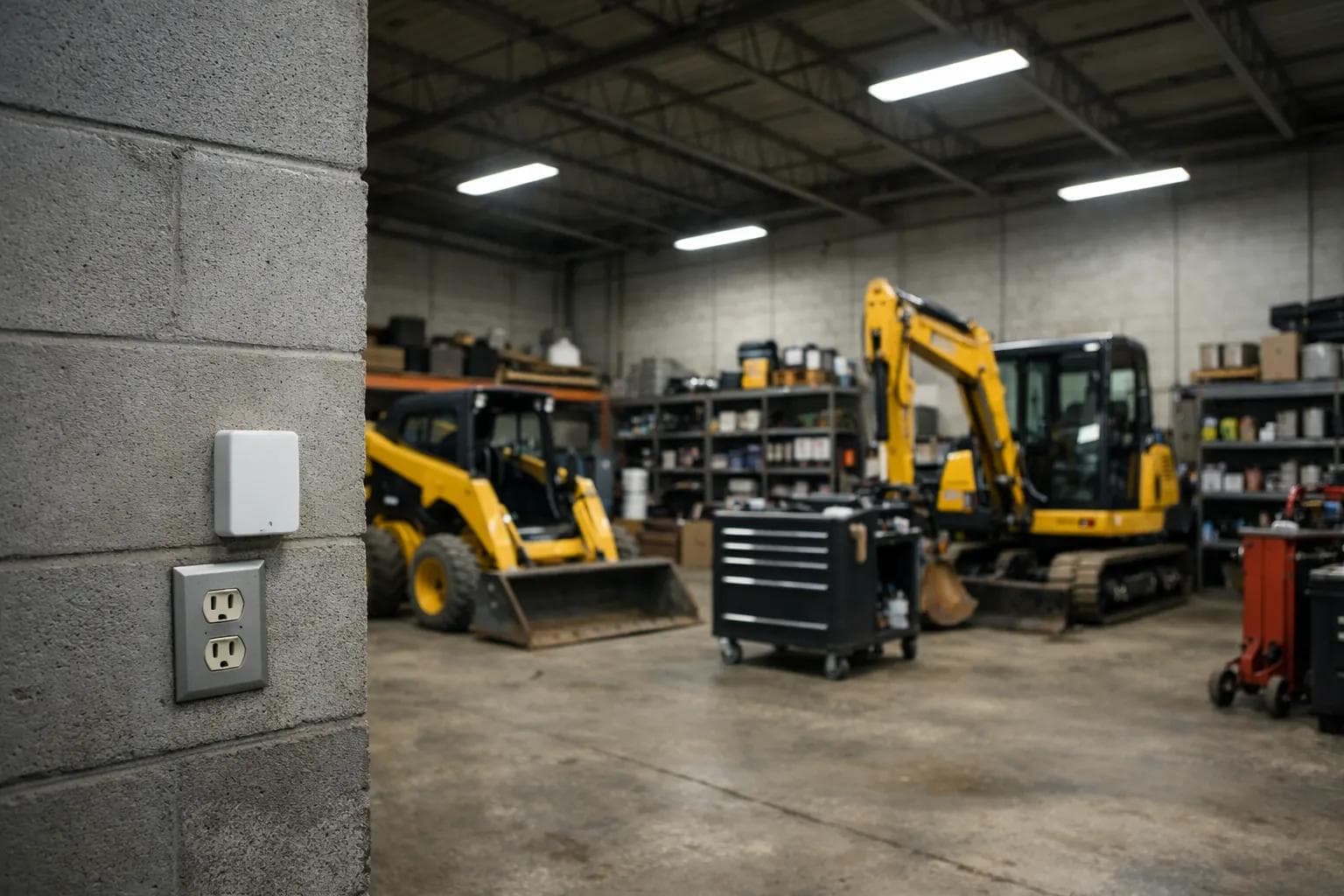
To track equipment inside buildings without WiFi or IT support, operations teams use cellular-enabled gateways paired with Bluetooth Low Energy (BLE) tags. Unlike traditional Real-Time Location Systems (RTLS) that depend on your company's internet, dedicated cellular gateways plug directly into a standard wall outlet and communicate over independent cellular networks. This allows you to monitor indoor assets—tool cribs, staging areas, maintenance bays—with zero network configuration or IT involvement.
Key Takeaways
- Traditional enterprise WiFi RTLS systems often cost $50,000–$200,000+ to deploy and require extensive IT infrastructure that most job sites don't have.
- Cellular-based indoor tracking gateways bypass local WiFi entirely, requiring only a standard power outlet to connect to the cloud via independent cellular networks.
- Hapn Zones BLE tags cost $5–$8 each with $3–$5/mo subscriptions—a fraction of enterprise RTLS systems that run $50–$100+ per tag.
- A standard 10-gateway, 100-tag deployment can be set up and calibrated by two people in under 4 hours with no IT support.
- Hapn Zones runs on the same platform as Hapn's GPS fleet tracking, so indoor zone data and outdoor GPS data appear on one dashboard—no portal hopping.
Last updated: March 2026
The WiFi Myth: Why Traditional Indoor Tracking Fails on Job Sites
Most legacy indoor tracking systems—WiFi-based RTLS and UWB (Ultra-Wideband)—were designed for pristine, climate-controlled environments like hospitals and corporate data centers. They assume a site has dense, reliable enterprise WiFi infrastructure already in place. The reality of mixed fleet operations is entirely different.
Construction sites, equipment rental yards, remote warehouses, and facilities actively under construction rarely have reliable, site-wide internet. Even in completed facilities that do have enterprise WiFi, getting an indoor tracking project approved is a logistical nightmare. IT departments tightly control network access for security reasons. Submitting a ticket to get third-party tracking sensors whitelisted, approved, and integrated into an enterprise network routinely takes three to six months—assuming it gets approved at all. Ethernet drops have to be scheduled, routers reconfigured, and security protocols analyzed before a single asset is ever tracked.
The friction compounds when you consider temporary environments. A general contractor managing a 14-month build isn't going to invest in enterprise WiFi infrastructure that gets torn down when the project wraps. An equipment rental company with a 5-acre outdoor yard and an adjacent metal-roofed maintenance shop doesn't have the IT budget or headcount to maintain a WiFi RTLS deployment. The result: indoor tracking gets shelved as "too complex" or "not worth the IT hassle," and operations managers are left blind to where assets go once they enter a building.
That blindness is expensive. Tools get hoarded by crews on multi-trade job sites. Mechanics waste billable hours searching for specific attachments in large repair bays. Equipment gets shuffled between indoor areas with no audit trail, leading to theft and shrinkage that costs the construction industry over $1 billion annually.
What is RTLS?
Real-Time Location Systems (RTLS) refer to technologies that automatically identify and track the location of objects or people in real time, usually within a building or contained area. Traditional RTLS relies on established local networks like WiFi or UWB anchors to triangulate positioning, which typically requires significant infrastructure investment and IT involvement.
What is BLE (Bluetooth Low Energy)?
Bluetooth Low Energy (BLE) is a wireless communication protocol designed for short-range data transmission at very low power consumption. In asset tracking, small BLE tags broadcast a signal that is picked up by nearby receivers (gateways or access points), allowing the system to determine which zone or area an asset is located in without requiring the tag to connect to WiFi or cellular networks directly.
How Cellular Gateway Tracking Works (No WiFi Required)
The solution to the WiFi bottleneck is to bypass local networks entirely. Hapn Zones uses cellular gateway asset tracking—a fundamentally different architecture that removes the IT department from the equation.
The system has three components: BLE tags, cellular gateways, and the Hapn cloud platform. You attach low-cost BLE tags to your assets—welders, plate compactors, diagnostic tools, parts bins, anything worth monitoring. These tags broadcast a continuous low-power signal. Cellular gateways placed throughout the facility listen for those tag signals. Because each gateway has its own independent SIM card and cellular modem, it pushes tag data straight to the cloud over 4G/LTE—completely independent of your building's internet.
There is zero IT involvement. No network configuration, no Ethernet cable drops, no WiFi passwords, no firewall exceptions. You plug the gateway into a standard 110v wall outlet, and it connects automatically. If the facility's internet goes down, your asset tracking continues uninterrupted. If you move to a new temporary site next month, you unplug the gateways, put them in your truck, and plug them in at the new location. They reconnect automatically.
What separates this from commodity BLE beacon systems is the intelligence layer. Raw BLE signal strength (RSSI) is notoriously unreliable indoors—metal racks, concrete walls, and heavy equipment cause signal bounce and false readings. Hapn Zones solves this with ML-powered walk-to-train calibration. You open the Hapn app, stand in the named zone (e.g., "Repair Bay" or "Tool Crib"), and walk the perimeter. The machine learning engine maps the unique RF environment of that specific space, learning how signals behave around your particular obstacles. The result is dramatically higher accuracy than raw signal strength alone.
Accelerometer fusion in the tags adds another layer—even if a tagged asset moves between zones in a way that temporarily confuses the RF model, the system detects motion and reconciles the location faster.
Need visibility where GPS can't reach?
Deploy indoor asset tracking in hours with zero IT setup. See how Hapn Zones extends your fleet visibility indoors.
See How Zones Works →Cellular Gateways vs. Alternative Indoor Tracking Methods
When evaluating indoor asset tracking, the conversation usually comes down to precision vs. practicality. Here is how cellular-backed zone tracking compares to other approaches.
| Approach | Pros | Cons |
|---|---|---|
| Hapn Zones (Cellular BLE) | Zone-level accuracy, 24/7 visibility, zero IT support, plugs into any wall outlet. Tags cost $5–$8 each with $3–$5/mo subscriptions. | Provides zone-level accuracy (e.g., "Bay 3") rather than centimeter-level coordinates. Requires basic cellular reception at the gateway. |
| WiFi-based RTLS | High accuracy (1–3 meters) in well-covered facilities. | Requires enterprise WiFi infrastructure, deep IT involvement, and high capital expense ($50K–$200K). Typical deployment takes months. |
| UWB (Ultra-Wideband) | Centimeter-level accuracy. Ideal for robotic automation and precision manufacturing. | Extreme overkill for logistics and fleet operations. High cost per tag ($25–$100+) and requires complex anchored infrastructure with professional installation. |
| Passive BLE (Vehicle Scanners) | No facility infrastructure needed—piggybacks off passing telematics-equipped vehicles. | Only updates when a vehicle drives past. The site goes completely dark on nights, weekends, and holidays. Proximity data only—no named zones. |
| Manual Tracking | No technology cost. | Relies on spreadsheets and whiteboards. Instantly inaccurate at scale, leading to shrinkage, wasted labor, and unbilled equipment. |
Be honest about your requirements. If you are running an automated robotic fulfillment center and need centimeter accuracy for machine-guided pick-and-place operations, UWB is the correct tool. But if you manage equipment rental assets or mixed construction fleets and need to know "is this generator in Building A, the Repair Bay, or the Staging Yard?"—cellular zone tracking is dramatically faster, simpler, and cheaper. For a deeper look at how real-time location systems are evolving across industries, see our breakdown of the rise of RTLS in asset management.
Where Cellular-Based Indoor Tracking Works Best
Because it removes the dependency on local internet, cellular indoor tracking thrives in industrial environments where connectivity is an afterthought—or doesn't exist at all.
Construction Sites and Temporary Projects
Modern construction fleet tracking relies heavily on GPS for heavy yellow iron in the field. But smaller, high-value assets—laser levels, specialty drills, generators, and diagnostic tools—are frequently moved indoors as structures go up. Construction sites are temporary by nature; investing in enterprise WiFi infrastructure for a 12-month build is financially unviable. With dedicated cellular gateways, project managers define zones like "Floor 1," "Floor 2," and "Tool Crib" to monitor expensive inventory as the structure takes shape around it. When the project wraps, the gateways move to the next site.
Equipment Rental Yards and Maintenance Bays
Equipment rental companies face a constant battle with utilization. High-value attachments and compact equipment frequently get lost in large, multi-acre yards or shuffled between indoor repair bays, outdoor wash stations, and customer staging areas. A gateway plugged into the maintenance shop wall instantly catalogs every tagged asset inside. Mechanics stop wasting billable hours searching for specific trenchers or plate compactors, and yard managers can verify that returned equipment is actually back on-site—not sitting in a customer's building unreported. For rental operators focused on maximizing fleet ROI, zone-level visibility directly improves fleet utilization rates.
Warehouses and Distribution Facilities in Low-Connectivity Areas
Not every warehouse is a modern, connected fulfillment center. Rural distribution hubs, agricultural storage facilities, and older industrial buildings frequently lack enterprise WiFi—and retrofitting them is expensive. Cellular gateways give these facilities zone-level asset visibility without touching the network. This is especially valuable for companies tracking high-value inventory or shared equipment across multiple buildings on the same property.
Parking Structures and GPS Dead Zones
GPS requires a clear line of sight to the sky. When a $50,000 piece of equipment is parked inside a metal-roofed warehouse, a concrete parking structure, or a deep underground staging area, GPS signals bounce and fail. By deploying a gateway in these GPS dead zones, operations maintain a continuous chain of custody. This dual-layer approach—GPS outdoors, Zones indoors—is particularly critical for theft recovery, since stolen assets are frequently hidden indoors to avoid satellite detection.
Temporary Event Sites and Seasonal Operations
Concert venues, trade shows, seasonal pop-up operations, and disaster-response staging areas all share a common problem: they need asset visibility in spaces that exist for days or weeks, not years. Permanent WiFi infrastructure makes no sense. Cellular gateways can be deployed in a matter of hours, run for the duration of the event, and be packed up when it's over. For operations that frequently set up and tear down, this portability is a requirement—not a nice-to-have.
Note: Many construction and rental businesses also operate service vehicles—trucks for maintenance crews, vans for site supervisors, or technician vehicles. For tracking those lighter fleet assets alongside field service operations, Spytec is purpose-built for small service fleets like HVAC, plumbing, and electrical contractors who frequent these indoor job sites.
Deployment Walkthrough: Running in Hours, Not Weeks
The starkest difference between legacy WiFi RTLS and Hapn Zones is the deployment timeline. A system that takes months to approve and weeks to hardwire can be replaced by a workflow that takes a single afternoon.
Step 1: Plug in the Gateways
Identify the distinct areas you want to track—"North Staging," "Repair Bay," "Tool Crib," "Loading Dock." Take a compact cellular gateway and plug it into any standard power outlet in that area. It powers on and connects to the cloud automatically via its built-in cellular modem. No Ethernet, no WiFi credentials, no IT tickets.
Step 2: Walk Your Zones (ML Calibration)
This is where Hapn Zones diverges from commodity BLE beacon systems. Open the Hapn app on your phone, stand in the named zone, and walk the perimeter. The ML engine builds a signal model specific to your environment—learning how RF behaves around your particular mix of metal racks, concrete walls, and equipment. This walk-to-train calibration takes a few minutes per zone and dramatically outperforms raw RSSI-based positioning that ignores the physical environment.
Step 3: Tag and Go
Affix the IP67-rated BLE tags to your unpowered assets using zip ties, adhesive, or screws. The tags immediately start broadcasting to the gateways, and the assets populate in your Hapn dashboard with their assigned zone locations. From unboxing to live visibility, a standard deployment of 10 gateways and 100 asset tags can be completed by two people in three to four hours. No network architects, no system integrators, no six-week implementation.
Unifying Indoor Assets and GPS Fleets on One Platform
Solving the indoor tracking problem is only half the battle. The real operational bottleneck occurs when companies use one system to track indoor tools, a second platform for heavy equipment GPS, and a third for vehicle telematics. This fragmentation—what we call portal hopping—creates data silos and dashboard fatigue that erode the value of tracking in the first place.
Hapn's core differentiator is that it provides a single, unified platform for your entire mixed fleet. Hapn delivers full telematics depth—engine hours, fault codes, diagnostics, and CAN bus data via hardwired equipment trackers—alongside vehicle tracking, AI dash cameras, battery-powered asset monitoring, and indoor zone-based tracking, all on one dashboard.
Unlike platforms that specialize in only vehicles or only construction equipment, Hapn handles the entire spectrum without forcing you onto multiple systems. When a generator moves from an indoor "Staging Zone" (monitored via BLE gateway) onto a flatbed truck (monitored via vehicle telematics) and out to a remote job site (monitored via hardwired GPS), you track that entire lifecycle on one screen. That continuity—indoor to outdoor, powered to unpowered, vehicle to equipment—is what makes the one-platform approach operationally transformative.
Hapn monitors over 463,000 assets for 50,000+ customers across 50+ industries, processing more than 4 billion messages annually with 99.9% uptime. The platform offers transparent pricing with no hidden fees and no long-term contracts—a meaningful differentiator from competitors that lock you into multi-year agreements before you've validated the deployment.
Written by Joe Besdin
Joe is the Founder of Hapn, which provides GPS fleet and asset tracking for 50,000+ customers across construction, equipment rental, and 50+ other industries. The Hapn platform monitors 463,000+ assets and processes over 4 billion messages annually with 99.9% uptime.
Frequently Asked Questions
Can you track equipment indoors without WiFi?
Yes. Hapn Zones uses dedicated cellular gateways that plug into standard wall outlets, bypassing the need for local WiFi entirely. Each gateway has its own SIM card and cellular modem, so it reads BLE tags attached to your equipment and sends location data directly to the cloud via 4G/LTE. No IT support, no network configuration, and no enterprise WiFi infrastructure required.
What is a cellular gateway for asset tracking?
A cellular gateway is an independent bridge between local BLE tracking tags and the cloud. Instead of relying on a building's internet router, the gateway contains its own SIM card and cellular modem. It constantly listens for nearby BLE asset tags and transmits their zone location to your tracking platform over the cellular network. Hapn Zones gateways require only a standard power outlet—no Ethernet, no WiFi credentials.
How much IT support does indoor asset tracking need?
With legacy WiFi RTLS systems, IT support is heavily required for network security, bandwidth allocation, firewall permissions, and ongoing maintenance. With cellular-based systems like Hapn Zones, zero IT support is needed. The hardware operates entirely outside your corporate network, requiring only a physical power source. A 10-gateway, 100-tag deployment can be completed by two field staff in under 4 hours.
How does BLE tracking work without WiFi?
BLE (Bluetooth Low Energy) tags broadcast a continuous, low-power signal. In traditional systems, those signals are picked up by WiFi-connected access points. Cellular-based systems like Hapn Zones replace those WiFi access points with gateways that have their own cellular connection, so BLE signals are captured and transmitted over 4G/LTE networks instead. The system is entirely self-sufficient—it works in buildings with no internet at all.
What's the cheapest way to track tools and equipment indoors?
Cellular BLE systems like Hapn Zones offer the lowest total cost for indoor asset tracking at scale. Tags cost $5–$8 each with $3–$5/month subscriptions, compared to enterprise RTLS systems that typically run $50–$100+ per tag with six-figure infrastructure costs. Because Hapn Zones gateways require only a wall outlet and no IT involvement, deployment and labor costs are a fraction of WiFi-based or UWB alternatives.
Stop Guessing. Start Tracking.
See how Hapn gives you complete visibility across your mixed fleet—vehicles, heavy equipment, and indoor assets on one platform. Transparent pricing, no hidden fees, no long-term contracts.
Get Pricing →