Last updated: March 2026
Data center construction asset tracking uses dedicated cellular gateways and BLE tags to monitor the real-time location of tools, materials, and heavy equipment across hyperscale builds. By combining indoor zone-based tracking with traditional GPS telematics on a single platform, contractors can eliminate the $50,000–$500,000 daily costs associated with schedule delays, misplaced inventory, and subcontractor equipment disputes.
Key Takeaways
- Data center schedule delays cost between $50,000 and $500,000 per day, often triggered by missing equipment or materials staged in the wrong building.
- Construction workers waste an average of 30 to 45 minutes daily searching for tools, costing up to $5,250 per worker annually in lost labor productivity.
- GPS signals fail completely inside steel-and-concrete structures from Day 1 of vertical construction, leaving traditional trackers blind to any asset moved indoors.
- Hapn Zones uses ML-powered walk-to-train calibration to achieve named-zone accuracy in complex RF environments—no WiFi, no IT infrastructure required.
- Hapn Zones tags cost just $5–8 each with $3–5/month subscriptions—a fraction of enterprise RTLS systems that run $50–100+ per tag plus six-figure deployment costs.
The Chaos of Hyperscale: Why Data Center Equipment Tracking Is Critical
Building a hyperscale data center is one of the most logistically demanding undertakings in the commercial construction industry. These aren't typical builds. We're talking about 18-to-36-month timelines, 50+ specialized subcontractors operating simultaneously, 2,000+ pieces of equipment across a campus that can span 50 acres or more. The mechanical, electrical, and structural trades are all running in parallel, each with their own equipment, their own crews, and their own schedule pressures.
In this environment, the primary challenge isn't just theft—though construction equipment theft exceeds $1 billion annually in the U.S., with less than 25% of stolen assets ever recovered. The deeper, more expensive problem is that nobody knows where anything is. High-value tools end up in the wrong building. Critical switchgear or cooling equipment gets staged in the wrong bay. A $200,000 rented generator sits completely idle for three weeks because the mechanical crew simply can't find it among the sprawling campus footprint.
The consequences are immediate and expensive. A hyperscale GC operating under a liquidated damages clause doesn't get the luxury of "we'll find it tomorrow morning." A missing forklift that delays concrete pours by half a day. A generator that can't be located when the commission crew needs it. Materials that were staged in Building B when the crew is working in Building A. Each of these incidents sounds minor in isolation. On a $500M build with daily delay costs running into six figures, they compound fast.
The reason these problems persist is straightforward: the tools contractors have historically used to track assets—GPS telematics—stop working the moment an asset goes indoors. And on a hyperscale data center build, "indoors" begins on Day 1 of vertical construction and only gets more complex from there. Solving this requires a different architecture entirely.
Why Traditional GPS Fails Inside Data Centers
GPS has transformed heavy equipment tracking for outdoor construction. But data center builds create a unique physical challenge that no amount of GPS hardware can solve.
What is Zone-Based Tracking?
Zone-based tracking is an asset monitoring method that uses dedicated cellular gateways and low-energy BLE tags to identify the specific named area—or "zone"—an asset occupies, such as "Building A - Floor 2" or "Tool Crib," without requiring GPS satellite signals or on-site WiFi infrastructure.
From Day 1 of vertical construction, steel and concrete structures create absolute GPS dead zones. As walls go up and roofs go on, satellite signals are blocked completely. A tracker on a generator that gets moved inside a mechanical bay will show "last seen 3 days ago" on your fleet dashboard—not because the device failed, but because it's physically incapable of reaching a satellite from inside a reinforced concrete enclosure.
The problem compounds on multi-building campuses where assets move constantly between indoor environments and outdoor staging yards. Many of the highest-value assets on these sites—portable compressors, light towers, generators, specialized test equipment—remain stationary for extended periods. Standard GPS breadcrumb tracking doesn't trigger effectively for assets that are both stationary and indoors. You end up with a dashboard full of stale timestamps and no actionable information about what's actually where.
Some contractors try to solve this by requiring crews to manually check in equipment or scan QR codes. These systems fail in practice because compliance is inconsistent, data is always lagging, and nobody on a hyperscale job site has time to scan a tag on every piece of equipment that moves between zones throughout the day.
The only viable answer is a system that automatically tracks assets indoors without GPS and without relying on the site's network infrastructure.
How Hapn Zones Works on a Data Center Build
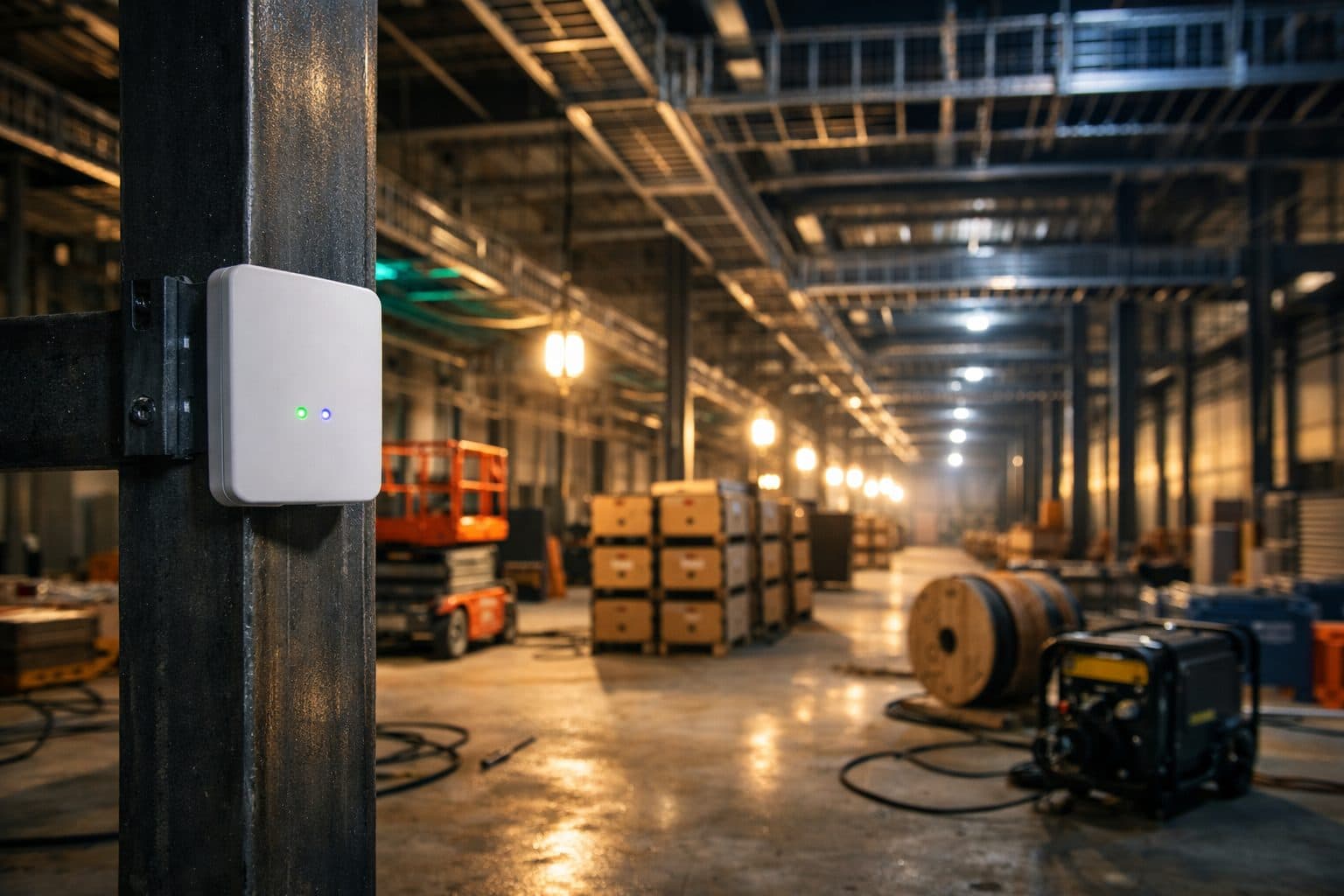
Hapn Zones is a BLE-based zone tracking system built to operate in exactly these conditions. BLE tags are attached to assets, and those tags communicate with dedicated cellular gateways placed around the site. The gateways report back to the Hapn platform continuously, providing real-time zone-level visibility across every named area on the site.
Zero IT Dependency — No WiFi Required
The most critical feature for active construction deployments is that Hapn Zones gateways are cellular-connected. They require nothing but a standard 110V power outlet. No WiFi. No IT department involvement. No enterprise network configuration. This matters because hyperscale builds under active construction don't have finished, stable IT networks—and enterprise RTLS systems from vendors like Zebra or Cisco require exactly that. Hapn Zones bypasses the problem entirely, making it deployable from the moment a building has power, not after it's fully commissioned.
ML-Powered Walk-to-Train Calibration
Data center structures are among the most RF-hostile environments for location tracking. Thick concrete walls, dense structural steel framing, electrical switchgear, and dense cabling runs all create signal reflections and interference that cause commodity BLE beacon systems to fail. These systems use raw RSSI—signal strength—to estimate location, and in complex environments, RSSI bounces unpredictably off metal surfaces.
Hapn Zones takes a fundamentally different approach. When you deploy, a site manager walks each zone with the mobile app in hand. The machine learning engine records the specific signal patterns, interference characteristics, and metal reflections of that exact environment. It builds a site-specific model rather than applying a generic algorithm. The result is named-zone accuracy—the system knows an asset is in "Electrical Bay - Building A" versus "Mechanical Bay - Building B," not just "approximately 30 feet in this direction." Accelerometer fusion inside the tags detects movement between zones even when BLE signal updates lag, providing continuous position awareness throughout the site.
Eliminate Construction Blind Spots
Track tools indoors and heavy equipment outdoors—all on one platform. See how Hapn Zones delivers total site visibility without IT infrastructure or long-term contracts.
See How Zones Works →Top Use Cases for Asset Tracking in Data Center Construction
Deploying zone-based tracking alongside traditional telematics unlocks workflows that directly protect the project schedule and budget. Here are the four highest-impact applications on a hyperscale build.
Tool Crib Management and Accountability
With thousands of specialized tools moving across a 50-acre campus, manual end-of-day tool counts are notoriously inaccurate and time-consuming. By tagging high-value tools and designating the crib as a named zone, managers know exactly what left the crib, what time it departed, and whether it came back. If a $4,000 torque wrench hasn't returned to the Tool Crib zone by shift end, an alert fires automatically. You eliminate the daily friction of disputes, the hours burned on manual counts, and the cost of replacing tools that were never actually lost—just in the wrong building.
Material Staging Verification
In hyperscale builds, staging accuracy directly drives schedule adherence. If CRAC units, server racks, or cable tray sections are staged in Building B when the mechanical crew is scheduled to install them in Building A, you lose an entire day of specialized labor relocating materials—potentially triggering downstream delays across multiple trades. Zone tracking allows logistics coordinators to verify digitally that materials are confirmed in the correct building and bay before the installation crew ever mobilizes, turning a potential day-long delay into a 10-minute correction.
Subcontractor Equipment Accountability
With dozens of subcontractors operating concurrently across the same campus, equipment hoarding is endemic. An electrical sub appropriates a scissor lift rented by the HVAC team. A concrete crew holds onto a compactor that the framing crew needs across the site. Zone tracking pinpoints exactly which subcontractor's tagged equipment is in which zone at any point in time, providing objective data for daily coordination meetings, billing disputes, and rental return scheduling. It removes the "I don't know where it went" excuse entirely.
Security, Theft Prevention, and After-Hours Monitoring
Traditional GPS geofencing secures the site perimeter effectively, but it's blind to movement inside the structures—which is exactly where high-value copper, specialized tooling, and expensive test equipment tend to walk off. Hapn Zones provides 24/7 indoor zone monitoring. If a pallet of copper buss bar or a specialized power analyzer moves out of a secured storage zone at 2:00 AM, an alert triggers immediately. This is real-time deterrence and evidence collection, not a Monday morning discovery.
Schedule Compliance Verification
Knowing when equipment arrives on site, when it moves to the active build zone, and when it clears for the next phase gives project managers objective data to confirm schedule compliance in real time rather than relying on verbal check-ins. That level of visibility is critical during commissioning phases where multiple systems are being activated in sequence and a delay in one zone cascades immediately into the next.
The ROI Case for Complete Site Visibility
The financial justification for full-stack platform visibility on a hyperscale build is unusually strong because the cost of the problem is so high relative to the cost of the solution. The math works at several independent levels.
Schedule Delay Costs
Liquidated damages and financing carrying costs on hyperscale projects run between $50,000 and $500,000 per day of delay. These numbers are written into the contract. If zone tracking prevents even a single day of delay per quarter—by eliminating the hours crews burn searching for misplaced assets, confirming materials are staged correctly before mobilization, or catching an equipment hoarding issue before it stalls a trade—the system pays for itself many times over in that single event. A 500-asset deployment at $8/tag and $5/month per asset runs roughly $4,000 in hardware and $2,500/month in subscriptions. One avoided delay day covers two years of operating costs.
Labor Productivity Recovery
Industry data consistently shows construction workers spend 30 to 45 minutes per day searching for tools and equipment. At blended union and specialized labor rates of $75 to $125 per hour, that's $3,750 to $5,250 per worker per year in direct, recoverable labor waste. On a hyperscale site with 500 workers, that figure reaches $1.875M to $2.625M annually across the workforce. Recovering even 20% of that waste through better asset visibility represents a seven-figure annual return.
Theft Prevention and Loss Recovery
The average construction site theft incident costs upwards of $30,000, with an industry-wide recovery rate below 25%. On a hyperscale campus with high concentrations of copper, specialized tooling, and expensive electrical equipment, the exposure is significantly higher. Real-time zone alerts catch theft in progress rather than surfacing a problem on Monday morning after the asset has left the site. That difference—immediate alert versus delayed discovery—is the difference between prevention and insurance claim.
Equipment Utilization and Rental Optimization
Full visibility into what's actively working versus what's sitting idle prevents the most common form of cost overrun on large builds: duplicate rentals. When a superintendent can't locate a compactor, the path of least resistance is to call the rental yard and get another one. With zone tracking, they can see it's sitting unused in Building C and reassign it in minutes rather than spending $400/day on a duplicate rental. Across dozens of assets and an 18-month timeline, utilization improvement alone delivers meaningful ROI.
| Feature | Hapn Zones | Enterprise RTLS (WiFi) | Traditional GPS Only |
|---|---|---|---|
| Indoor Tracking | ✓ Named-zone accuracy (ML calibrated) | ✓ High accuracy (triangulation) | ✗ Fails completely indoors |
| Infrastructure Required | Standard 110V outlet only | Active WiFi/IT network | None (battery or hardwired) |
| Tag Cost | $5–$8 per tag | $50–$100+ per tag | $50–$200+ per tracker |
| Monthly Subscription | $3–$5/asset/mo | Varies; typically $10–$25+/asset | $10–$30/asset/mo |
| Deployment Time | Hours (plug in, walk zones, go) | Weeks to months + IT project | Minutes per asset |
| Deployable During Active Build | ✓ Yes — no network dependency | ✗ Requires finished network | ✓ Outdoors only |
Deploying Zone Tracking on Your Data Center Site
Unlike enterprise RTLS platforms that require six-figure deployments and months of IT project work, Hapn Zones is built for the rugged, fast-moving reality of active construction. Deployment is measured in hours, not weeks.
Plug the cellular gateways into standard wall outlets at your chosen locations around the site—tool crib, each building floor, staging yard, entry and exit gates. Attach the IP67-rated BLE tags to assets. Walk each zone with the mobile app to train the ML model on your site's specific RF environment. You're live. No network provisioning tickets. No IT project kickoff. No professional services engagement.
The system scales with the build. Start tracking the tool crib and one active building during early vertical construction. Add gateways as new floors and structures come online. By the time the campus is fully enclosed, your entire indoor asset footprint is covered—and it's all running on the same platform as the GPS telematics on your heavy equipment and delivery vehicles outside.
That single-platform story matters more than it might seem. Hapn processes over 4 billion messages annually with 99.9% uptime for 50,000+ customers across 50+ industries. The platform provides full telematics depth—engine hours, fault codes, diagnostics, and CAN bus data—alongside vehicle tracking, AI dash cameras, battery-powered asset tracking, and indoor zone-based tracking, all in one dashboard. You can track your flatbed delivery trucks on the highway, monitor excavator engine health in the dirt, and locate a generator inside a finished server hall—without switching systems or portals.
Many data center GCs also manage service vehicle fleets—maintenance crews, site supervisors, commissioning technicians. For tracking those lighter vehicles alongside field service operations, Spytec is purpose-built for small and mid-size service fleets with transparent, no-contract pricing. Hapn and Spytec run on the same underlying platform, so the operational model is consistent across both.
Stop Guessing. Start Tracking.
See how Hapn gives you complete visibility across your entire data center build—heavy equipment, indoor tools, materials, and service vehicles—on one platform. No contracts, transparent pricing.
Get Pricing →Written by the Hapn Team
Hapn provides GPS fleet and asset tracking for 50,000+ customers across construction, equipment rental, and 50+ other industries. Our platform monitors 463,000+ assets and processes over 4 billion messages annually with 99.9% uptime.
Frequently Asked Questions
How do you track construction equipment inside a data center?
To track equipment inside a data center where GPS signals fail, contractors use zone-based tracking systems like Hapn Zones. BLE tags attached to assets communicate with cellular gateways plugged into standard outlets throughout the building, providing real-time named-zone visibility—"Building A Floor 2," "Electrical Bay," "Tool Crib"—without requiring any on-site WiFi or IT infrastructure.
Why doesn't GPS work inside data centers under construction?
GPS requires a clear line of sight to orbiting satellites to calculate location. The dense structural steel, thick concrete walls, and metal roofing used in hyperscale data center construction block satellite signals completely, causing GPS trackers to go dark the moment an asset is moved indoors. This is a physics limitation—no GPS hardware upgrade fixes it.
How much does data center construction asset tracking cost?
Enterprise RTLS systems typically run $50–$100+ per tag plus significant IT infrastructure and professional services costs that can reach six figures for a large deployment. Hapn Zones offers transparent, no-contract pricing at $5–$8 per BLE tag and $3–$5 per asset per month in subscription fees, making it viable to track thousands of tools and materials at a fraction of traditional RTLS cost.
How quickly can you deploy zone tracking on an active construction site?
Hapn Zones gateways deploy in under 30 minutes with no IT involvement—plug them into a standard power outlet, walk each zone with the mobile app to train the ML model, and the system is live. Full site deployments across multiple buildings are typically operational within a single day, compared to the weeks or months required for enterprise RTLS installations.
What's the best asset tracking system for a hyperscale data center build?
For hyperscale data center construction, the best system combines GPS telematics for outdoor heavy equipment with indoor zone-based tracking for tools and materials inside the structures. Hapn provides both on a single platform—GPS fleet tracking with full engine telematics for outdoor equipment, and Hapn Zones for indoor asset visibility—without requiring WiFi, IT infrastructure, or separate vendor contracts.