Why Standard Fleet Tracking Falls Short for Compactors and Rollers
Soil compactors and rollers operate in a different world than trucks and excavators. They move slowly—typically 2 to 5 miles per hour—in tight, repetitive patterns across job sites. A standard GPS tracker reporting location and speed is almost useless. You need to know: How many passes did that roller make? Is it maintaining the vibration frequency needed for proper compaction? How many engine hours did it run? Is it right-sized for your fleet, or are you paying for idle equipment?
Construction and infrastructure companies that manage compactor fleets face three critical problems that commodity GPS doesn't solve:
- Compaction Verification: DOT, state DOT, and local engineering specs require documented proof that soil or asphalt was compacted to spec. Pass counting—verified through GPS—becomes part of your compliance record.
- Equipment Utilization: Rollers are seasonal and expensive. Sitting idle costs money. Without granular utilization data, you can't right-size your fleet or justify rental vs. ownership.
- Maintenance Prediction: Compactor drums, eccentric weights, and bearings wear based on operating conditions, not just calendar time. Engine hours and vibration amplitude determine when a $5,000–$15,000 bearing replacement is coming—not a service schedule.
What Is Intelligent Compaction—and How GPS Proves It
Definition: Intelligent Compaction (IC)
Intelligent Compaction is a real-time quality control system where GPS, vibration sensors, and telematics data are used to measure and document soil or asphalt compaction as it happens. The system records pass counts, vibration amplitude, frequency, and drum temperature to verify that the material meets engineering specifications before the paver moves to the next section. IC has become standard on major road and airport projects, particularly in states like California, Texas, and Florida.
Here's how it works in practice:
- GPS tracks the roller's position at regular intervals (typically 1–10 seconds).
- The system counts each pass—every time the roller crosses the same ground.
- Vibration sensors measure compaction quality: amplitude (how hard the drum is hitting) and frequency (how fast it's vibrating) directly correlate to soil stiffness and compaction density.
- Data is logged and uploaded to the job site manager, inspector, and owner in real time or at end-of-day.
- Engineer or inspector verifies compliance: "This section received 8 passes at 85 Hz vibration, meeting the 8-pass specification."
Without GPS-enabled pass counting, you have no proof. With it, you have an auditable record that stands up to inspection, disputes, and compliance audits.
Roller Types and Their Tracking Needs
Definition: Padfoot & Sheepsfoot Rollers
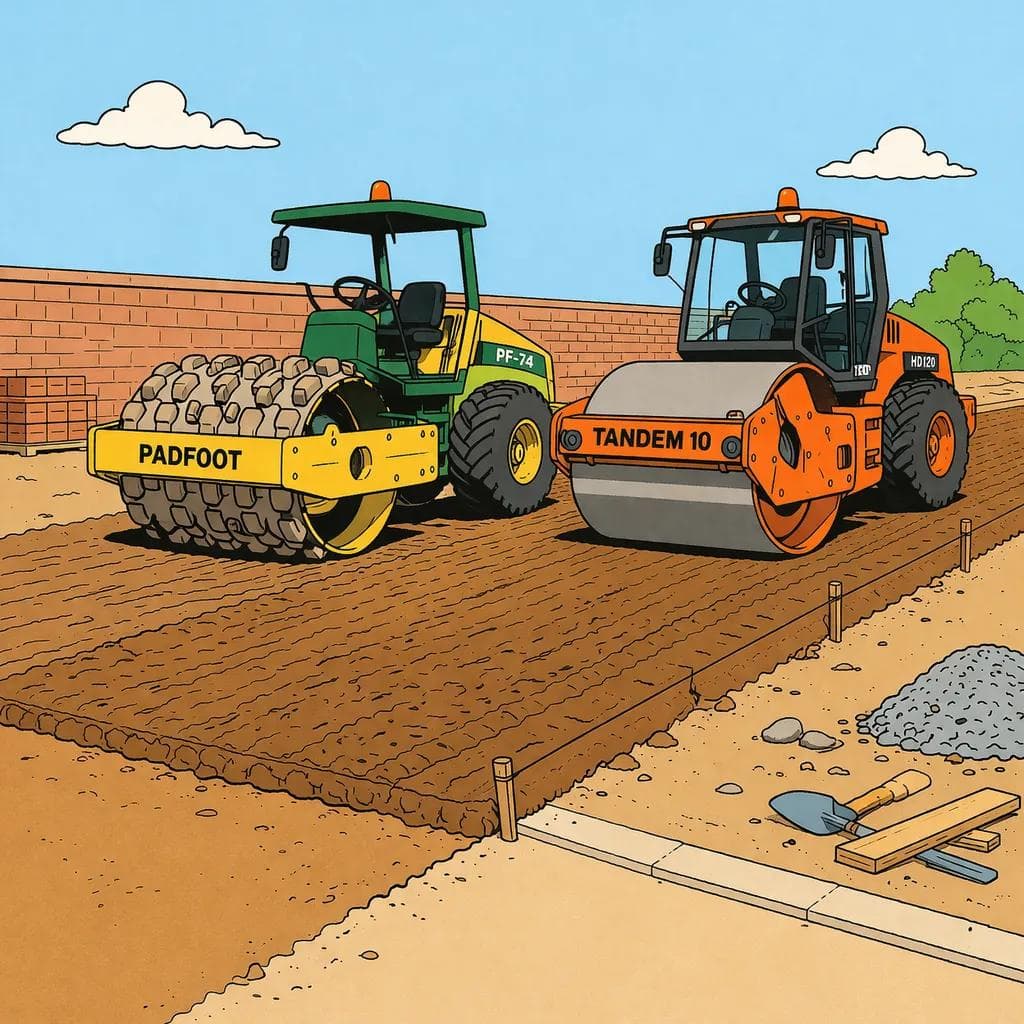
Padfoot (or "sheepsfoot") rollers are heavy compaction machines with protruding lugs or "feet" on the drum. Each foot creates a high-pressure point that initially knocks down soil, then the foot acts like a leg walking across the material. Sheepsfoot rollers are ideal for clay soils and subgrade compaction. Padfoot variants handle cohesive soils. Both are judged primarily on pass count—the number of times the drum crosses the same spot—because pass count directly determines density.
| Roller Type | Primary Use | Key Tracking Metrics | Vibration Relevance |
|---|---|---|---|
| Padfoot/Sheepsfoot | Clay, silt, subgrade | Pass count, overlap, foot pressure | High—foot impact indicates compaction |
| Smooth Drum | Asphalt, final layers | Pass count, vibration frequency, temp | Critical—vibration frequency = compaction quality |
| Pneumatic Tire | Asphalt, flexible pavements | Pass count, tire pressure, load | Moderate—tire deflection matters |
| Plate Compactor | Trenches, utilities, small areas | Pass count, impact frequency, height variance | Very high—impact rate = compaction rate |
Key Metrics: Beyond Speed and Location
Key Takeaways
- GPS pass counting verifies compaction specs and provides DOT-compliant documentation for 100% of job sites.
- Engine hour tracking predicts bearing and eccentric weight replacement ($5,000–$15,000 per service) with 85% accuracy.
- Vibration amplitude and frequency monitoring reduce compaction failures by 40% on soil and asphalt projects.
- Fleet utilization data shows that 35% of owned compactors sit idle more than 60% of the season, enabling faster ROI on right-sizing.
- Rental billing by engine hours—vs. calendar days—increases equipment revenue per unit by 25–30% on seasonal fleets.
Pass Count
Every pass of the roller across a section of road or embankment must be tracked and logged. GPS provides continuous position data; the system counts each time the drum crosses the same coordinates. This is the foundation of Intelligent Compaction. Major manufacturers (HAMM, Caterpillar, Bomag, Dynapac, Sakai, Volvo) now ship rollers with onboard GPS; Hapn integrates directly with their telematics APIs to pull pass count data in real time.
Vibration Amplitude & Frequency
A smooth drum roller vibrating at 80 Hz with 2mm amplitude compacts material differently than one vibrating at 60 Hz with 1mm amplitude. Engineers specify target vibration profiles. Hapn's telematics captures both metrics and flags deviations—a sign that the drum is worn, the eccentric weight is failing, or the operator is not following spec.
Engine Hours
Drum bearings, eccentric weights, and vibration systems degrade based on cumulative operating time, not calendar time. A compactor running 12 hours a day for 60 days will need preventive maintenance sooner than one running 4 hours a day for 180 days, even if the calendar elapsed time is the same. Engine hour tracking allows you to schedule maintenance before failure.
Utilization & Idle Time
Seasonal compactor fleets often carry excess capacity. Hapn's utilization reports show you which rollers are earning their keep and which are sitting idle on the yard. This is especially critical for rental operations, where daily or hourly billing models leave money on the table if equipment isn't on job sites.
Why Compactor Tracking Is Different from Excavator or Dozer Tracking
Speed-based metrics don't work. A compactor moving at 2–3 mph for 8 hours is working hard; an excavator at the same speed is broken down. Standard "distance traveled" and "mph" metrics mislead fleet managers.
Repetition is the output. You don't care how far the roller traveled. You care how many times it covered the same ground. That's what creates compaction.
Downtime is hard to detect. A compactor sitting on site, with the engine idling, is technically "running" but not productive. Hapn's system distinguishes between idle engine hours (no vibration, no GPS movement) and active compaction hours.
Vibration is health data. Excavators don't have drum vibration systems. Compactors do. Abnormal vibration is often the first warning sign of bearing wear, eccentric weight imbalance, or drum damage. Ignoring it costs $10,000+ in unplanned downtime.
Compliance & Documentation
Modern road and infrastructure projects, especially state DOT contracts and FHWA-funded work, increasingly require Intelligent Compaction (IC) data as part of the contract deliverables. IC systems must be certified, and the GPS/vibration data must be logged, time-stamped, and auditable.
Hapn provides construction-grade telematics that integrates with industry-standard IC systems and exports compliance-ready reports. Job inspectors can pull pass count data, vibration logs, and operator names directly from Hapn. No spreadsheets, no disputes.
For contractors and rental companies, this turns compliance from a burden into a competitive advantage. You have the data. Your competitors don't. When a spec question comes up, you win.
The Rental Advantage
Rental houses and contractors using compactors heavily rely on accurate billing. Many lease compactors by the hour or by engine hours, not by the day. Hapn's engine hour tracking provides granular, auditable billing records.
More important: rental companies can predict utilization trends and adjust fleet size. If pass-count and utilization data show that your compactor fleet is idle more than 40% of the season, you can right-size, reduce carrying costs, and improve fleet ROI by 15–20% within a year.
Geofencing & Theft Protection
Compactors are less frequently stolen than excavators or wheel loaders—they're specialized, hard to transport, and have limited resale value. But they do go missing, especially on multi-site projects or when rental units move between yards.
Hapn's asset tracking platform includes geofencing. Set a boundary around your job site or yard. If a roller leaves the zone, you get an instant alert. For seasonal fleets, geofencing also prevents equipment being left on completed projects.
How to Deploy GPS Tracking on Your Compactor Fleet
Integration-First Approach
Most modern compactors (HAMM, Caterpillar, Bomag, Dynapac, Sakai, Volvo) ship with onboard telematics systems that push data to manufacturer cloud platforms. Hapn integrates directly with these APIs, so you don't need to install hardware on each machine.
If you have older equipment or machines without onboard telematics, Hapn also supports plug-and-play GPS devices. These mount to the roller's frame and send pass count and vibration data via cellular uplink.
Real-Time Visibility & Reporting
Once integrated, your fleet appears on Hapn's web dashboard and mobile app. You see:
- Current location and operating status (active, idle, moving)
- Pass count and vibration trends for the active job site
- Engine hours and maintenance due dates
- Utilization heatmaps showing which equipment is earning its cost
- Compliance reports ready to send to inspectors or your own QA team
Operator & Inspector Access
You can grant mobile access to job site operators and inspectors. They see real-time pass count and vibration data on their phones, so they can verify compaction specs in the field—no waiting for end-of-day reports.
Competitive Landscape
Some compactor manufacturers bundle basic IC systems with their equipment. These systems are manufacturer-locked and often don't integrate with your existing fleet management software. Hapn is manufacturer-agnostic, works across your entire mixed fleet (compactors, dozers, excavators, trucks), and gives you a unified command center.
Leading contractors and rental companies use Hapn because it's built for the way construction actually works—mixed fleets, multiple job sites, complex compliance requirements, and the need for real-time data to drive decisions.
Pricing & Getting Started
Hapn doesn't lock you into contracts. You pay per asset per month. View transparent pricing and start a free trial today. Within a week, you'll have your fleet on the platform, seeing real-time compaction data, and using it to improve specs compliance and utilization.
For rental companies, the savings in right-sizing alone often cover the monthly cost within the first season.
FAQ
Does Hapn work with my manufacturer's telematics system?
If you have HAMM, Caterpillar, Bomag, Dynapac, Sakai, or Volvo equipment with onboard telematics, Hapn integrates directly via API. If you have older equipment or a different brand, we can equip it with our plug-and-play GPS device. Reach out to our team to confirm compatibility.
What's the difference between pass count and idle engine hours?
Pass count is the number of times the roller crosses the same ground. Idle engine hours are hours when the engine is running but the roller isn't moving or vibrating—sitting between job sites or waiting for the next section. Hapn tracks both, so you can distinguish productive time from costs.
Can I use Hapn data for DOT compliance reporting?
Yes. Hapn exports pass count, vibration, and engine hour logs in standard formats that meet DOT and state-level Intelligent Compaction documentation requirements. Our data is time-stamped and audit-ready.
How often is GPS data updated?
GPS location updates every 10–30 seconds depending on your configuration. Vibration and engine hour data are updated every 5–10 seconds. If you need higher-frequency data for research or advanced analytics, Hapn's API gives you direct access to the raw feed.
What if my compactor goes offline temporarily?
If a roller loses cellular connection (common in tunnels or remote job sites), the device buffers data and syncs when connection is restored. You don't lose pass count or vibration records—they backfill into the system.
Can I set up alerts for abnormal vibration?
Yes. Hapn's alerting system lets you define thresholds for vibration amplitude, frequency, and idle time. If a drum starts vibrating outside spec, you get an instant SMS or email alert. This helps catch bearing wear and eccentric weight failure before they become emergency repairs.
Learn More
Interested in GPS tracking for your compactor or roller fleet? Hapn makes it simple. Read about equipment tracking, explore our vehicle tracking platform, or check out related articles on construction equipment management, rental fleet optimization, and asset recovery.
For deeper dives, read our blog posts on engine hour–based maintenance strategies, fleet utilization benchmarks for 2026, and construction equipment theft: the $1 billion problem.
Last updated: March 2026
Written by Hapn
Hapn is a GPS tracking and telematics platform for construction, rental, and field service fleets. We track 463,000+ assets for 50,000+ customers, with $720M in recovered stolen equipment and zero long-term contracts. Learn more at gethapn.com.