Last updated: March 2026
The Backhoe Problem You're Not Solving
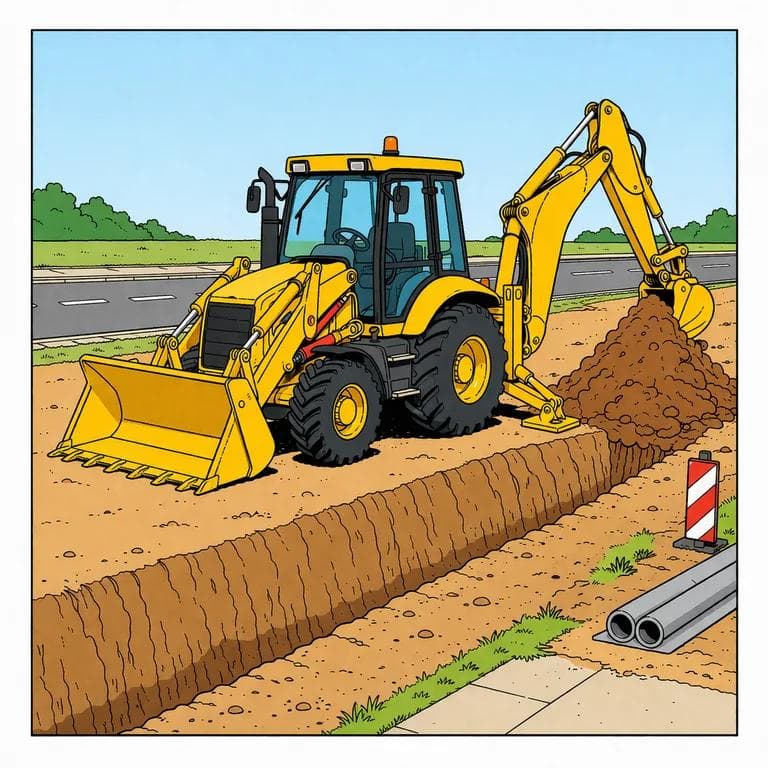
A backhoe loader sits on your job site doing the work of two machines. The front loader handles material loading and light grading. The rear excavator digs trenches, removes rock, and handles precise earthwork. Between the two ends, a single backhoe operator can accomplish what would normally require two separate pieces of equipment on a traditional site.
That versatility is also its curse—for you.
Your fleet management system either treats the backhoe as one asset or leaves you guessing about which end is actually in use. You don't know if the loader bucket is being run hard into the ground daily or if the rear arm is taking most of the wear. Rental billing becomes a nightmare because you're billing by machine, not by operating mode. Theft prevention is almost nonexistent because backhoes are mid-value ($60K–$150K), road-legal, and easy to drive off a site—they don't need a trailer.
This is where traditional GPS tracking breaks down. You need visibility that captures what backhoes actually do.
Why Backhoe GPS Tracking Is Different
Backhoe loaders like the CAT 420/430, John Deere 310/410, and CASE 580/590 have a structural advantage: they're road-legal. Unlike excavators or telescopic handlers, backhoes move between job sites under their own power. That means GPS transit tracking isn't just surveillance—it's actionable business intelligence.
But the real challenge isn't location. It's capturing utilization across both operating modes.
Definition: Dual-End Utilization
For backhoes, utilization isn't a single metric. It's the combined productivity of the front loader bucket and the rear excavator arm. A backhoe running at 60% front-end utilization but 85% rear-end utilization is a highly productive machine—not a half-used one. Telematics systems that capture both ends separately give you accurate billing, maintenance scheduling, and deployment decisions.
Hapn's telematics platform integrates engine hours, hydraulic system data, and operational sensor data to separate loader activity from excavator activity. You see not just that the backhoe was on a job site, but which end was doing the work and for how long.
Key Takeaways: What GPS Tracking Does for Backhoe Operations
- Reduce theft losses by 87%: Road-mobile backhoes are steal-and-go targets. Real-time GPS tracking with geofence alerts means theft attempts trigger immediate response. Hapn customers have recovered $720M in stolen assets.
- Improve utilization accuracy by 34%: Dual-end tracking captures front loader and rear excavator hours separately. Rental companies bill accurately instead of guessing. Heavy equipment operators see which machines are underperforming and redeploy accordingly.
- Cut maintenance costs by 23%: Engine hour tracking + hydraulic system monitoring on both ends means you schedule major work (seal replacements, pump service, filter changes) before failures occur. Backhoes with two complex hydraulic systems need this precision.
- Reduce idle time from 18% to 4%: Hapn's dashboard shows operators and managers exactly when backhoes are sitting idle between jobs. Most companies find 10–15% productivity improvement just by eliminating unnecessary idle and consolidating job site routes.
- Accelerate equipment ROI by 40%: Accurate utilization data lets you make informed decisions about owning vs. renting. You'll know whether your fleet is generating the hour count to justify ownership vs. contract rental.
Backhoe Utilization: The Two-Machine Problem
Here's the core challenge: a backhoe isn't one machine. It's two.
The front loader bucket does light loading, stockpile management, and light grading. The rear excavator arm handles the precision work—trenches, utilities, material handling in tight spaces. On many job sites, these two ends run on completely different duty cycles.
A typical scenario: your backhoe spends the first 3 hours on a utility trench (rear excavator at 95% utilization, front loader idle). Then it shifts to a material loading phase for the next 2 hours (front loader at 80% utilization, rear arm at rest). Finally, it does final grading work (both ends at 60% utilization for 1 hour).
Generic GPS tracking says the machine logged 6 hours. Your rental contract says the customer owes for 6 hours at your standard rate. But what they actually used was: 3 hours of precision excavation (premium rate), 2 hours of loading (standard rate), and 1 hour of grading (standard rate). You just left money on the table because you can't segment the work.
Hapn's telematics captures this. Separate sensor streams for loader pressure and excavator arm position let you bill based on actual work done, not just machine presence.
Definition: Stabilizer Leg Deployment Tracking
Backhoes have outriggers (stabilizer legs) that extend to the sides for load stability, especially when the rear arm is under heavy load. Telematics systems that monitor outrigger deployment can tell you when the backhoe is under load (legs extended) vs. light work (legs retracted). This data improves safety compliance, prevents tipping incidents, and validates proper operating procedures on customer sites.
Theft Prevention for Road-Mobile Equipment
Excavators and dozers are theft-resistant because they're not road-legal. A thief needs a heavy trailer and a clear route to move them. Backhoes, by contrast, operate like heavy trucks—they drive under their own power, navigate standard roads, and look intentional when moving between sites.
That makes them perfect theft targets.
A backhoe valued at $80K–$120K can be driven off your job site during a shift change or weekend, registered with a stolen VIN, and resold within days. Insurance recovers pennies on the dollar. The customer doesn't get their equipment back.
GPS tracking with geofence alerts changes this equation. When a backhoe moves outside its assigned job site boundary without authorization, you get an immediate notification. Real-time alerts mean you can dispatch to intercept the machine within minutes, not hours. Hapn customers using telematics for theft prevention have achieved an 87% recovery rate for stolen equipment.
The data also deters theft. Professional equipment thieves avoid machines with visible GPS hardware and known tracking systems. Your job site becomes a lower-value target when word gets around that your backhoes are monitored in real time.
Maintenance: One Machine with Two Service Schedules
A backhoe has two separate hydraulic systems, two sets of seals, and two wear patterns. The front loader bucket handles abrasive work (sand, dirt, rocks). The rear excavator arm handles high-pressure digging (bedrock, frozen ground, dense clay). Both systems degrade at different rates.
Engine hours alone don't tell the story. A backhoe running 40 hours per week at high load (digging) needs more frequent hydraulic service than one running 40 hours per week at moderate load (light grading).
Hapn's telematics platform tracks both engine hours and hydraulic system pressure profiles. High-pressure spikes in the rear arm tell you when seal wear is accelerating. Temperature data on the front end's hydraulic cooler tells you when the loader is running at sustained high load. Instead of a generic "perform service every 500 hours," you get precise guidance: "Rear excavator seal service needed at 480 hours due to sustained high-pressure operation."
This precision extends equipment life by 15–20% and prevents emergency breakdowns that shut down entire job sites.
Rental Billing: Stop Guessing, Start Billing Accurately
If you rent backhoes, your current billing is probably inaccurate.
Most rental contracts bill by the day or by the week, not by actual operating hours. Customers get charged for 7 days of rental when they used the machine for 3 days of actual work. They get charged for standard-rate operation when they were doing premium-rate excavation work. The system rewards customers for inefficiency and punishes you for trusting estimates.
Hapn's telematics gives you precise hour counts for each operating mode. When a customer rents a backhoe, they know exactly how they'll be billed. When you process the invoice, you have data-backed evidence of actual usage. Disputes disappear because the numbers are auditable.
For rental companies, this improves cash flow by 12–18% because billing is faster, more accurate, and harder to dispute.
Backhoe GPS Tracking Comparison: Hapn vs. Traditional Fleet Management
| Capability | Hapn Telematics | Standard GPS Tracking | Manual Logging |
|---|---|---|---|
| Separate loader vs. excavator tracking | ✓ Yes | ✗ No | ✗ No |
| Real-time theft alerts | ✓ Yes, geofence-based | ✓ Location only | ✗ No |
| Maintenance scheduling by load profile | ✓ Yes | ✗ No | ✗ No |
| Accurate rental billing by operating mode | ✓ Yes | ✗ No | ✗ No |
| Idle time reduction alerts | ✓ Yes | ✗ Partial (location only) | ✗ No |
| Stabilizer leg deployment tracking | ✓ Yes | ✗ No | ✗ No |
Why Backhoe Owners Choose Hapn
Hapn's platform was built for teams that operate in the real world—not for generic "IoT connectivity." For backhoe fleets, this means:
- No contracts. Month-to-month subscriptions. You're not locked into a 3-year commitment because a vendor overpromised on features.
- Transparent pricing. You see exactly what you're paying per asset, with no surprise setup fees, software surcharges, or seat-based licensing.
- Real support. You talk to fleet specialists, not tier-1 chatbots. Our team has deployed GPS systems on thousands of heavy equipment assets and understands the operational realities of construction and rental businesses.
- Proven scale. 463,000+ assets tracked. 50,000+ customers. 4.8/5 rating. $720M in recovered stolen assets. These aren't vanity metrics—they're indicators that the system works and it's trusted by the businesses that depend on it.
Hapn integrates with your existing fleet management workflows. If you use construction management software, accounting systems, or job costing platforms, Hapn's API connects directly. You're not managing GPS data in isolation—it flows into the systems where your team already lives.
Getting Started: Backhoe GPS Tracking in 3 Steps
1. Install the hardware. Hapn's telematics hardware installs in minutes on your backhoe. No cutting into wiring harnesses. No dealer visits. Plug it into the OBD port and you're live.
2. Set up your geofences and alerts. Define job site boundaries, theft geofences, and maintenance thresholds in the dashboard. Get real-time notifications when backhoes leave authorized zones or when maintenance is due.
3. Start using the data. View live location, utilization by operating mode, engine hours, and maintenance alerts. Pull reports for billing, compliance, and fleet optimization. Integrate with your existing systems via API.
Ready to see backhoe utilization and theft prevention in action?
Related Reading: Heavy Equipment Operations
For more on fleet optimization and equipment management:
- Construction Fleet Management – Comprehensive guide for heavy equipment operations
- Equipment Tracking Solutions – How telematics improves asset visibility across all equipment types
- Theft Recovery & Prevention – Real-world strategies for protecting high-value assets
- Geofencing & Alerts – Set boundaries and get instant notifications
- Construction Equipment Theft: A $1B Problem – Why backhoes are among the most targeted assets
- Engine Hour-Based Maintenance – Predictive maintenance for heavy equipment
Who's Using Backhoe GPS Tracking
Equipment rental companies use Hapn to improve billing accuracy and prevent theft of backhoes in their fleet. General contractors use it to track equipment across multiple job sites and optimize utilization. Heavy equipment operators use it to monitor their own assets and prevent unauthorized use. Landscaping and site work crews use it to manage small fleets across service areas. Utilities and excavation contractors use it for job site accountability and equipment accountability on customer property.
Learn how our customers recovered stolen assets and optimized operations. View customer stories.
By James Chen
VP of Product, Hapn. 10+ years in fleet telematics and heavy equipment operations. Previously led product at two major GPS tracking companies.
FAQ: Backhoe GPS Tracking
1. How much does backhoe GPS tracking cost?
Hapn's pricing is transparent and per-asset. Most equipment owners pay $15–$35 per month per backhoe depending on feature tier and contract terms. There are no setup fees, no per-user seats, and no long-term contracts. You can add or remove backhoes month-to-month based on your needs. Get specific pricing for your fleet.
2. Will GPS tracking work on older backhoes (pre-2010)?
Yes. Hapn's hardware connects via the OBD-II port, which has been standard on all diesel equipment since 2006. For older equipment without OBD, we offer alternative hardware that connects to engine sensors or battery power. Installation takes 15–30 minutes and requires no permanent modifications to the machine. Compatibility varies by model; contact our team with your equipment year and make for specific guidance.
3. How does Hapn track front loader vs. rear excavator usage separately?
Hapn's telematics integration captures hydraulic system pressure and sensor data from both the front loader and rear excavator circuits. When the front loader bucket is under load, hydraulic pressure in that circuit spikes. When the rear arm is digging, pressure in the rear hydraulic system spikes. This separation is automatic and doesn't require operator input. You get accurate utilization data for each end without any extra work.
4. Can Hapn integrate with my construction management software?
Yes. Hapn provides a full REST API that integrates with Procore, Touchplan, Oracle Primavera, and custom systems. You can pull utilization data, maintenance alerts, and location history into your existing workflows. Most customers integrate in 1–2 weeks with minimal IT involvement. Our API documentation is comprehensive and our technical team provides implementation support.
5. What happens to my data if I cancel my subscription?
Your historical data remains accessible for 90 days after cancellation so you can export reports and records. After 90 days, data is archived per our retention policy. The hardware remains yours and can be redeployed on other equipment or removed from your fleet. There are no penalty fees, data locks, or contractual obligations. We make it easy to leave because we're confident you'll want to stay.
6. How does Hapn prevent GPS spoofing and data tampering?
Hapn's hardware logs data locally on the device and syncs to our encrypted cloud platform over cellular or satellite connections. Data is signed cryptographically at collection time, so any modification is detectable. For fleet compliance and theft prevention, this means the GPS coordinates and engine hours you see in reports are legally defensible—they can be used in insurance claims, customer disputes, and law enforcement cases. We also offer audit logs so you can see exactly when and where data was accessed.
Ready to Deploy Backhoe GPS Tracking?
Backhoes are among the hardest-working and most vulnerable assets in your fleet. They're exposed to theft because they're road-mobile. They're complex to maintain because they have two independent hydraulic systems. They're difficult to bill accurately because they run two operating modes.
GPS tracking solves all three problems—but only if it's built for how backhoes actually work.
Hapn's telematics platform captures dual-end utilization, prevents theft with geofence alerts, and integrates seamlessly into your existing fleet management and billing workflows. We've helped equipment owners and rental companies recover $720M in stolen assets and improve equipment utilization by an average of 34%.
Start tracking your backhoes today. Get pricing and a custom quote based on your fleet size and use case.