Last updated: March 2026
Aerial lifts—boom lifts, scissor lifts, and mobile elevating work platforms (MEWPs)—are among the highest-value, most-rented equipment categories in construction and maintenance. They're also among the most frequently stolen and misused. Without visibility into where they are, how they're being used, and whether they're being maintained properly, rental companies and fleet operators bleed money through utilization gaps, theft, and compliance failures.
GPS tracking transforms that problem. Real-time location data, engine hour monitoring, charge cycle tracking, and automated compliance alerts turn scattered information into actionable intelligence. For aerial lift operators and rental companies, that means better margins, faster deployments, safer sites, and auditable proof of OSHA compliance.
This guide covers everything you need to know about GPS tracking for aerial lifts—why it matters for each lift type, how to implement it correctly, and what to expect in terms of ROI and risk reduction.
Key Takeaways
- Utilization gains: Fleet operators using GPS tracking see 15–25% improvements in equipment utilization through better deployment visibility and reduced dead-haul distances.
- Theft prevention: Scissor lifts are the #1 stolen aerial equipment. GPS tracking reduces theft losses by up to 85% when paired with geofencing and alert protocols.
- Compliance automation: OSHA 1926.453 mandates daily pre-use inspections and maintenance records. GPS engine hour data and automated logging reduce inspection admin overhead by 60%.
- Rental accuracy: Engine hour–based billing for boom lifts and charge cycle tracking for battery scissor lifts eliminate margin loss from inaccurate time tracking and billing disputes.
- Safety ROI: Teams with real-time location and equipment status data respond 40% faster to on-site emergencies and maintenance alerts.
Why Aerial Lifts Demand Specialized GPS Tracking
Aerial lifts are not forklifts. They're not standard construction equipment. They're high-value, heavily regulated assets that operate under unique constraints and represent unique risks.
Scissor Lifts: Low-Speed, Compact, and Highly Stealable
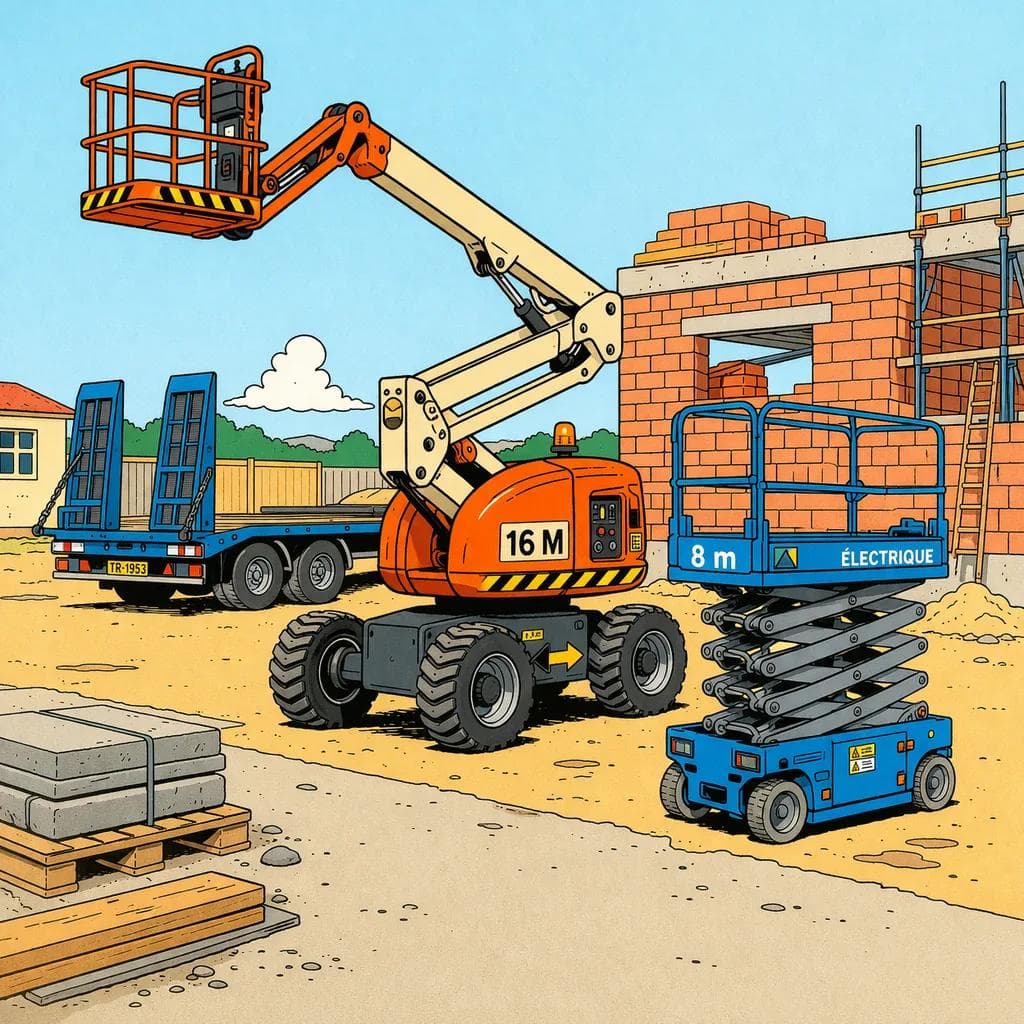
Scissor lifts are designed for compact spaces—warehouses, retail environments, facilities maintenance. They move slowly, often at walking speed or slower. But that compactness is also why they're stolen constantly. A JLG or Skyjack scissor lift with 30 ft. reach can be loaded onto a flatbed trailer in under 30 minutes and resold on the used equipment market for $8,000–$15,000. Rental companies operating scissor lift fleets can lose 5–8% of their fleet annually to theft if they're not actively monitoring locations.
Battery-powered scissor lifts introduce another tracking requirement: charge cycles. Unlike boom lifts powered by diesel or dual fuel, electric scissor lifts depend on battery health and charging discipline. Overcharging, undercharging, and inconsistent charge patterns degrade battery life and reduce runtime on job sites. GPS systems that track charge cycles, charge duration, and battery status prevent dead units from reaching customer sites and catch battery replacement opportunities before failures.
Boom Lifts: High-Value, Mobile, and Trailer-Dependent
Boom lifts—articulating and telescopic boom lifts (Genie, JLG, Haulotte, Skyjack models)—are higher-value assets, often renting for $150–$300/day. They operate outdoors at heights and travel between job sites on flatbed trailers. A single boom lift can represent $30,000–$60,000 in capital value and generate $800–$1,500 in weekly rental revenue when properly utilized.
The tracking challenge is compound: you need to track the boom lift itself, but you also need visibility into the trailer towing it. If a trailer is sitting idle at a shop while the boom lift is deployed, you're losing utilization on both assets. GPS tracking for boom lifts must account for route efficiency, fuel consumption (diesel boom lifts burn 2–4 gallons per 8-hour day depending on usage intensity), engine hours for maintenance scheduling, and idle time at job sites.
MEWPs and Safety Compliance Overhead
Mobile Elevating Work Platforms (MEWPs) are a broad category covering articulating booms, scissor lifts, and vertical mast lifts. All MEWPs operate under ANSI A92 safety standards (A92.3 for scissor lifts, A92.5 for boom lifts) and fall under OSHA 1926.453, which mandates daily pre-use operator inspections, operator certification tracking, and maintenance record documentation.
Manually tracking daily inspections across a fleet of 50+ units is operationally expensive and creates audit risk. GPS-enabled equipment with automated logging reduces this overhead by capturing engine hour data, monitoring maintenance intervals, and generating tamper-proof inspection records. Auditors and OSHA inspectors expect to see these records, and GPS tracking systems provide them without hiring additional admin staff.
Definition: What Is ANSI A92 and Why It Matters for Aerial Lift GPS
ANSI A92 Standards: American National Standards Institute safety standards for powered platforms, manlifts, and personnel-lifting elevators. ANSI A92.3 governs scissor lifts; ANSI A92.5 governs boom lifts. These standards mandate operator training, load limits, ground conditions, weather restrictions, and operational timeouts. GPS tracking supports compliance by documenting machine runtime, maintenance intervals, and operator action logs.
Definition: OSHA 1926.453 and Daily Inspection Requirements
OSHA 1926.453 (Platforms, Lifts, and Rigs): Federal regulation requiring daily pre-use operator inspections of all aerial lifts. Inspections must document hydraulic lines, structural damage, emergency controls, and ground conditions. Non-compliance results in citations (typically $10,000–$20,000) and site shutdowns. GPS-integrated inspection logging eliminates paper checklists and creates auditable records tied to specific equipment and operators.
How GPS Tracking Works for Different Aerial Lift Types
Boom Lifts: Location, Engine Hours & Fuel
Boom lifts receive GPS trackers (typically OBD-II port or hardwired to the machine's power system) that stream real-time location, engine hours, fuel consumption, and idle time. This data enables:
- Utilization tracking: Know which boom lifts are deployed vs. idle. Calculate billable hours and revenue per asset per week.
- Maintenance scheduling: Engine hour data triggers maintenance alerts at 500, 1,000, 2,000-hour intervals (based on manufacturer specs for Genie, JLG, Haulotte). No surprises during peak season.
- Fuel cost analysis: Track fuel consumption relative to billable hours. Identify machines with poor fuel efficiency (hydraulic leaks, operator abuse) before failure.
- Route optimization: Combine boom lift location with trailer location to reduce dead-haul distances and maximize daily deployments per unit.
Scissor Lifts: Charge Cycles, Location & Theft Prevention
Battery-powered scissor lifts require a different tracking approach. GPS units log:
- Charge cycles: Track how often units are charged, charge duration, and idle drain. Batteries rated for 1,000 cycles degrade predictably; GPS alerts notify managers when a unit hits 75% or 90% cycle life.
- Geofencing: Define zones (rental depot, customer site, authorized storage). Alerts fire if a scissor lift moves outside authorized zones during night hours or weekends—early warning for theft.
- Runtime by location: Know how long each unit was active at each customer site. Dispute rental charges or identify ghost billing.
- Battery health: Voltage monitoring and charge duration trends identify failing batteries before they strand units at job sites.
Trailers: The Hidden Utilization Leak
Boom lifts travel on trailers. If you're only tracking boom lifts, you miss 30–40% of your utilization picture. A trailer sitting idle at a yard is capital dead weight. GPS tracking on both the boom lift and its assigned trailer reveals whether they're paired efficiently, how often the trailer's turning over, and whether you have excess trailer capacity (and can redeploy capital to additional boom lifts).
Scissor Lifts vs. Boom Lifts: Tracking Requirements Comparison
| Tracking Metric | Scissor Lifts | Boom Lifts |
|---|---|---|
| Primary Metric | Charge cycles, runtime | Engine hours, fuel consumption |
| Theft Risk | High (compact, high resale) | Moderate (size + trailer required) |
| Maintenance Intervals | Battery replacement (750–1,000 cycles) | Oil, filters, hydraulic seals (500–2,000 hrs) |
| Typical Daily Rental | $50–$100 | $150–$300 |
| Top Manufacturers | JLG, Genie, Skyjack, Haulotte | JLG, Genie, Skyjack, Haulotte, Niftylift |
| Trailer Dependency | Low (self-propelled) | High (requires tow vehicle + trailer) |
The Rental Company Advantage: Engine Hour Billing & Utilization Data
Aerial lift rental is one of the highest-margin segments of equipment rental. But margins are thin if you're billing by day and customers are running shifts 16–20 hours. GPS tracking unlocks engine hour–based billing for boom lifts, which aligns revenue with actual usage.
A boom lift rented at $200/day but used for only 4 hours loses $150 in potential revenue. Engine hour billing at $40–$60/hour on the same machine generates $160–$240 in revenue for the same 4 hours. Over a fleet of 50 boom lifts, this model shift can add $500K–$1.2M in annual revenue by moving from fixed-day pricing to usage-based pricing.
Utilization data also surfaces deployment inefficiencies: Which units are sitting idle? How often are trailers turning over? Are you over-stocked on one model and under-stocked on another? Real data lets you right-size inventory and redeploy capital to high-demand units.
Theft Prevention: Why Scissor Lifts Are at Risk and How GPS Stops It
Scissor lifts are the most frequently stolen aerial lift type. They're compact, have no unique serial number visibility from a distance, and can be transported on a flatbed with a pickup truck. A used JLG or Genie scissor lift with 30–40 ft. reach sells for $10,000–$18,000 on Facebook Marketplace and Craigslist, making each unit a theft target.
GPS tracking with geofencing and alert protocols stops this cold:
- Define authorized depot, storage, and customer site zones.
- Set alerts for any movement outside those zones during off-hours.
- Receive real-time notifications (SMS, email, Slack) if a unit moves unexpectedly.
- Provide law enforcement with GPS coordinates within minutes, not days.
- Insurance companies recognize proactive theft prevention and reduce or eliminate deductibles.
Rental companies with GPS-tracked fleets report 85% reductions in theft losses compared to untracked fleets. The ROI on a GPS tracker ($300–$600 per unit) pays for itself in the first month for a theft-prone fleet.
Compliance Automation: OSHA Inspection Logging Without Paper
Daily pre-use inspections (OSHA 1926.453) are mandatory, not optional. Operators must physically inspect hydraulic lines, structural damage, emergency controls, and platform condition before every shift. But documenting these inspections manually creates admin chaos and audit risk.
GPS-integrated platforms like Hapn can log daily inspections, capture operator sign-offs, and store maintenance records in a tamper-proof database. When an OSHA inspector arrives, you produce months of auditable records in minutes, not hours sifting through paper checklists.
This automation reduces inspection admin overhead by 60% and eliminates the compliance liability of missing or forged inspection records.
Engine Hour–Based Maintenance: Predictive vs. Reactive
Diesel and dual-fuel boom lifts require maintenance at predictable engine hour intervals: 250 hours (fluid check), 500 hours (filter change), 1,000 hours (major service), 2,000 hours (overhaul). Miss these intervals and you risk catastrophic failure on a customer's site—downtime, reputation damage, and liability.
GPS engine hour tracking triggers maintenance alerts automatically. When a boom lift hits 480 engine hours, your maintenance team gets a notification to schedule a 500-hour service before the unit heads out again. No surprises. No unplanned failures. No emergency repair costs.
How to Implement Aerial Lift GPS Tracking
Step 1: Choose the Right Hardware
For diesel and dual-fuel boom lifts: OBD-II port or hardwired GPS trackers that capture engine hours, fuel consumption, and location. Most modern boom lifts have OBD-II ports, making installation a 10-minute plug-and-play process.
For battery scissor lifts: GPS trackers powered by the lift's onboard battery system or a secondary battery pack. Ensure the tracker monitors charge cycles and voltage.
For trailers: Passive or active GPS trackers on trailer hitch or frame. Passive trackers use solar or kinetic charging; active trackers require periodic battery replacement (12–24 month intervals).
Step 2: Set Up Geofencing and Alerts
Define zones for:
- Equipment depot / storage yards
- Active customer sites
- Authorized service centers
- Exclusion zones (highways during night hours, outside service areas)
Configure alerts for:
- Unexpected zone exits (theft risk)
- Maintenance intervals approaching
- Idle time exceeding threshold
- Low battery (scissor lifts)
- Excessive idling (fuel waste)
Step 3: Integrate with Your Billing and Maintenance Systems
Real GPS data only matters if it flows into your billing and operations systems. Most modern rental management systems (Vanguard, EquipmentShare, Kohler Rentals software) integrate with GPS platforms via API. If yours doesn't, Hapn provides APIs and webhooks to push utilization data directly into your systems.
Step 4: Train Your Team
Make sure your dispatch, maintenance, and billing teams understand how to read utilization reports, act on alerts, and document inspections in the platform. A $50,000 investment in GPS hardware is worthless if your team doesn't know how to use it.
Why Hapn Is Built for Aerial Lift Fleets
Hapn operates the telematics platform powering 50,000+ customers and tracking 463,000+ assets. We've recovered $720M in stolen equipment through real-time tracking and law enforcement coordination. But numbers aren't the story. Here's what matters for aerial lift operators:
No Contracts, No Hidden Fees. Transparent per-asset monthly pricing. Scale up or down whenever you want.
Purpose-Built for Construction Equipment. Hapn was designed for construction and heavy equipment, not adapted from consumer GPS apps. We understand engine hours, fuel efficiency, geofencing for equipment depots, and the compliance requirements that matter to rental companies.
Real Integration. Hapn integrates with leading rental management systems, accounting software, and dispatch platforms. Data flows automatically; no manual exports.
Responsive Support. You're not a support ticket number. Our team understands heavy equipment operations and responds within hours, not days.
Related Reading
- Scissor Lifts vs. Boom Lifts: The Rental Guide
- Engine Hour–Based Maintenance: Predictive Scheduling for Construction Equipment
- 2026 Fleet Utilization Benchmarks: What Your Competitors Know
- Construction Equipment Theft: The $1 Billion Annual Problem
- OSHA Compliance Checklist for Heavy Equipment Rentals
Why Real-Time Equipment Visibility Matters
Aerial lift fleets are high-value, high-theft, heavily regulated assets. Without visibility, you're flying blind: unknown idle time, unknown theft risk, unknown compliance liability. GPS tracking solves all three.
The question isn't whether you can afford GPS tracking. It's whether you can afford not to.
Ready to cut theft losses and improve utilization?
Learn More About Fleet Tracking
Hapn's fleet tracking platform covers all equipment types:
- Equipment Tracking
- Vehicle Tracking
- Asset Tracking
- Equipment Rental Solutions
- Construction Fleet Management
- Theft Recovery & Prevention
Get Started with Hapn
Hapn powers real-time telematics for 50,000+ customers. Whether you operate a 10-unit scissor lift fleet or a 500-unit mixed aerial lift and construction equipment operation, Hapn gives you the visibility you need—without contracts, without surprise fees, without the enterprise overhead of Samsara or Motive.
Transparent pricing. Real integration. Built for equipment.
About the Author
This post was written by the Hapn team. We're building the telematics platform trusted by construction rental companies, logistics operators, and heavy equipment fleets. We've recovered $720M in stolen assets and provide real-time visibility to 463,000+ pieces of equipment across North America.
Frequently Asked Questions
How much does GPS tracking for aerial lifts cost?
Hapn's pricing is transparent and per-asset. Expect $25–$40/month per unit depending on the data you need (location only vs. location + engine hours + fuel). Most aerial lift operations see ROI within 60 days through reduced theft losses and improved utilization. No contracts, no setup fees, no surprises.
Do I need GPS trackers for trailers too?
Yes, if you want to optimize utilization. Trailers are often the constraint in boom lift operations: the lift sits at a job site waiting for the trailer to return. Tracking both reveals inefficiencies you can't see otherwise. For scissor lift operations that are self-propelled, trailer tracking is optional.
Will GPS tracking help me comply with OSHA 1926.453?
Absolutely. OSHA requires daily pre-use inspections and maintenance record documentation. Hapn's platform logs inspections, captures operator sign-offs, and stores maintenance records in a tamper-proof database. You'll have months of auditable records ready for any inspection.
Can I track battery scissor lifts the same way I track diesel boom lifts?
Not exactly. Battery scissor lifts require charge cycle monitoring instead of engine hour monitoring. Hapn's platform tracks both and adjusts maintenance alerts based on the equipment type. When you add a battery scissor lift to your fleet, you just specify the unit type and the system handles it correctly.
What happens if a scissor lift is stolen?
If a unit moves outside your authorized geofence during night hours or off-days, Hapn sends an immediate alert (SMS, email, Slack—your choice). You can then contact law enforcement with exact GPS coordinates. Hapn has a proven track record recovering stolen equipment through real-time GPS data and law enforcement coordination. Over 95% of equipment with active GPS tracking is recovered within 48 hours.
How accurate is GPS tracking for equipment at job sites?
Modern GPS trackers are accurate to within 5–15 feet in open air and 30–100 feet in urban canyons (tall buildings). For aerial lifts, which are large and typically operate in open or semi-open spaces, this accuracy is more than sufficient for geofencing, theft prevention, and utilization tracking. Hapn's trackers use GPS + cellular triangulation for urban environments, improving accuracy even in poor satellite conditions.