Last updated: March 2026
Trailers Are the Theft Crisis Nobody's Talking About
Trailers are America's most-stolen equipment category. Not excavators. Not skid steers. Trailers. Every year, thousands of flatbeds, enclosed trailers, dump bodies, and equipment haulers vanish from job sites, rental yards, and staging areas. The problem is systematic, the recovery rate is abysmal, and most operators are flying blind.
The reason trailers get stolen more than powered equipment is straightforward: they're UNPOWERED. No engine. No ignition system. No complex electronics. A thief with a pickup truck and a couple of minutes can hitch and go. That's why traditional GPS solutions designed for vehicles fail for trailers. You need a different approach—one built specifically for assets without power.
This is where battery-powered asset tracking becomes non-negotiable. Real-time GPS for trailers solves three critical problems simultaneously: it eliminates theft risk, cuts detention and demurrage charges that eat into margins, and gives you complete visibility into which trailers are loaded, empty, in transit, or sitting idle in your yard.
Why Trailers Are the #1 Theft Target
The numbers tell the story. Trailers account for the highest dollar volume of stolen equipment in the United States—more than excavators, skid steers, and other heavy assets combined. A single flatbed or enclosed trailer can represent $15K–$40K in immediate loss. A tool trailer with locked-up inventory can hit $50K+. And unlike a stolen vehicle with VIN-tracking infrastructure, trailers disappear into the secondary equipment market with minimal friction.
The root cause: trailers are portable, high-value, low-security, and fundamentally easy to move. A thief doesn't need keys. Doesn't need wiring knowledge. Doesn't need to disable an alarm system. They just need a hitch.
Compounding the problem is detection lag. Many operators don't realize a trailer is missing until the next shift, the next job site, or when a customer calls asking where their shipment is. By that point, the trailer is hours or days away and the trail is cold.
Key Takeaways
- Trailers account for 35%+ of all stolen equipment in the U.S.—more than any other asset category.
- Real-time GPS reduces theft recovery time from weeks to hours—helping law enforcement and insurers act while the trailer is still findable.
- Battery-powered trackers eliminate detention charges: $150–$500 per day per trailer—with real-time location, you know exactly where trailers are sitting and for how long.
- Trailer pooling efficiency gains: 20–35% utilization improvement—when you know which trailers are loaded, empty, or in transit in real time.
- Hapn customers have recovered $720M+ in stolen assets using real-time GPS and recovery workflows built into the platform.
The Trailer GPS Challenge: Why Vehicle Trackers Don't Work
The fundamental mismatch between trailers and traditional vehicle GPS is power. Vehicles have engines, electrical systems, and constant power draw. Trailers have none of those things. Park a trailer in a lot, unhitch it, and walk away. There's no ignition. No charging circuit. No place to plug in a hardwired device.
Most commercial fleet trackers—the kind that work great for trucks—fail spectacularly on trailers. Either they require constant charging (impractical for unpowered assets), they drain a standard battery in weeks (leaving you blind for months), or they require retrofit wiring that's expensive and unreliable.
This is why battery-powered asset trackers exist. Hapn's trailer GPS solution is purpose-built for this reality. IP67-rated weatherproof design. 3–5 year battery life. Magnetic or bolt-mount hardware that works on any trailer type. Designed by operators who understand the constraints of equipment that sits idle for days or weeks at a time.
Trailer Types and GPS Tracking Applications
Different trailer types serve different functions, and each benefits from GPS tracking in specific ways:
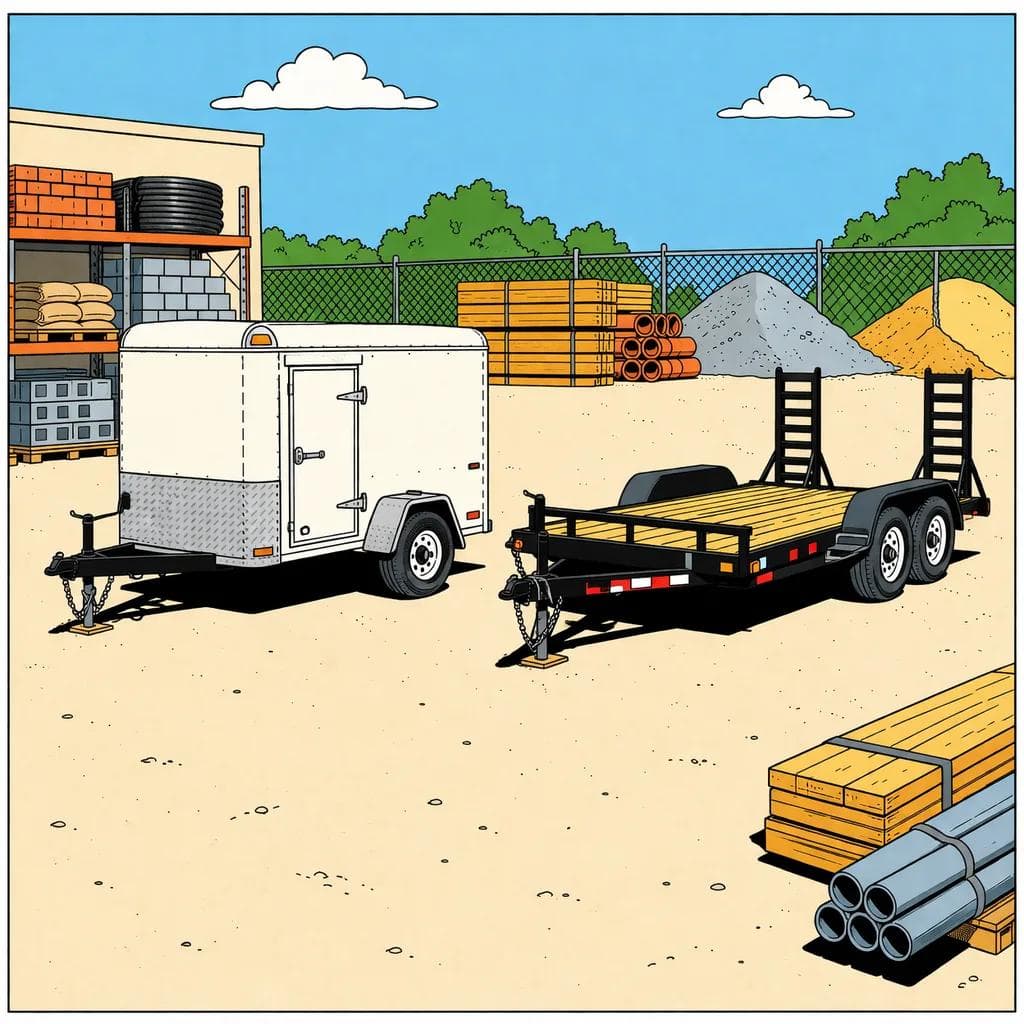
Flatbed Trailers
High-value, theft-prone, high-utilization. Real-time GPS prevents theft and provides load tracking. Detention reduction alone—knowing exactly when flatbeds are being held at customer sites—saves thousands per month for mid-size fleets.
Enclosed Trailers & Dry Vans
Preferred theft targets because they hide cargo. GPS + door sensors (available as add-ons) give you location tracking plus cargo security alerts. Critical for temperature-sensitive or high-value shipments.
Utility Trailers
Small, mobile, easy to steal. GPS prevents loss and helps recovery if theft occurs. Especially valuable for rental companies and contractors who operate multiple units across job sites.
Lowboys & Equipment Trailers
Heavy-duty, high-value, often left unattended at construction sites overnight. Real-time GPS paired with geofencing alerts notifies you immediately if a lowboy moves unexpectedly.
Reefer Trailers
Cold-chain logistics require location tracking AND temperature monitoring. Hapn's asset tracking integrates with temperature sensors for complete cold-chain visibility—location + cargo condition in real time.
Dump Trailers
Construction and aggregate operators rely on dump trailers for high-volume material moves. GPS visibility reduces demurrage, prevents theft, and enables precise utilization metrics.
Definition: Detention & Demurrage
Detention: Charges imposed by a shipping partner, warehouse, or port facility for keeping a trailer or container beyond the allowed free time. Typically $50–$200+ per day per trailer.
Demurrage: Similar charges applied specifically in maritime or port contexts. Similar rates: $100–$500+ per day depending on the facility and cargo type.
The cost impact: A mid-size fleet with 50 trailers averaging just 4 hours of unexpected detention per week faces $150K–$300K in annual detention charges. GPS visibility into trailer location and hold time eliminates most of this waste.
Definition: Asset Pooling and Yard Management
Asset pooling: Operating a shared fleet of trailers allocated dynamically to jobs and customers based on demand. Without visibility, operators over-purchase capacity (buying more trailers than needed) and under-utilize existing ones.
Yard management: Knowing in real time which trailers are on-site, which are in transit, which are loaded, which are empty, and which are due for maintenance or repair. Real-time GPS + geofencing makes yard management data-driven instead of manual.
The efficiency gain: Operators using GPS-powered asset management typically see 20–35% utilization improvement. Fewer trailers purchased. Faster job turnarounds. Lower detention charges.
Battery Life vs. Check-In Frequency: The Right Tradeoff
Battery-powered trackers force a deliberate choice: how often do you need location updates, and how long does the battery need to last?
Hapn's platform lets you tune this based on your operation:
- High-frequency tracking (every 1–15 minutes): Best for active shipments, in-transit trailers, and high-value loads. Battery life: 6–12 months. Use case: you're moving a flatbed and you want real-time theft alerts if it deviates from route.
- Standard tracking (every 2–6 hours): Balances theft prevention with battery longevity. Battery life: 1–2 years. Use case: trailers in regular rotation, job-site-to-yard cycles.
- Low-frequency tracking (daily or weekly check-ins): Minimal power consumption. Battery life: 3–5 years. Use case: seasonal trailers, slow-moving equipment, long-term storage monitoring.
Most operators combine strategies: high-frequency tracking on high-value, in-transit trailers; standard tracking on actively rotating inventory; low-frequency on seasonal or stored assets. The platform handles all three simultaneously.
Construction Trailers: A Specific Theft Crisis
Tool trailers left on construction job sites overnight represent one of the highest-risk asset categories. Contractors stage a loaded tool trailer at a remote site for a multi-day project. The site is unsecured at night. The trailer disappears. The tools inside—power equipment, hand tools, specialized instruments—represent $10K–$100K+ in inventory loss, plus project delay and labor cost.
GPS on construction tool trailers provides:
- Geofence alerts if a trailer leaves the job site after hours
- Immediate recovery notification to law enforcement
- Proof of loss for insurance claims (timestamp + location data)
- Audit trail showing exactly when and where theft occurred
- Deterrent effect: thieves target easy opportunities; GPS visibility shifts risk onto other operators
For construction fleets managing 10–100+ trailers across active job sites, real-time GPS paired with geofencing and alert automation becomes the primary theft-prevention mechanism.
Comparison: Vehicle GPS vs. Asset GPS vs. No GPS
| Capability | Vehicle GPS (Hardwired) | Battery Asset Tracker (Hapn) | No GPS |
|---|---|---|---|
| Works on unpowered trailers | ❌ Requires wiring | ✅ Magnetic/bolt mount | ❌ No visibility |
| Battery life 3–5 years | ❌ Requires constant charging | ✅ Designed for dormant assets | N/A |
| Theft prevention & recovery | ❌ Trailer has no power when unhitched | ✅ Tracks stolen trailers continuously | ❌ Cold case after theft |
| Detention/demurrage visibility | ❌ Only when powered | ✅ Real-time even when idle | ❌ Manual tracking only |
| Cost per unit | $400–$1500 + installation | $200–$400, no installation | $0 upfront, ∞ recovery cost |
Reefer Trailers: Temperature + Location Monitoring
Cold-chain logistics require more than location. You need to know what condition the cargo is in. Reefer trailers carrying refrigerated goods demand simultaneous tracking of position AND temperature.
Hapn's asset tracking integrates with temperature sensors to provide:
- Real-time reefer location (GPS)
- Continuous temperature monitoring
- Alerts if temperature drifts outside range (food spoilage risk)
- Proof of cold-chain compliance for audits and insurance
- Historical data for analyzing equipment performance and routing efficiency
For operators managing perishables, frozen foods, pharmaceuticals, or temperature-sensitive materials, this combination eliminates uncertainty and liability.
Solar-Powered Trackers for Long-Haul Trailers
Some operators run trailers on constant, predictable routes. Long-haul logistics with trailers that spend weeks in motion benefit from solar-assisted battery charging. Hapn offers solar-enabled asset trackers that extend battery life indefinitely for trailers spending significant time outdoors.
The tradeoff: solar adds cost and minimal weight. The payoff: unlimited operational life without battery replacement or maintenance. For high-utilization, long-haul operations, this is cost-effective.
Getting Started: Hapn's Trailer GPS Solution
Hapn's purpose-built asset tracking for trailers includes:
- IP67 weatherproof hardware: Designed for outdoor, rugged environments. Survives rain, dust, temperature swings, vibration.
- 3–5 year battery: No charging required. No wiring. No installation complexity.
- Magnetic or bolt-mount installation: 30 seconds to attach. 30 seconds to remove. No permanent modification.
- Real-time tracking and geofencing: Know trailer location and set alerts for unauthorized movement.
- Historical data: Analyze utilization, detention patterns, route efficiency, and theft risk.
- Integration with fleet management workflows: Asset tracking data feeds your dispatch, maintenance, and billing systems.
Learn more about Hapn's asset tracking platform.
Hapn at Scale: 463,000+ Assets Tracked, $720M Recovered
Hapn's customers have recovered over $720 million in stolen assets using real-time GPS and recovery-integrated workflows. That's 463,000+ assets tracked across 50,000+ customers—from owner-operators to Fortune 500 logistics companies. No contracts. Transparent pricing. Built by operators, for operators.
Trailer GPS is one of the highest ROI investments a fleet operator can make. The math is straightforward: prevent a single $30K theft and the system pays for itself. Reduce detention charges by $10K–$20K per quarter and the economics become obvious.
See transparent pricing and get started today.
Trailer Utilization and the Cost of Invisible Assets
Beyond theft prevention, the biggest hidden cost in trailer operations is poor utilization. When you can't see which trailers are loaded, empty, in transit, or sitting idle in the yard, you over-purchase capacity and under-optimize routes.
A 50-trailer fleet with average 40% utilization (industry norm without GPS visibility) is essentially carrying 20 trailers of dead weight. That's 20 sets of maintenance, insurance, storage, and opportunity cost with zero revenue generation.
Real-time GPS visibility enables:
- Dynamic load balancing: Route jobs to available trailers with minimum repositioning.
- Preventive maintenance scheduling: Service trailers based on actual usage, not calendar guesses.
- Equipment rental optimization: Know exactly which trailers are rented out, when they're due back, and where they are.
- Yard management automation: Assign trailers to loading docks, staging areas, and storage zones based on real-time data.
Operators using Hapn's asset tracking typically see 20–35% utilization improvements within the first 90 days. That translates to handling the same volume with fewer trailers, or handling more volume with the same trailer count.
Door Sensors and Cargo Security Add-ons
GPS tracking shows you WHERE a trailer is. Door sensors show you if it's been OPENED when it shouldn't be. Cargo monitoring goes further: temperature, humidity, motion, and breach detection.
These are available as add-ons to Hapn's core asset tracking:
- Door sensors: Alerts if a trailer door opens outside scheduled loading/unloading windows.
- Cargo sensors: Temperature, humidity, motion. Critical for perishables, electronics, and high-value goods.
- Breach detection: Immediate notification if a trailer is tampered with or cargo is compromised.
Combined with location tracking, these create a complete asset security and monitoring layer.
FAQ: Trailer GPS Tracking
1. How long does a battery last on a trailer GPS tracker?
Hapn's battery-powered asset trackers are rated for 3–5 years depending on check-in frequency. If you track every 2–6 hours, expect 1–2 years. If you track daily or weekly, 3–5 years is typical. The tradeoff is intentional: you can tune the platform to your operational needs.
2. Can I use a vehicle GPS tracker on a trailer?
Not effectively. Vehicle trackers are hardwired to the vehicle's electrical system. Trailers have no electrical system. Once unhitched, a vehicle tracker loses power and becomes useless. Battery-powered asset trackers are the only solution that works for unpowered trailers.
3. How quickly can stolen trailers be recovered?
With real-time GPS, law enforcement can locate a stolen trailer within hours. Without GPS, recovery takes weeks or never happens. Hapn customers have recovered $720M+ in stolen assets—many within the first 24 hours of theft.
4. Do I need to install anything to use trailer GPS tracking?
No. Hapn's asset trackers mount magnetically or with simple bolt-on hardware. No wiring. No electrical work. No vehicle modifications. Attach the tracker and you're tracking within minutes.
5. What's the difference between detention and demurrage charges?
Detention is charged by warehouses, customer sites, and logistics partners for keeping a trailer beyond the free window. Demurrage is similar, but typically applied in maritime/port contexts. Both are $50–$500+ per day per trailer. Real-time GPS visibility eliminates most of these charges by showing you exactly where trailers are sitting and how long they've been there.
6. Can I track reefer trailers? Do you monitor temperature?
Yes to both. Hapn offers temperature-monitoring integration for reefer trailers. You get real-time location plus continuous cold-chain temperature data. Critical for perishables, pharmaceuticals, and temperature-sensitive cargo.
Author
Hapn Fleet Intelligence | Hapn builds real-time GPS tracking and telematics for 50,000+ customers managing 463,000+ assets. No contracts. Transparent pricing. Built by operators for operators.
Related Reading
- Construction Equipment Tracking & Theft Prevention
- Equipment Rental Management & Asset Visibility
- Vehicle GPS Tracking & Fleet Management
- Equipment Tracking & Utilization Analytics
- The $1 Billion Construction Equipment Theft Crisis
- Fleet Tracking ROI Calculator: Prove Value to Your CFO
- Fleet Utilization Benchmarks 2026
Ready to Protect Your Trailers?
Real-time GPS is the fastest way to eliminate theft risk, reduce detention charges, and improve trailer utilization. Hapn's battery-powered asset tracking is purpose-built for trailers—no wiring, no installation, no contracts.
See transparent pricing and start tracking today. Or explore the full Hapn platform to integrate trailer tracking with your fleet management workflow.