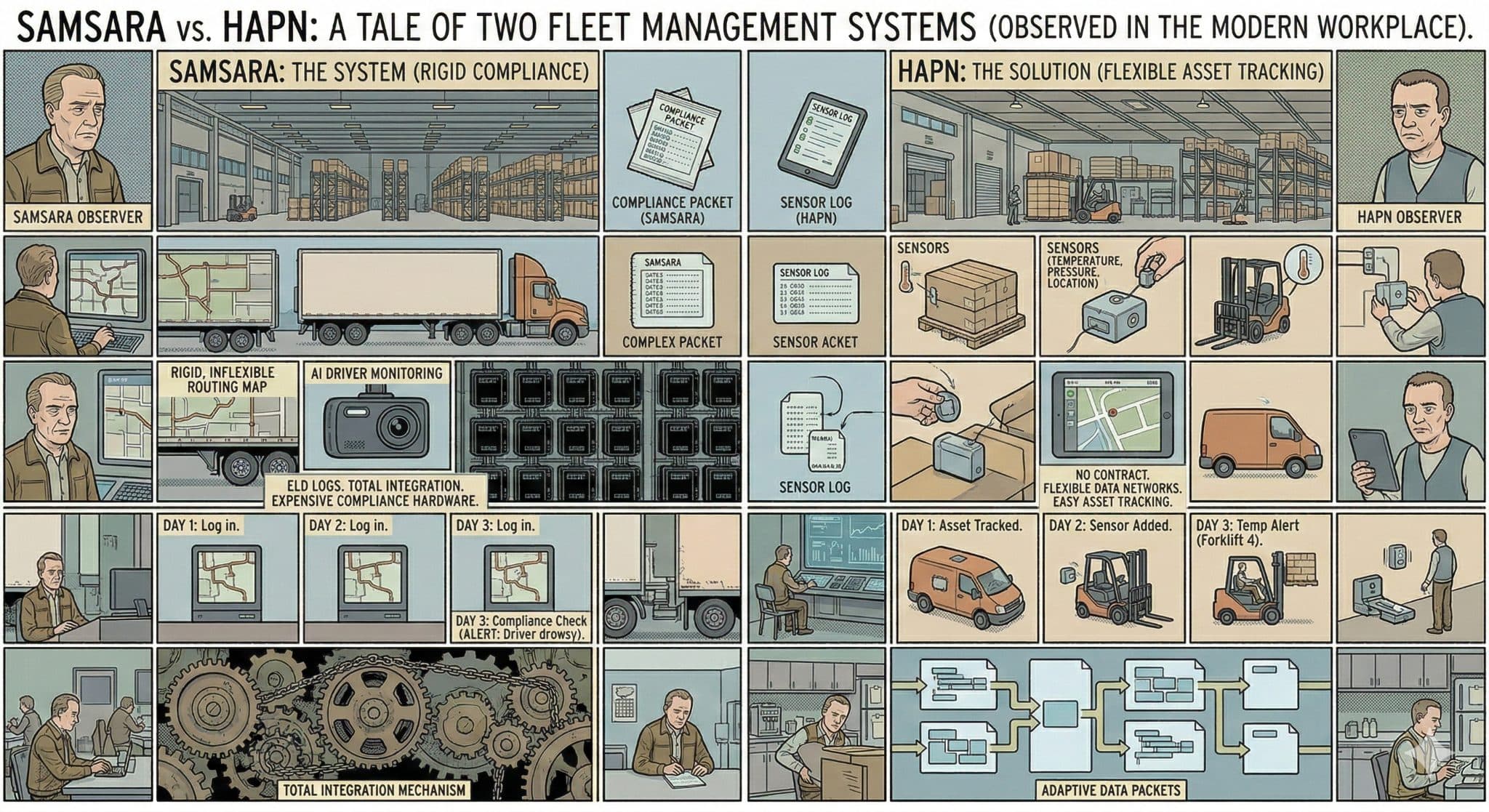
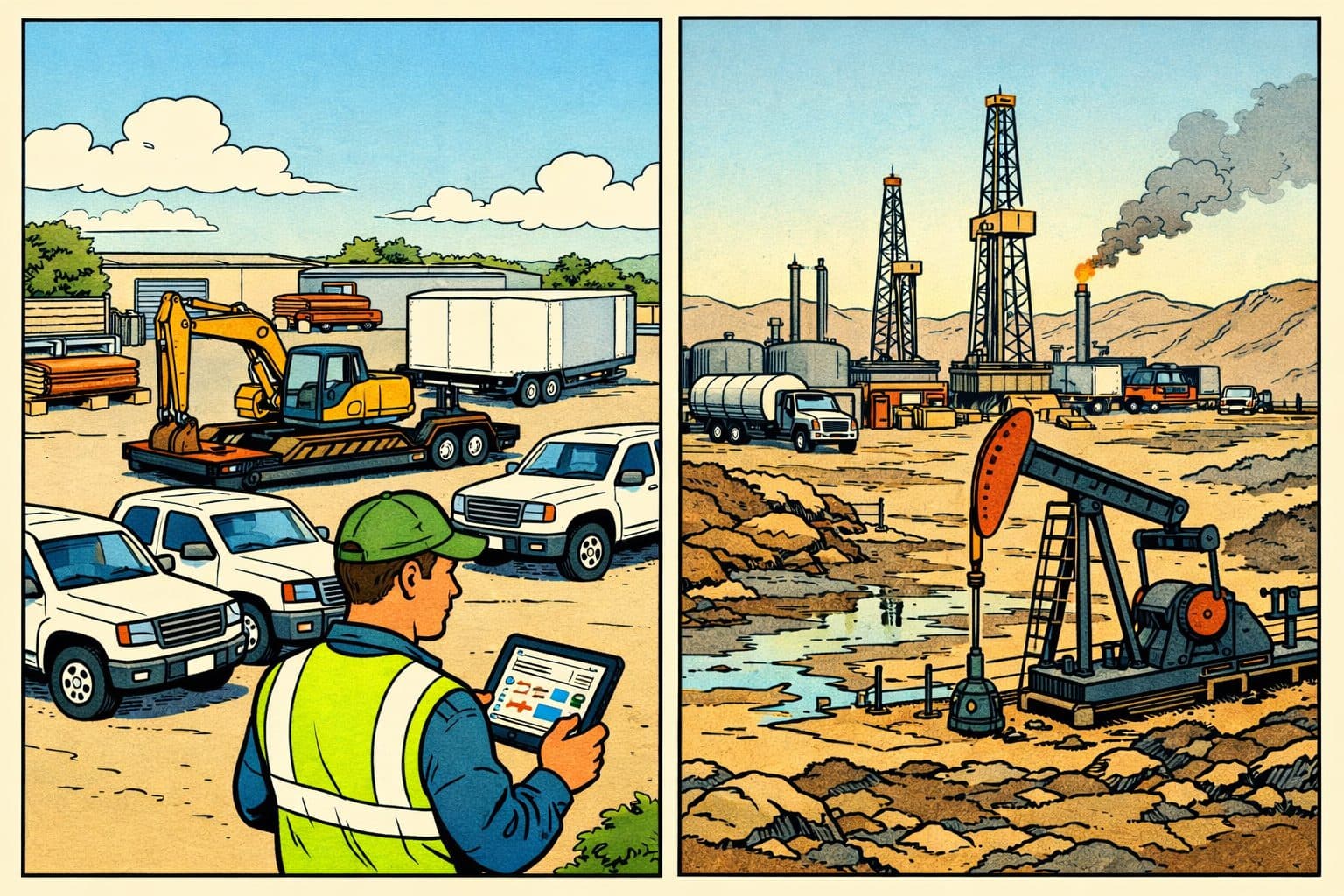
When comparing Hapn vs Samsara, the deciding factor is your fleet composition and pricing preferences. Samsara is a vehicle-first platform built primarily for over-the-road (OTR) trucking and ELD compliance, typically requiring long-term, multi-year contracts. Hapn is a full-stack telematics platform designed specifically for mixed fleets—seamlessly tracking vehicles, heavy equipment, battery-powered assets, and indoor tools via Hapn Zones on a single dashboard, all with transparent, month-to-month pricing.
Last updated: March 2026
Key Takeaways
- Samsara excels in enterprise trucking and ELD compliance but often locks growing businesses into 3-to-5-year binding contracts with opaque pricing.
- Hapn monitors over 463,000 assets for 50,000+ customers with a 4.8/5 rating across 11,300+ reviews—offering transparent, no-contract pricing across its entire hardware ecosystem.
- Mixed fleets using a single tracking platform for both vehicles and heavy equipment see an average 15–20% improvement in equipment utilization.
- Over a 3-year period, a 100-device fleet on a multi-year contract can pay $50,000–$80,000+ more in total cost of ownership than the same fleet on Hapn's month-to-month model—before factoring in early termination penalties.
- Hapn Zones enables indoor asset tracking at a fraction of the cost of enterprise RTLS, with tags costing $5–8 each and a $3–5/mo subscription—no WiFi or IT infrastructure required.
For growing businesses, selecting a fleet tracking platform is a critical operational decision. You need visibility to stop theft, optimize utilization, and streamline maintenance. But as operations scale from 50 to 500 assets, the limitations of niche tracking tools become painfully obvious. You might find yourself juggling one login for your delivery trucks, another for your heavy excavators, and yet another spreadsheet for unpowered assets and warehouse inventory.
This is the exact pain point that drives the Hapn vs Samsara evaluation. While both are enterprise-grade solutions processing billions of data points, their foundational philosophies—and who they are built to serve—are entirely different.
The Core Difference: Vehicle-First vs. Mixed-Fleet Telematics
To understand which platform serves your business better, you have to look at how each company approaches telematics architecture.
Samsara: The Over-the-Road Champion
Samsara is undeniably a powerhouse in the commercial trucking space. If your primary operational challenges involve interstate commerce, Electronic Logging Device (ELD) mandate compliance, Hours of Service (HOS), and managing hundreds of Class 8 semi-trucks, Samsara is built for you. They are a vehicle-first platform. While they offer equipment tracking as an add-on, their core software, development velocity, and user experience revolve around the cab of a truck and the driver inside it.
Hapn: The Mixed-Fleet Master
Unlike platforms that specialize in only vehicles or only equipment, Hapn handles the entire mixed fleet without forcing you onto two systems. Hapn provides full telematics depth—engine hours, fault codes, diagnostics, and CAN bus data—alongside vehicle tracking, AI dash cameras, battery-powered asset monitoring, and indoor zone-based tracking, all on one platform.
What is a Mixed Fleet?
A mixed fleet is an operational inventory that includes diverse asset types—such as highway vehicles, heavy off-road construction equipment, unpowered trailers, and smaller portable tools—requiring different tracking technologies to monitor effectively.
For operations in construction or equipment rental, Hapn's hardwired trackers capture the same depth of engine fault codes and diagnostic data as construction-specific platforms, while also supporting the service vehicles and unpowered assets that those niche platforms ignore. The result is a single pane of glass where a rental operations manager can see a CAT 336 excavator's engine hours right next to a Ford F-350's trip history and a battery-tracked light tower's location—all without switching tabs or logins.
Hapn vs Samsara: Feature Comparison Breakdown
When evaluating the total capabilities of both systems, it helps to see the hardware and software features side-by-side.
| Capability | Hapn | Samsara |
|---|---|---|
| Pricing Model | Transparent, No-Contract, Per-Device | Opaque, Quoted, 3-to-5 Year Contracts |
| Vehicle Tracking & AI Cameras | Yes (Full OBD & Hardwired, Road/Driver AI) | Yes (Industry-leading OTR features) |
| Deep Equipment Telematics | Yes (Engine hours, CAN bus, fault codes, OEM data) | Secondary focus (Bolt-on solutions) |
| Battery-Powered Asset Tracking | Yes (IP67, OTA config, long-life) | Yes (Asset tags available) |
| Indoor / Zone Tracking | Yes (Hapn Zones via dedicated BLE gateways) | Limited (Proximity-based, vehicle-dependent) |
| ELD & HOS Compliance | Not primary focus | Yes (Core competency) |
| OEM Data Integration | Yes (Major OEM fleets via AEMP standards) | Yes (Select OEM partnerships) |
| API & Custom Integrations | Production-grade open API (Hapn's own products run on it) | Enterprise API |
| Contract Terms | Month-to-month, cancel anytime | Typically 3–5 year minimum |
Pricing Transparency and Contract Terms
Perhaps the most immediate difference buyers notice during the procurement process is how these two companies handle pricing and commitments. For a growing fleet, this isn't just an accounting detail—it directly affects your operational flexibility and total cost of ownership.
The Cost of Long-Term Contracts
Samsara utilizes a traditional enterprise SaaS sales motion. Pricing is not publicly listed; you must go through a sales representative to receive a custom quote based on your fleet size. More critically, Samsara typically requires multi-year contracts—often locking fleets in for 36 to 60 months. While this can sometimes lower the upfront hardware cost, it severely limits agility. If your fleet downsizes, or if you rotate seasonal equipment, you are still paying for licenses you no longer use.
What is TCO (Total Cost of Ownership)?
Total Cost of Ownership in telematics calculates the true expense of a system over time, including upfront hardware, recurring software subscriptions, installation downtime, and the cost of inflexible long-term contracts.
Transparent, Pay-for-What-You-Use Pricing
Hapn takes a radically different approach. We believe in transparent, self-serve pricing with no long-term contracts required. You pay a simple monthly subscription per active device. Because there are no multi-year lock-ins, the platform has to earn your business every single month by maintaining our 99.9% uptime and delivering continuous ROI.
What Does This Look Like Over 3 Years?
Consider a mid-size equipment rental company running 100 tracked assets—a mix of 40 vehicles, 35 pieces of heavy equipment, and 25 unpowered trailers. With an enterprise contract model, you're committing to all 100 licenses for the full term, even during seasonal downturns when 20–30% of your fleet may be idle. If you need to shed 15 assets in year two, you're still paying for them. Early termination fees on enterprise telematics contracts can run 50–100% of the remaining contract value.
On Hapn's month-to-month model, you add devices when you add assets and remove them when you don't need them. Over a 3-year period, the flexibility alone can save a 100-device fleet $50,000–$80,000+ compared to a locked-in contract—before factoring in the operational cost of managing a procurement cycle that requires legal review, finance sign-off, and a 6-week sales process just to get a quote.
For a detailed breakdown on how to calculate these costs for your CFO, check out our guide on the Fleet Tracking ROI Calculator.
Extend Visibility Beyond the Cab
Want to track indoor tools, staging areas, and yard inventory without enterprise WiFi networks? Discover how Hapn Zones changes the game for mixed fleets.
See How Zones Works →Deep Equipment Telematics Beyond the Cab
Many growing construction and rental companies make the mistake of buying a vehicle tracking system, only to realize later that it cannot adequately monitor their heavy iron. Tracking a Ford F-150 is fundamentally different from tracking a Caterpillar D8 Dozer.
Hapn provides equipment tracking solutions that go far beyond a simple GPS ping. Using hardwired trackers that connect directly to the ignition wire or the machine's CAN bus, Hapn pulls rich diagnostic data including engine hours, fault codes, coolant temperature, fuel consumption, and runtime patterns. Engine hour-based maintenance schedules service intervals around actual equipment usage rather than arbitrary calendar dates. For construction and rental fleets where machines may sit idle for weeks then run 14-hour days, this approach can reduce maintenance costs by 20–30% while cutting unplanned breakdowns significantly.
What is a CAN bus?
A Controller Area Network (CAN bus) is a robust communication standard that allows microcontrollers and devices within a vehicle or heavy machinery to communicate with each other, providing telematics platforms with deep diagnostic and performance data.
Samsara offers an equipment gateway, but its feature set and reporting are secondary to its vehicle routing and compliance dashboards. If you are a fleet manager who needs to analyze heavy equipment utilization, engine fault codes, and OEM data side-by-side with your pickup trucks, Hapn offers a more comprehensive, natively built experience. According to recent industry benchmarks, the average equipment rental company sees 12–18% idle inventory at any given time—visibility into actual engine hours and runtime patterns is how you close that gap.
Indoor and Yard Visibility: The Hapn Zones Advantage
Here is where the gap between traditional telematics providers and Hapn widens considerably. What happens to your assets when they move indoors, into a maintenance bay, or are staged in a massive rental yard where GPS signals bounce or fail?
With Hapn Zones, the same platform that tracks your GPS fleet can also track assets indoors—tool cribs, staging areas, warehouse bays—without installing WiFi or enterprise RTLS infrastructure. Traditional Enterprise Real-Time Location Systems (RTLS) from companies like Zebra or Cisco are incredibly expensive, often requiring $50–100+ per tag, complex IT integration, and facility-wide WiFi arrays.
What is RTLS?
Real-Time Location Systems (RTLS) track the physical position of assets within a defined space—typically indoors where GPS cannot reach. Enterprise RTLS solutions often cost $50–100+ per tag and require extensive WiFi infrastructure, while newer approaches like Hapn Zones use BLE gateways to achieve zone-level accuracy at a fraction of the cost.
Hapn Zones democratizes indoor tracking. It uses ML-powered walk-to-train calibration that learns each site's unique RF environment for high accuracy. The system relies on dedicated cellular gateways that plug into standard wall outlets—no WiFi, no IT department involvement, setup in under 30 minutes. You simply define named zones (e.g., "Bay 3," "Staging Area," "Tool Crib"). Accelerometer fusion detects movement even between zones, ensuring precise inventory control.
Samsara's approach to BLE (Bluetooth Low Energy) is largely parasitic—meaning the tags rely on being close to a vehicle gateway to report their location. If the truck leaves the yard, the yard inventory goes dark. Hapn uses dedicated gateways that are always on, providing 24/7 visibility into your indoor and unpowered assets regardless of vehicle proximity.
Onboarding and Implementation
The speed and complexity of getting up and running is an often-overlooked factor when comparing fleet platforms—especially for growing businesses that don't have a dedicated IT team or a six-month implementation runway.
Samsara's Enterprise Onboarding
Samsara follows a traditional enterprise implementation model. After the sales process concludes (which itself can take weeks of quoting and contract negotiation), onboarding typically involves an assigned implementation team, structured rollout phases, and training sessions. For a large OTR carrier with 500+ trucks, this structured approach makes sense. For a regional equipment rental company that just wants to get 80 devices installed and start tracking, it can feel like overkill—and the timeline from signed contract to full deployment can stretch to 60–90 days.
Hapn's Self-Serve or Guided Approach
Hapn is designed so that a fleet manager can order devices, install them, and be live on the platform the same week. The self-serve model means you don't need to wait for a dedicated implementation team. Hardware arrives pre-configured. Hardwired devices connect via ignition wire or CAN bus with straightforward installation guides. Battery-powered trackers are truly plug-and-play—activate, attach, and go. For customers who want hands-on guidance, Hapn offers onboarding support, but it's optional rather than mandatory.
For Hapn Zones, the story is even simpler: plug a gateway into a wall outlet, define your zones in the dashboard, and the ML calibration begins learning your site's RF environment immediately. There's no IT ticket, no WiFi access point mapping, and no six-figure infrastructure project.
Managing Service Fleets and Light Commercial Vehicles
Many construction and rental businesses also operate service vehicles—trucks for maintenance crews, vans for site supervisors, or technician vehicles. For tracking those lighter fleet assets alongside field service operations, Spytec is purpose-built for small service fleets like HVAC, plumbing, and electrical contractors. Both Spytec and Hapn run on the same powerful backend, meaning as your operation scales from light commercial vans to heavy excavators, the ecosystem scales with you.
Theft Recovery and Asset Security
According to the National Equipment Register, construction equipment theft exceeds $1 billion annually in the U.S., with a shockingly low recovery rate of under 25%. For a business with a mixed fleet, losing a $100,000 skid steer or a trailer full of copper wire is devastating to project timelines and profit margins.
Hapn is engineered for rapid theft recovery. Through real-time geofencing, after-hours movement alerts, and specialized hardware designed to be covertly installed on heavy machinery, Hapn customers have successfully recovered over $720M+ in stolen assets. Because our platform natively handles battery-powered asset trackers alongside hardwired equipment, you can secure everything from unpowered light towers to massive loaders on one screen.
Who Should Choose Which Platform?
Both Hapn and Samsara are powerful platforms processing billions of data points annually. The right choice depends entirely on your business model and fleet composition.
When Samsara Makes Sense
- You operate a large fleet of over-the-road (OTR) semi-trucks and ELD compliance is your primary daily requirement.
- Hours of Service (HOS) logging and IFTA reporting are critical regulatory obligations for your operation.
- You have the enterprise budget and procurement process to sustain 3-to-5-year binding contracts.
- Heavy equipment tracking is a "nice-to-have" rather than a core operational requirement.
When Hapn Is the Better Fit
- You manage a true mixed fleet: vehicles, yellow iron, generators, trailers, and unpowered assets.
- You need deep equipment telematics (engine hours, fault codes, CAN bus data) alongside vehicle tracking on one dashboard.
- You want to extend visibility indoors to staging areas, tool cribs, and maintenance bays using Hapn Zones.
- You demand transparent, month-to-month pricing without being locked into a multi-year contract.
- You need a production-grade open API to integrate telematics data into your ERP, rental management software, or custom workflows.
- You want to be live in days, not months—without a mandatory enterprise implementation process.
Stop Guessing. Start Tracking.
See how Hapn gives you complete visibility across your mixed fleet — vehicles, equipment, and assets in one platform. No contracts, transparent pricing.
Get Pricing →Written by the Hapn Team
Hapn provides GPS fleet and asset tracking for 50,000+ customers across construction, equipment rental, and 50+ other industries. Our platform monitors 463,000+ assets and processes over 4 billion messages annually with 99.9% uptime. Rated 4.8/5 across 11,300+ reviews.
Frequently Asked Questions
Is Hapn a good alternative to Samsara?
Yes, Hapn is an excellent Samsara alternative for businesses managing mixed fleets of vehicles, heavy equipment, and unpowered assets. While Samsara focuses heavily on OTR trucking and ELD compliance, Hapn provides deep equipment telematics, battery-powered asset tracking, and indoor Hapn Zones tracking on a single platform—all with transparent, month-to-month pricing and no long-term contracts. Hapn monitors over 463,000 assets for 50,000+ customers with a 4.8/5 rating across 11,300+ reviews.
Does Hapn require a contract?
No, Hapn does not require long-term contracts. Unlike many enterprise telematics providers that lock fleets into 3-to-5-year agreements, Hapn offers transparent, month-to-month pricing based on the number of active devices you use. You can scale up or down as your fleet changes without early termination fees or unused license costs.
Can Hapn track both vehicles and equipment?
Hapn's platform is purpose-built to track both vehicles and heavy equipment on a single dashboard. Hapn uses OBD trackers and AI dash cameras for highway vehicles, while deploying hardwired trackers into the CAN bus of excavators, loaders, and generators to monitor engine hours, fault codes, runtime, and diagnostic data in real time. Battery-powered trackers cover unpowered assets like trailers and tool cribs.
How does Hapn pricing compare to Samsara?
Hapn uses a transparent, self-serve model with subscriptions running per active device and no hidden fees. Samsara uses a traditional enterprise sales model with bundled, custom-quoted pricing that typically requires multi-year financial commitments. Over a 3-year period, a 100-device fleet can save $50,000–$80,000+ on Hapn's flexible model compared to a locked-in enterprise contract, especially when accounting for seasonal fleet fluctuations and early termination risks.