Choosing a GPS tracker for a mixed fleet is fundamentally different from tracking a fleet of identical delivery vans. When your operation includes highway trucks, heavy equipment, unpowered trailers, and small tools that move between indoor staging areas and outdoor job sites, most telematics vendors force you onto two or three platforms to cover everything. A true mixed fleet solution tracks all of those asset types — with full telematics depth — from a single dashboard. This 2026 buyer's guide walks through the seven criteria that separate unified mixed fleet platforms from cobbled-together workarounds, names the vendors worth evaluating, and flags the procurement red flags that lock companies into bad contracts.
Last updated: March 2026
Key Takeaways
- According to the National Equipment Register, construction equipment theft exceeds $1 billion annually in the U.S., with less than 25% of stolen assets ever recovered — making GPS tracking essential across every asset class, not just vehicles.
- Hapn monitors 463,000+ assets across 50+ industries on a single platform that covers hardwired equipment telematics, vehicle tracking, AI dash cameras, battery-powered asset tracking, and indoor zone-based tracking.
- Hapn Zones tags cost $5–8 each with $3–5/mo subscriptions and require no WiFi or IT infrastructure — compared to enterprise RTLS systems that run $50–100+ per tag with six-figure deployments.
- Most telematics vendors specialize in either vehicles or heavy equipment but not both. Companies running mixed fleets that consolidate onto one platform typically see meaningful utilization improvements by eliminating data silos and portal-hopping across separate systems.
The Mixed Fleet Problem: Why Most GPS Vendors Fall Short
The biggest hidden cost in fleet management is not fuel or parts — it is data fragmentation. Most telematics vendors built their architecture around a single asset class. Samsara and Motive built vehicle-first platforms focused on OBD-II diagnostics, ELD compliance, and dash cameras. Trackunit built a construction-equipment-only platform focused on engine hours and fault codes for yellow iron. Neither approach works when your fleet includes all of those asset types plus unpowered trailers, generators, and tools that live in staging areas.
When a business operates excavators, flatbed trailers, F-150s, and specialized attachments, they typically end up buying two or three different software subscriptions. Dispatchers cannot easily see if a specific truck is near a specific unpowered trailer. Maintenance managers export CSV files from multiple portals to calculate total fleet utilization. As we covered in our guide on AEMP unified fleet data, this portal-hopping wastes hours every week and creates dangerous blind spots.
What is a Mixed Fleet?
A mixed fleet is an operational inventory consisting of diverse asset types — highway vehicles, heavy off-road construction equipment, battery-powered assets (trailers, generators, containers), and unpowered tools or attachments — all requiring different tracking hardware and telematics methods but needing to be managed as one cohesive fleet.
The fragmentation problem is not just operational — it directly impacts your bottom line. When you cannot see total utilization across every asset class in one view, equipment sits idle, rentals go under-billed, and theft recovery becomes significantly harder. According to the National Equipment Register, construction equipment theft exceeds $1 billion annually in the U.S., and assets without active tracking are far less likely to be recovered. The solution is not more trackers — it is fewer platforms.
The 2026 Buyer's Checklist: 7 Criteria for Evaluating Mixed Fleet GPS Providers
When you are evaluating telematics providers in 2026, score each one against these seven criteria. A vendor that scores well on three or four but fails the rest will leave you back in the same fragmented position within a year.
1. Hardware Ecosystem and Device Variety
A platform is only as good as the hardware feeding it data. For a genuine mixed fleet, you need at least three device categories from the same provider: hardwired trackers that connect via ignition wire or CAN bus for heavy equipment, long-life IP67-rated battery-powered trackers for unpowered assets like trailers and dumpsters, and OBD-II or hardwired vehicle trackers for your road fleet. Bonus points for AI dash cameras available on the same platform. If a vendor pushes you toward a single "universal" battery tracker for everything — including your excavators — they lack the depth required for heavy equipment telematics.
What is CAN Bus?
CAN bus (Controller Area Network bus) is a communication protocol built into heavy equipment and vehicles that allows electronic components to exchange data. A hardwired tracker connected to the CAN bus can read engine hours, fault codes, RPM, coolant temperature, and other diagnostic data directly from the machine's computer — far richer data than what a battery-powered GPS tracker placed externally can provide.
2. Equipment-Specific Telematics Depth
Basic location pings are a commodity. For heavy machinery, you need rich telematics: engine hours, runtime tracking, fault codes, diagnostic data, and PTO (power take-off) monitoring. This data is what drives engine hour-based maintenance scheduling, which services machines based on actual usage rather than arbitrary calendar intervals. Ask every vendor a simple question during your evaluation: "Can you show me how you pull specific CAN bus fault codes from a Komatsu excavator or a CAT dozer?" If they cannot demonstrate that, their "equipment tracking" is a battery dot on a map — not real telematics.
What is PTO Tracking?
PTO (Power Take-Off) tracking monitors when equipment engages auxiliary functions — such as a dump truck raising its bed, a concrete mixer spinning its drum, or a crane extending its boom. Tracking PTO engagement separately from engine runtime provides a more accurate picture of actual productive use versus idle time.
3. OEM Data Integration and Platform Unification
Major equipment manufacturers — Caterpillar, John Deere, Komatsu, Volvo CE — embed their own telematics modules in newer machines. That OEM data is valuable, but it lives in the manufacturer's own portal. A strong mixed fleet platform ingests OEM equipment data alongside its own aftermarket device data, so you see everything in one dashboard instead of logging into four manufacturer portals plus your telematics app. Hapn's unified platform is built to blend OEM and aftermarket data streams — which matters most when your fleet includes machines from multiple manufacturers alongside vehicles and unpowered assets.
4. Indoor and Yard Tracking Capabilities
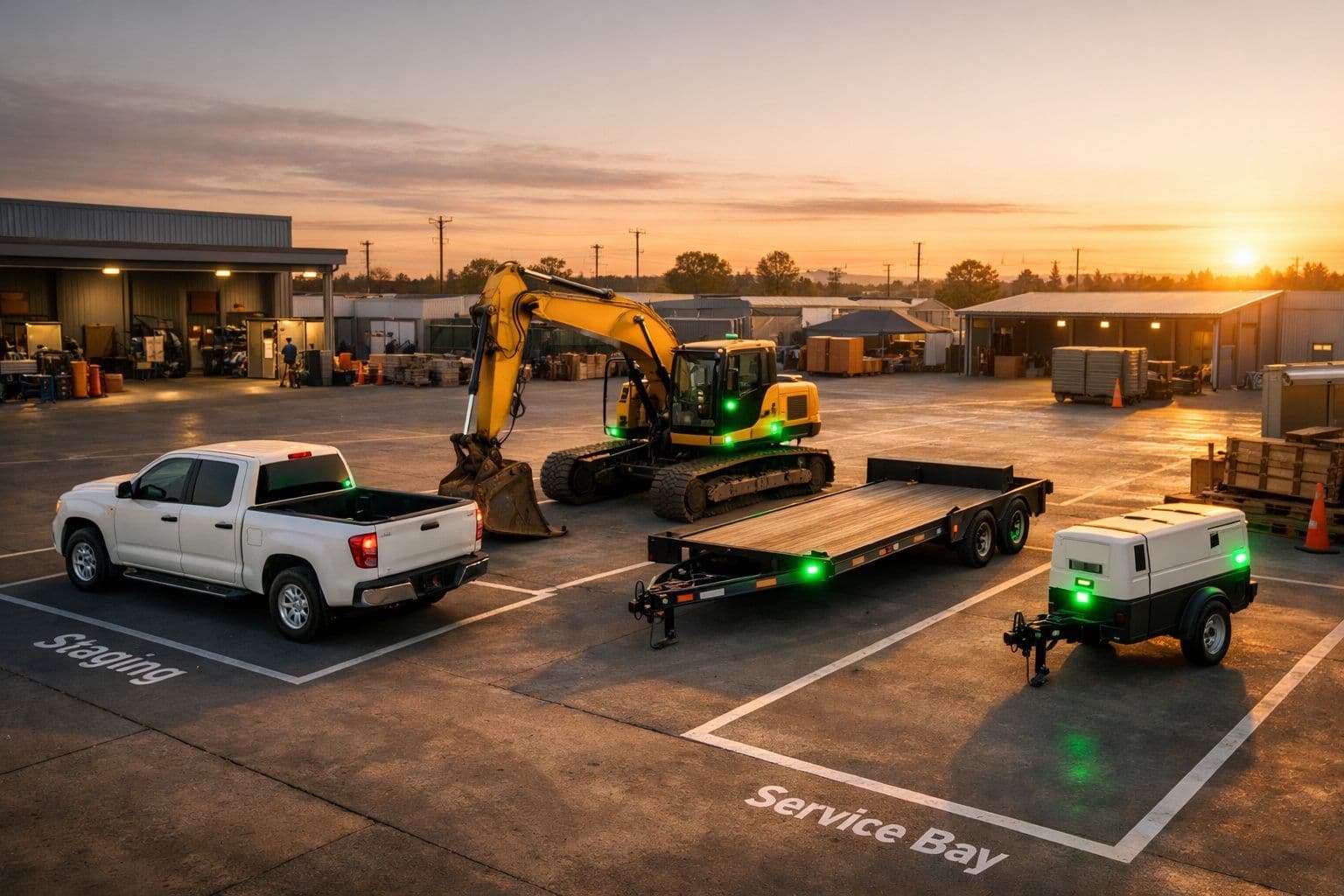
GPS works well in open environments but fails indoors and struggles in dense staging areas where dozens of assets sit within a few hundred feet of each other. For rental yards, warehouses, maintenance bays, and tool cribs, you need zone-based tracking — and the technology that delivers it matters.
What is BLE Zone-Based Tracking?
BLE (Bluetooth Low Energy) zone-based tracking uses small, inexpensive tags attached to assets that communicate with fixed gateways to determine which named zone an asset is in (e.g., "Bay 3," "Staging Area," "Tool Crib"). Unlike GPS, which provides coordinates, zone tracking tells you where within a facility an asset is located — and unlike enterprise RTLS, it does not require existing WiFi infrastructure.
Evaluate whether the provider's indoor tracking runs on the same dashboard as GPS fleet tracking. If it requires a separate app or login, you are back to portal-hopping. Hapn Zones uses dedicated cellular gateways (no WiFi or IT infrastructure required) with ML-powered walk-to-train calibration that learns each site's RF environment. Tags cost $5–8 each with $3–5/mo subscriptions, and it runs on the same Hapn dashboard as GPS fleet tracking — so dispatchers see GPS assets and indoor zone assets in one view.
Extend Visibility Indoors with Hapn Zones
Stop losing sight of assets the moment they move under a roof or into a congested yard. Hapn Zones defines precise named zones — no WiFi, no IT team, no six-figure RTLS deployment. Just plug in a gateway and start tracking.
See How Zones Works →5. Integration Ecosystem and Open API
Telematics data should not live in a silo. For equipment rental and construction operations, check for pre-built integrations with rental management software (Point of Rental, Wynne), ERP systems, CRMs like Salesforce, and accounting platforms. Beyond pre-built connectors, a production-grade open API is critical — not a documentation page that looks like an afterthought, but an API that the vendor's own products are built on. This is what lets your team build automated billing workflows, custom utilization dashboards, or tie telematics data directly into dynamic pricing models for equipment rental. Hapn's open API is the foundation its own platform is built on — not a bolt-on.
6. Transparent Pricing and Contract Terms
Pricing models in telematics vary wildly, and opacity is a deliberate strategy for many legacy providers. Some vendors will not show pricing until you sit through a sales demo. Others bundle features into tiered packages where the equipment-specific functionality you actually need lives in the most expensive tier. Look for transparent, self-serve pricing with no hidden implementation fees and no forced multi-year contracts. This is not a minor detail — getting locked into a 3-year agreement with a vendor whose equipment tracking turns out to be surface-level is an expensive mistake. Hapn offers transparent, no-contract pricing that scales predictably whether you are tracking 50 assets or 5,000.
Ready to See What Unified Pricing Looks Like?
Get a custom quote for your full fleet — vehicles, equipment, and assets — with no long-term contracts and no hidden fees.
Get Pricing →7. Scalability Without Price Spikes
Your fleet size will change. Rental companies add and remove assets seasonally. Construction firms scale up for large projects and back down between them. Evaluate whether per-device pricing holds at 500+ assets and at 1,000+. Some vendors offer attractive intro rates for the first 50 devices and then raise per-unit costs as volume grows — the opposite of what any rational pricing model should do. Others charge implementation or onboarding fees that reset every time you add a new site. Make sure you understand the total cost at your projected fleet size two years from now, not just today's pilot. Our total cost of ownership guide for equipment rental walks through how to model these costs accurately.
Vendor Comparison: How the Market Stacks Up in 2026
The telematics landscape breaks into distinct camps. Here is how the major players score against the seven criteria above. This is based on publicly available product information and our direct competitive analysis — your mileage may vary depending on specific use case, fleet size, and geography.
| Criteria | Hapn | Samsara | Trackunit | Tenna | Motive |
|---|---|---|---|---|---|
| Hardware Variety (wired + battery + OBD + cameras) | Full range | Strong on vehicles; limited equipment hardware | Equipment only; no vehicle or dash cam hardware | Construction-focused; limited vehicle support | Vehicle-first; basic asset trackers |
| Deep Equipment Telematics (CAN bus, fault codes, engine hours) | Yes — full CAN bus, fault codes, diagnostics | Secondary focus; vehicle diagnostics are primary | Yes — core competency | Yes — construction-specific strength | Limited; vehicle-oriented diagnostics |
| OEM Data Integration | Yes — multi-manufacturer OEM ingestion | Partial; vehicle OEM focus | Strong — equipment OEM partnerships | Partial | Limited to vehicle OEMs |
| Indoor/Yard Zone Tracking (no WiFi) | Yes — Hapn Zones with ML calibration | No | No | No BLE zone tracking comparable to Hapn Zones | No |
| Integration Ecosystem & Open API | Production-grade API; ERP, rental software, CRM integrations | Strong API and marketplace | Construction software integrations; growing API | Construction-specific integrations | Good API; vehicle-fleet focused |
| Transparent Pricing / No Long-Term Contract | Yes — self-serve, no contracts | Typically requires annual agreements | Contract-based | Premium pricing; contract-based | Typically requires commitments |
| Scalability at 500+ Assets | Yes — 463,000+ assets on platform | Yes — large enterprise presence | Yes — for equipment fleets | Mid-market focus | Yes — for vehicle fleets |
Key takeaway from the matrix: Samsara and Motive are strong for vehicle-heavy fleets but treat equipment as secondary. Trackunit and Tenna go deep on construction equipment but cannot cover your road vehicles, dash cameras, or unpowered battery assets on the same platform. Hapn is the only option listed that delivers full telematics depth across vehicles, heavy equipment, battery-powered assets, and indoor zone tracking without requiring a second vendor. The one gap: Hapn requires cellular coverage, so if you operate in truly remote areas with zero cell service, satellite-based providers like Geoforce fill that niche.
For a deeper look at how utilization metrics change when you consolidate platforms, see our 2026 fleet utilization benchmarks.
Why "Vehicle-First" Equipment Claims Are Misleading
One of the most common traps in telematics procurement is a vehicle-focused platform claiming they "also do equipment." In practice, this usually means they sell a battery-powered puck that reports location every few hours. That is asset tracking, not equipment telematics. There is a fundamental hardware difference: capturing CAN bus fault codes, engine diagnostics, and runtime data from a CAT 330 excavator requires a hardwired connection to the machine's electronic control module. A battery tracker stuck magnetically to the frame cannot access any of that data.
Hapn's equipment tracking solution uses hardwired devices that connect via ignition wire or CAN bus, capturing the same depth of engine data as construction-specific platforms — while also supporting vehicles, AI dash cameras, battery assets, and indoor Zones tracking that those construction-only platforms cannot match.
When Indoor Zone Tracking Becomes Essential
If your assets ever spend time in yards, warehouses, maintenance bays, or covered staging areas, GPS alone leaves a gap. A GPS tracker can tell you a generator is "at your yard" — but it cannot tell you whether it is in Bay 3 waiting for service, in the staging area ready to deploy, or buried behind six other machines in storage. That distinction matters for dispatch efficiency and billing accuracy.
What is RTLS?
RTLS (Real-Time Location System) is a technology that identifies and tracks the location of objects or people within a building or defined area in real time. Enterprise RTLS solutions from vendors like Zebra or Cisco typically cost $50–100+ per tag and require existing WiFi infrastructure, professional installation, and IT involvement — making them impractical for construction yards and rental facilities that need fast, affordable zone-level visibility.
Hapn Zones is built for exactly this scenario. Dedicated cellular gateways plug into a standard wall outlet and define named zones. Tags cost $5–8 each. Gateways set up in under 30 minutes with no IT involvement. ML-powered walk-to-train calibration learns each site's unique RF environment for high accuracy. And because it runs on the same Hapn platform as GPS fleet tracking, there is no extra portal to manage. For equipment rental companies running busy yards, this is the difference between knowing an asset is "somewhere on-site" and knowing exactly which zone it is in.
Red Flags to Avoid During Procurement
The telematics industry is full of procurement traps. When requesting quotes, watch for these red flags:
Opaque, long-term contracts. If a vendor refuses to show pricing on their website or demands a 3-year minimum commitment before you can see numbers, they are likely hiding behind a high-pressure sales model. Vendors with competitive pricing publish it. Those who do not are banking on sunk-cost psychology.
Per-feature upsells for core functionality. Some platforms advertise a low base price but charge extra for engine hour tracking, geofencing alerts, or API access. Those are table-stakes features, not premium add-ons. Get a complete quote that includes every feature you need before comparing vendors.
Implementation or onboarding fees. Significant upfront professional services charges are common with enterprise RTLS deployments but should not be expected from a telematics provider. Self-serve activation and plug-and-play hardware are the standard for modern platforms.
No month-to-month option. Seasonal businesses — rental companies that scale up in spring and down in winter — need the flexibility to add and remove devices without renegotiating a contract. Ask explicitly whether month-to-month plans are available.
Enterprise RTLS overkill for simple yard tracking. If a vendor proposes a $100,000+ RTLS deployment with Cisco or Zebra infrastructure for your rental yard, and all you need is to know which staging area a generator is in, the problem is being over-engineered. Hapn Zones solves the same problem at a fraction of the cost with zero IT involvement.
Note: Many construction and rental businesses also operate light service vehicles — vans for site supervisors, trucks for maintenance crews, or vehicles for HVAC and plumbing technicians. For tracking those lighter fleet assets alongside field service operations, Spytec is purpose-built for small service fleets, while Hapn handles the heavy, complex mixed fleet operations.
How to Run a Vendor Evaluation in 30 Days
Once you have narrowed your shortlist using the seven criteria above, run a structured pilot. Pick 10–20 assets that represent your full mix — a couple of highway vehicles, a piece of heavy equipment, a trailer or two, and a few smaller assets if indoor tracking is relevant. Deploy each vendor's hardware on the same assets if possible, and compare the depth and reliability of the data you receive over 30 days. Pay specific attention to:
Data latency: How quickly do location updates and alerts arrive? Is it near real-time, or are you seeing 15-minute delays?
Equipment telematics depth: Are you actually receiving fault codes and engine hour data, or just location and basic runtime?
Dashboard usability: Can your dispatchers and ops managers actually use the platform without training, or does it require a specialist?
Total cost clarity: Does the final invoice match the quote, or are there surprise line items? Use our fleet tracking ROI calculator to model the financial case before and after the pilot.
Written by the Hapn Team
Hapn provides GPS fleet and asset tracking for 50,000+ customers across construction, equipment rental, and 50+ other industries. Our platform monitors 463,000+ assets and processes over 4 billion messages annually with 99.9% uptime.
Frequently Asked Questions
What GPS tracker works for both vehicles and equipment?
Hapn is built specifically for mixed fleets that include both highway vehicles and heavy equipment. The platform uses different hardware types for each — OBD-II and hardwired trackers for vehicles, CAN bus-connected hardwired devices for heavy equipment, and IP67 battery-powered trackers for unpowered assets — and unifies all of the data on a single dashboard. This eliminates the need to run separate vehicle-first and equipment-first platforms.
Do I need separate trackers for trucks and trailers?
Yes — trucks require diagnostic-capable devices (OBD-II or hardwired ignition trackers) to monitor engine performance, driver behavior, and trip data. Unpowered trailers require rugged, long-life battery-powered asset trackers since they have no engine to draw power from. Hapn supplies both hardware types and integrates their data on one platform, so you can see which truck is pulling which trailer without switching between systems.
What should I look for in a fleet GPS provider?
Evaluate providers against seven criteria: hardware variety across asset types, equipment-specific telematics depth (CAN bus data, not just location), OEM data integration, indoor and yard tracking capabilities, integration ecosystem with an open API, transparent no-contract pricing, and scalability at fleet sizes of 500+ assets. The most common mistake is choosing a vehicle-first platform that treats equipment tracking as an afterthought — resulting in a second platform purchase within 12 months.
How does indoor zone tracking work for construction and rental yards?
Indoor zone tracking uses BLE (Bluetooth Low Energy) tags and dedicated cellular gateways instead of GPS. Hapn Zones gateways plug into a standard wall outlet and define named zones like "Bay 3" or "Staging Area." Tags cost $5–8 each with $3–5/mo subscriptions. The system uses ML-powered calibration that learns each site's RF environment for high accuracy — no WiFi, no IT team, and no enterprise RTLS infrastructure required. It runs on the same dashboard as Hapn's GPS fleet tracking.
Can I get deep telematics data without a long-term contract?
Yes. Hapn offers transparent, no-contract pricing with full access to CAN bus data, engine hours, fault codes, and diagnostics. Unlike many legacy telematics providers that require 3-year commitments, Hapn's flexible plans let you scale up or down with your fleet without renegotiating terms. This is particularly important for seasonal rental operations and construction firms that staff up for specific projects.
Stop Guessing. Start Tracking.
See how Hapn gives you complete visibility across your mixed fleet — vehicles, heavy equipment, battery assets, and indoor zones — all on one platform. No contracts, transparent pricing.
Get Pricing →